The rally was organized in support of Cory Morgan and his third-party administrator, Pathway to Independence, which sparked backlash following his purchase of billboard advertising promoting Alberta Independence. The billboard ad features the text “Send Ottawa A Message” and “Choose Alberta” displayed over an Alberta flag.
I spoke with the owner of PixelBoom Media, Wilmer Dueck, who told me that he received more calls of support than he did backlash, with some even inquiring how they could donate to Morgan’s campaign.
I had the chance to head to Taber to meet up with Morgan, who also convoyed there to deliver lawn signs and talk to his supporters on the ground!
NB-embed:independence_reports_donate
]]>According to Terrazzano, the National Capital Commission spent $135 million over 16 years maintaining and renovating official residences, or roughly $8.5 million annually. Despite this, the agency has requested an additional $175 million over 10 years, plus $26 million every year ongoing, to restore all six properties.
Question from reporter (paraphrase): What do you expect the new budget and cost of the 24 Sussex renovation to be?
— Franco Terrazzano (@franco_nomics) June 26, 2026
Carney: "I don't want to be too forward on what the budget is for this."
So is there a cap on how much taxpayers could be on the hook for?
Terrazzano pointed to a string of expenditures he described as wasteful, including $8 million for a barn at Rideau Hall, $140,000 spent designing a staircase that was never built, and more than $700,000 renovating a kitchen at Harrington Lake.
The conversation also touched on the ongoing Centre Block renovation on Parliament Hill, which the NCC now estimates will cost between $4.5 billion and $5 billion.
Ezra and Terrazzano discussed how some journalists appear to advocate for lavish spending on behalf of the prime minister, from private jet upgrades to the multi-million dollar renovation of 24 Sussex Drive, while taxpayers are left footing the bill.
NB-embed:donate
]]>Premier Danielle Smith wrote to Calgary City Council expressing concerns that the restrictions could negatively impact businesses, artists, workers and tourism while also creating public safety concerns by forcing large crowds to leave multiple venues at the same time.
The Calgary Stampede is one of Alberta’s most important cultural and tourist attractions, supporting thousands of jobs and showcasing our province to the world.
— Danielle Smith (@ABDanielleSmith) June 22, 2026
We’ve written Calgary City Council urging immediate and meaningful consultation with the businesses, workers,… pic.twitter.com/fF83EUgxcj
Calgary Mayor Jeromy Farkas responded in a lengthy social media post, accusing critics of spreading misinformation and defending the bylaw changes as a reasonable response to years of complaints from residents living near Stampede venues.
It's time to cut through the bullshit about the Cowboys tent. Stampede succeeds because Calgarians welcome millions of people into our city. That goodwill matters. A few operators do not get to treat neighbours like garbage and damage the reputation of an event that belongs to… pic.twitter.com/AbPAiFCnZn
— Jeromy (Pathfinder) Farkas (@JeromyYYC) June 23, 2026
According to the mayor, nearby residents have dealt with excessive noise, property damage, disorderly conduct and concerts that have run until 2 or 3 a.m. He has argued that businesses operating near residential communities do not receive a free pass simply because it is Stampede.
The debate intensified after Country Thunder Alberta announced it was cancelling its 2026 festival just two days before it was scheduled to begin.
In a statement, organizers said the decision followed months of discussions with the City of Calgary regarding what they described as "city-created safety and operational barriers."
Country Thunder said active construction surrounding the grounds, the loss of critical site infrastructure, a last-minute water bypass installation through festival space, restricted access for emergency services and production crews, and proposed changes to Calgary's noise rules made it impossible to safely and effectively stage the event.
Organizers argued that while each issue presented its own challenge, together they created conditions that prevented them from delivering the festival experience expected by artists and fans.
Mayor Farkas strongly rejected those claims and expressed surprise at the cancellation, as their previous talks had been successful, and the organizers mentioned the event was still a go.
City officials said they had been working with Country Thunder since January to accommodate the event by adjusting construction schedules, modifying work zones and helping preserve site access where possible.
The City also rejected claims that its revised noise rules forced the cancellation. Officials noted Country Thunder's concerts already concluded around 11 p.m., meaning the new midnight concert curfew would not have affected festival operations. The City also said it had approved a special noise permit allowing sound levels of up to 70 decibels while reducing bass levels to better align with permits issued for other major festivals.
Mayor Farkas pushed back further as well, arguing the city's noise restrictions were not responsible for the cancellation and pointing instead to other factors, including forecasts for significant rainfall, the withdrawal of headliner Kane Brown after he suffered a concussion, and allegedly poorer ticket sales.
Country Thunder, however, continued to assert that the cumulative impact of the city's operational requirements, ongoing construction, and sound restrictions made it impossible to proceed with the festival.
The controversy centered on Calgary's broader approach to outdoor music festivals ahead of the Stampede.
After initially voting to maintain stricter operating conditions, the City and Cowboys Music Festival later reached a compromise following further negotiations.
We have a deal. Tonight, the City of Calgary and the big Stampede tent operators reached a win-win agreement that delivers even stronger late night noise protections for nearby residents.
— Jeromy (Pathfinder) Farkas (@JeromyYYC) June 27, 2026
Before I explain what each side gained, let's talk about why this matters.
Over the last… pic.twitter.com/rvQOF5fvBJ
Under the agreement, live concerts will continue to end at midnight throughout the Stampede. However, the City agreed to keep the pre-midnight sound limit at 75 decibels, rather than lowering it to 70 decibels as originally proposed. On Friday and Saturday nights, reduced-volume music will be permitted until 1:30 a.m. to help stagger crowds leaving the grounds, while Sunday through Thursday, cool-down music may continue until 12:30 a.m. Lower bass limits will remain in place, and similar operating conditions were also approved for the Badlands and Wildhorse music festivals.
To get a sense of where Calgarians stand on the issue, we headed to downtown Calgary and asked folks their thoughts.
Rebel News also spoke with Mayor Farkas and Ward 13 Councillor Dan McLean to hear their perspectives.
NB-embed:rebel_field_reports_donate
]]>Madison, who says she openly disclosed her learning disability on her resume and has difficulty multitasking, was punched in the arm four times by a supervisor identified as Amonjot.
“My one supervisor, she punched me in the arm four times because people kept coming in through drive-thru to order things,” Madison said. “I asked her why she punched me, and she said it was out of rage.”
The assault left bruises, and when Madison reported it to owner Stephan and warned she would press charges if it happened again, he threatened her with termination because management “needs” the supervisor, according to a detailed May email from her mother.
Madison’s mother described the Havelock location as “disgustingly run,” accusing Stephan of prioritizing money over employees, allowing supervisors to yell at staff in front of customers, cutting hours as punishment, and ignoring health and safety complaints that were not issues under the previous owner.
https://assets.nationbuilder.com/therebel/pages/154704/attachments/original/1782856938/email_watermarked.pdf
In one instance, Madison’s hours were slashed from 25–28 per week to just 7–11 after she tried to self-advocate.
Even more disturbing is the repeated denial of bathroom access. While menstruating, Madison asked to use the restroom.
“I was menstruating, and I told him I need to go to the bathroom. He said that I can wait,” she recalled. “I leaked through my pants, everything, and he wouldn’t let me go home. Not even to change, because I had to finish my shift.”
On another occasion she warned a supervisor: “I’m going to the bathroom now or else I’m just going to wet myself. And then you’ll have to send me home because I’m not working in it.”
]]>Though Madison continues to work at the location, she was visibly terrified when I first spoke to her on her way to work earlier this month. Management immediately questioned her about what she had said to me and warned her not to speak to media.
She admitted then, and confirmed again now, that she had stayed silent out of fear of being fired on the spot.
Head office later accused me of forcing Madison to speak by blocking her on the sidewalk and refusing to let her by. The response focused on defending corporate image rather than protecting a vulnerable employee with a disclosed disability.
Madison said she would not have come forward without external support because she feared losing her only job in a town with few options.
“I’d be afraid of losing my job,” she stated plainly.
Through the Help Madison campaign, funds are being raised via GiveSendGo to replace any potential lost income she may suffer as a result of her whistleblowing, provide free legal defence if retaliation escalates, and connect her with employers who will treat her with basic dignity.
Madison hopes her decision to speak out will ultimately encourage others and let them know that they’re not alone. “I’m hoping to help others… and maybe it will help other people get out of the bad situation that they are in,” she said.
A young woman with a learning disability was punched, humiliated, and denied bathroom access while bleeding through her clothes.
Tim Hortons says it does not tolerate abusive behaviour, yet Madison’s account, backed by her mother’s complaints and visible injuries, tells a different story.
Here is how Rebel News is helping — and how you can too:
1. Help Madison — Give what you can directly to Madison through GiveSendGo. Your support will show her that she is not alone, that whistleblowers deserve protection, and that vulnerable workers deserve dignity.
2. Donate to Madison's legal fund — If the bullying escalates, we want Madison to have access to a top-notch employment lawyer at no cost to her. Your donation makes that possible.
NB-embed:help_madison_legal_fund_donate
3. Sign the pledge to boycott Tim Hortons — Send a clear message to Tim Hortons that Canadians will not stand by while vulnerable workers are abused, silenced, and discarded.
NB-embed:tims_boycott_pledge
If you are an employer in the Havelock area who can offer Madison a safe, respectful job opportunity, please reach out to [email protected].
Thank you for standing with Madison.
Related News
Follow Rebel News' ongoing coverage of the Help Madison campaign and the broader Tim Hortons investigation below.
]]>
On Monday, Court of Appeal Justice Alice Woolley ruled that Elections Alberta can begin the process of verifying the signatures from Stay Free Alberta’s referendum petition and can publicly report the results. This partially overrules the ruling from Court of King’s Bench Justice Shaina Leonard that quashed the petition in May.
Elections Alberta will now formally count and check the validity of signatures gathered by volunteers last winter asking for the question: “Do you agree that the Province of Alberta should cease to be a part of Canada to become an independent state?” to be put on the ballot for a referendum.
The first step of validating signatures will be to check them against the electors list to ensure the signatories exist and are valid electors within the province. Then, a random selection of signatories will be contacted by Elections Alberta and asked if they signed.
This is how it can be determined if any signatures were falsely inserted into the petition through improper use of the electors list. If large numbers of people contacted assert, they never signed, Elections Alberta will investigate further.
As well, if there is an inordinate number of duplicate signatures, it will trigger further investigation. Electors’ lists are also salted with false names and if any of them are found in the petition, alarm bells will be set off. That is how it was determined that the Centurion Project had allegedly been using lists.
Some signatures on the petition will be rejected for other reasons such as a lack of physical address provided, or illegible writing or if the voter appears ineligible for other reasons such as age or location.
Elections Alberta won’t scrutinize every signature, but they will check thousands to ensure a good sampling and then reduce the estimated count based on the error rate. In the case of the Forever Canadian petition for example, they submitted 438,568 signatures but Elections Alberta reduced it to 404,293.
NB-embed:B0GXDXZ6LX
]]>This should clear up any allegations that the electors list had been used in the petitioning process. While the investigation continues with the Centurion Project and the Alberta Republican Party, there was never any evidence that Stay Free Alberta had access to or used the lists.
NDP Leader Naheed Nenshi repeatedly claimed the petition should be tossed out due to the actions of the Centurion Project. He stated, “To me, the entire petition is invalid.” His claims will be invalidated as the petition is validated.
All that said, if Elections Alberta does find evidence that the electors list was somehow used in the petitioning process, it will lead to a wide investigation and a massive controversy.
What the official counting and verification of the petitioning won’t do is change which referendum questions will be held on October 19.
Justice Woolley made it clear in her ruling that she was only allowing the counting to continue, but that the process will go no further until the full appeal process on the Leonard ruling is completed. The Stay Free Alberta question will not be appearing on the ballot this fall if the signatures are verified, nor will any current questions be removed if they aren’t.
The verification and counting of the signatures presented by Stay Free Alberta will strengthen the case for holding a referendum on independence, even indirectly with the non-binding question being presented on October 19. It will prove that hundreds of thousands of Albertans wanted the question asked, and assuming verification, it will quell allegations the signatures were fraudulently acquired.
If there is a majority vote for option 2 in the upcoming referendum, it will be much harder for the premier to resist working toward presenting a formal and binding referendum on the question posed by Stay Free Alberta.
Until the appeals process is completed, the ruling by Woolley gives Stay Free Alberta an important victory, but only a moral one.
NB-embed:independence_reports_donate
]]>Footage circulating on social media showed an apparent supporter of Chow approach her at the Pride Parade on Sunday. While filming the interaction, the woman asked the mayor: "Can we get a Free Palestine?"
"Yes, Free Palestine," Chow replied.
And there you have it. Mayor Olivia Chow said “Free Palestine” at Pride.
— Scarlett Grace (@ScarlettGrace92) June 29, 2026
O Canada 🇨🇦 pic.twitter.com/2ub6YcWJbD
The mayor has been widely condemned for her statement on various social media platforms, with critics accusing her of continuing to pander to anti-Israel protesters and radical activists while refusing to attend Jewish or pro-Israel events.
Chow has been notably absent from the annual 'Walk with Israel' march in Toronto over the last several years.
David criticized the mayor's statement, noting Israel is the only country in the Middle East tolerant enough to host annual Pride parades.
"This is from a mayor who won't march with Walk with Israel. And isn't it funny, in the entire Middle East, what is the one nation that has not one, but two Pride parades every year? That would be Israel," he said.
"In other words, you can be out, you can be queer, you can say it loud, say it proud, nothing's going to happen to you. On the contrary you can march in a parade. Go to some countries in that neighbourhood, it's a death sentence," David continued.
Since the October 7, 2023, Hamas terror attacks that killed over 1,200 people in Israel, Chow has skipped multiple events organized by Toronto’s Jewish community.
NB-embed:deport_hamas_donate
]]>
They did it last week for the first time and they want to do it every week.
And Regina police have warned the public that if you aren’t careful with your criticism, you just might be prosecuted under Mark Carney’s new hate speech laws.
It’s crazy. But the craziest part is who’s supporting this. It’s not just the mosque. It’s a left-wing church across the street. And it’s mainstream media journalists — who heckled me when I tried to ask legitimate questions of the imam.
Canada was founded as a Christian country. It used to be standard practice for children to start the school day with the Lord’s Prayer. But in the 1990s a judge ordered Saskatchewan schools to stop, after activists complained it violated their freedom of religion. So Christianity was driven out of the public square. And now a Muslim imam has come to fill the void — with loudspeakers that can be heard across the downtown.
What’s so crazy about the replacement of Christianity with Islam, is that one of the loudest boosters of it in Regina is a priest from the Anglican church right across the street from the mosque. I spoke with him, and he seems thrilled that the mosque will broadcast a message in Arabic, saying that Allah is the greatest and that there are no other gods but him. The only people more excited about all this were the journalists — including the Global News reporter who was wearing a hijab.
It’s nuts. But it’s absolutely the kind of story that Rebel News was built to cover.
If you care about this story, please consider doing two things:
1. Please sign our petition below or at www.StopIslamicDomination.com. That’s exactly what this is — even if the local Christian clergy are giddy about it.
NB-embed:stop_islamic_domination_petition
2. And while you’re at that same website, please chip in to help us continue to cover the story. It cost more than $1,000 each for my videographer, Lincoln, and me to fly out to Regina on short notice, and we’ll keep covering this story as long as we need to.
This is the new front-line in the battle over the Islamification of Canada. The CBC, Global News and the Anglican Church are on one side. And Rebel News is on the other side, with the people.
The Muslim imam said he had received threats about the loudspeakers. But did he really? I asked him for details — you’d laugh at his answer.
Unlike Global News and the CBC, Rebel News takes no government money, and it shows. If you can help us cover the cost of covering this story, please do, by chipping in below.
NB-embed:stop_islamic_domination_donate
]]>Today, we're looking at a viral report from Rebel's Lincoln Jay, who shined a light on the illicit drug problem that is running rampant in Canada's largest city.
Plus, former prime minister Justin Trudeau took part in a public debate in Finland last week, where he argued the "capacity to integrate" newcomers into society was a key aspect of immigration, which depends on the idea of shared values and not ancestry.
Join the Conversation
Hosts Tamara & Lise will read selected Rumble Rants and YouTube Super Chats on-air. Paid comments highlight your message and directly support our independent journalism.
To ask a question, all you need to do is send your question in as a "Rumble Rant" or "Super Chat" to highlight it in the chatbox.
"Rumble Rants" and "Super Chats" are sort of like donations, except with a comment! They're a great way to support Rebel News and participate in the show by sharing your thoughts, questions and opinions.
Get alerts for our next live news show
Don’t miss the next livestream on at 1 p.m. ET / 11 a.m. MT. Sign up below for instant reminders for all our daily news livestreams.
NB-embed:live_signup
Watch previous shows
]]>David Menzies and Alexa Lavoie discussed the contrast on Monday's Rebel Roundup, with David noting that Carney "literally has skin in the game," given that his daughter currently identifies as his son.
David asked Alexa a broader question: with workplace and housing discrimination protections for gay Canadians long since won, and DEI hiring preferences now in place in many sectors, why are Pride parades still being held in 2026 at all?
Alexa said the celebration itself isn't the issue — it's what now accompanies it. "It's all the degeneracy and all the disgusting things that we are seeing in the parade," she said, citing public nudity, furries, and people displaying mastectomy scars. "This is just going too far and too much."
The hosts then turned to footage from the parade showing men marching nude. David wondered why Pride is equated with nudity at all, and why police aren't laying public indecency charges.
"This is public indecency," he said. Alexa, who covered a Pride parade in person the previous year, said she asked police directly why they weren't enforcing the law.
]]>The conversation shifted to a banner displayed at Toronto's Dyke March by Ontario NDP MPP Kristyn Wong-Tam reading "the world is better with trans kids."
David pushed back, wondering "How is it better?" as he pointed to biological males competing in women's contact sports. Alexa said the opposite is true.
"We are seeing more and more children being literally lost, having confusion," she said, describing irreversible procedures like double mastectomies and hormone treatments that might initially make children feel better before leading to depression and suicidal ideation in many cases.
"Instead of giving them the treatment and seeing someone for their psychological problem," she said, "here is the quick sugary treatment."
David closed by drawing a comparison to other age-restricted categories — alcohol, cigarettes, lottery tickets — all requiring adulthood, while gender transition procedures are increasingly being extended to minors.
"If you're over 18 and you want to go through that procedure, go for it," he said. "Putting children under the knife for this, this is outrageous."
Rebel Roundup airs live every Monday, Tuesday and Thursday at 11 a.m. MT / 1 p.m. ET right here on RebelNews.com.
NB-embed:stop_classroom_grooming_donate
]]>
Political scientist Duane Bratt argues that Premier Danielle Smith is "willing to risk national unity" and that Alberta separatism is now tied to her political survival. But that framing skips over a fundamental question: why has support for Alberta independence grown in the first place?
Duane Bratt says Danielle Smith is “willing to risk national unity” to manage internal UCP politics — and that Alberta separatism is now tied to her political survival.#ableg #cdnpoli #DanielleSmith #Alberta pic.twitter.com/9OC7yDDZWN
— Energi Media (@EnergiMedia) June 30, 2026
The independence movement did not begin with Danielle Smith, nor was it created by her. Long before the current referendum campaign, Albertans were expressing frustration over equalization, pipeline cancellations, the federal emissions cap, the Impact Assessment Act, and what many see as a pattern of Ottawa imposing policies that disproportionately harm Alberta's economy.
Polling has shown support for independence reaching levels that can no longer be dismissed as a fringe phenomenon.
Smith herself has repeatedly said she supports a “strong Alberta within a united Canada” and has stated that she would vote to remain in Canada.
]]>Allowing Albertans to cast a ballot on their future is not the same thing as advocating separation.
The argument that permitting a democratic vote threatens national unity turns the issue on its head. Democracies do not preserve unity by refusing to let people express their grievances. They preserve unity by listening to those grievances and addressing them before dissatisfaction reaches a breaking point.
If national unity is at risk, the evidence suggests the problem did not begin when Premier Smith agreed to let Albertans vote. Support for Alberta independence has been building for years, driven by longstanding grievances over federal policies and a growing sense that Alberta's concerns are dismissed by Central Canada.
NB-embed:independence_reports_donate
]]>
Executive director of the anti-oil Pembina Institute Chris Severson-Baker wrote a blog posting rife with the usual sky-is-falling predictions for what would happen if Alberta chose to be independent.
While most of these claims have been made before, the hyperbole is outstanding. He claims, “A separate Alberta would lose investment for at least a full generation.” No evidence of how such an investment chill would come about was provided though.
He speculates that “Alberta would be completely cut off from all coasts, as well as from any Canadian supply chains.” This is simply untrue of course and such claims have already been thoroughly debunked on this site. Severson-Baker goes into the usual tropes about treaty rights and obligations too.
All predictable.
]]>
In an almost hysterical tone, he warns “Several energy scenarios, including from the oil and gas industry, foresee declining global demand in less than a decade.”
All credible studies on world energy demand and consumption predict oil and gas demand around the world will rise for decades. Peak oil theories have been made and debunked since the 1970s though they remain on brand for anti-oil groups such as the Pembina Institute.
Economic diversification can serve any region well, but Alberta is not facing a pressing or immediate need for it now more than any other time nor would it if it became independent.
They go further in threatening Alberta with a good time by stating, “an isolated Alberta would be at a huge disadvantage in providing Albertans with access to EVs, heat pumps, rooftop or balcony solar.”
An independent Alberta’s citizens would have just as much access to whimsical purchases of balcony solar panels as it does today. There wouldn’t be a federal entity mandating such purchases though.
Alberta sits upon one of the largest oil and gas deposits on earth and countries around the planet want to purchase products from it. This will not change if the province becomes independent and if anything, Albertans will be better able to take advantage of the resources.
The Pembina Institute’s claims about oil demand falling are hollow. What the institute really fears is an end coming to Ottawa’s ridiculous policies shutting in Alberta’s resource wealth. They also fear losing the nearly $1 million tax dollars per year they get from federal government grants.
NB-embed:independence_reports_donate
]]>
Prime Minister Mark Carney's reported description of Alberta's referendum movement as a "dangerous bluff" has struck a nerve with many Albertans because it appears to dismiss, rather than address, the grievances driving the independence movement.
Calling Alberta's democratic aspirations a bluff suggests that the concerns behind them are not serious, despite years of polling showing growing alienation in the province. Support for Alberta independence has consistently hovered well above the fringe level, with some recent polls putting it in the mid-30s overall and much higher among conservative voters.
More importantly, the referendum itself is not a bluff. It is a lawful process established under Alberta legislation. Hundreds of thousands of Albertans signed petitions to force the issue onto the political agenda. Elections Alberta approved the process, and voters will ultimately decide the question at the ballot box
]]>
Opponents of Alberta independence are perfectly entitled to argue that leaving Canada would be a mistake. But characterizing Alberta's aspirations as a "bluff" risks sending a different message entirely: that Ottawa doesn't believe Alberta's concerns are legitimate enough even to warrant a serious conversation.
A Prime Minister who responds to Alberta’s lawful democratic aspirations with warnings and scare tactics is not defending democracy.
— Keith Wilson (@ikwilson) June 28, 2026
He is revealing Ottawa’s attitude toward Alberta: pay, obey, and do not ask difficult questions.
That is precisely why Albertans need a vote and… https://t.co/hfaukNFwNK
For many Albertans, that attitude is precisely the problem. They argue that when the federal government responds to a lawful democratic movement with warnings and dismissive rhetoric instead of engagement, it reinforces the perception that Alberta is expected to pay, comply, and stop asking difficult questions.
Whether Albertans ultimately vote to stay in Canada or pursue independence is for voters to decide. But dismissing the movement as a bluff may only deepen the sense of alienation that gave rise to it in the first place.
NB-embed:independence_reports_donate
]]>Carter describes a dramatic escalation beginning in 2024, when he was ordered off public stock reserves he had used legally for years. He said he had consistently paid for the required permits, managed fencing, and maintained the land in accordance with regulations. Despite this, rangers from Local Land Services, a government department, abruptly informed him he could no longer graze cattle on the reserve.
He contends that the justifications for his eviction shifted repeatedly. Carter detailed claims from officials that ranged from allegations of sick animals, cattle straying from the reserve, unpaid rent totalling $700, and accusations of leaving his herd unattended. Carter denies all these allegations. In response, he said he reinforced fencing and continued to care for his herd in the same manner he had for decades.
The situation escalated further in early 2025. Carter recounts an incident on 22 January, when he observed someone monitoring his activities on the reserve. Shortly after leaving, he was stopped by a police officer near Albury and threatened in relation to his cattle.
]]>The ordeal, Carter argues, reflects a broader ideological campaign against cattle grazing and farmers, which he links to the current policy settings of the New South Wales Labor government. He believes there is a growing sentiment within government agencies and certain sections of the public that positions cattle as a threat, and that this attitude is fuelling increased regulatory pressure on livestock producers both in Australia and internationally.
Carter's experience, involving Local Land Services, NSW Police, and oversight by organisations such as the RSPCA, has left him disillusioned with the process and fearful for the future of rural livelihoods. Two of the original claims against him were eventually dropped, but not before he spent time in jail and endured a lengthy legal battle that has led to ongoing legal and reputational harm.
As he breaks his silence, Carter warns that his story is emblematic of a growing conflict between government authorities and primary producers. He describes the experience as devastating, both personally and professionally, and suggests that without reform, more farmers could face similar fates.
]]>But you can't help but notice the stain running through the area. It's impossible to ignore.
Take a walk through Hamilton and you'll see for yourself the destruction that drugs like fentanyl and crack cocaine have caused. Groups of people openly smoke hard drugs on the streets, with little apparent concern about being seen.
We met up with Dan Myles, a local resident who has been featured on our channel before. Also known as "Intervention Intersection," he has cameras set up around his property to monitor activity. Over the years, those cameras have captured footage that has assisted police investigations, including homicide cases.
Dan wanted to show us just how much the downtown area has deteriorated in recent years. Within minutes of beginning our walk through the streets, we witnessed drugs being distributed on the blade of a knife.
We also encountered groups of people openly using drugs, with some even showing us fentanyl on camera.
To fully understand the severity of the situation, you'll need to watch the video for yourself.
For more coverage on the challenges facing cities across Canada, visit FixOurCities.com. You can also sign the petition below or on our website to make your voice heard.
NB-embed:fix_our_cities_petition
]]>In an interview with Rebel News, Tamara Jansen, Conservative MP for Cloverdale—Langley City, explained why the committee's recommendation does not automatically change the law and why Canadians concerned about vulnerable people suffering from mental illness are still not out of the woods.
Although the Special Joint Committee on Medical Assistance in Dying overwhelmingly recommended that the federal government indefinitely pause the expansion, the Criminal Code remains unchanged. Unless Parliament acts before March 27, 2027, the temporary exclusion preventing MAID for mental illness alone is still set to expire.
Jansen is urging the government to adopt the proposed legislation set out in her Private Member's Bill, C-218, which would permanently prohibit MAID where mental illness is the sole underlying condition.
The MP also explains why the joint parliamentary committee ultimately recommended an indefinite pause after hearing testimony from psychiatrists, clinicians and people with lived experiences. Jansen says witnesses made it clear that it is "impossible" to determine whether a person's mental illness is truly irremediable — a key requirement for MAID eligibility.
"This cannot be done safely because we cannot tell if someone's mental illness is irremediable. There's always hope... There's new treatments... New people come into your life, and you can lookat life differently,” said Jansen.
Jansen is encouraging Canadians to contact their MPs over the summer to urge Parliament to enshrine the committee's recommendation in law before the current deadline.
]]>]]>
On Friday’s Rebel Roundtable livestream, Drea Humphrey and Tamara Lich were joined by Canadian Armed Forces veteran Jeff Evely to discuss the initiative, which encourages a new kind of Canadian pride.
“I’m frankly ecstatic to see this,” said Jeff. “We’re not seeing as much hysteria around Pride month this year as we have in previous years. So I’m starting to feel like maybe the pendulum is coming back on this a little bit, and this is one of those little wins that we should celebrate.”
Pride crosswalks can cost taxpayers as much as $15,000, compared to about $4,000 for a standard crosswalk. For this particular veterans' crosswalk, the city spent only $5,000, with the Legion contributing the remaining $4,500. That makes the veterans' crosswalk only slightly more expensive for taxpayers than a regular one.
Drea pointed out that this recognition of Canada's veterans is long overdue, especially when compared to the significant government attention given to the LGBTQ+ community.
“If you look at how many days our government, nationally, recognizes to celebrate LGBTQ-whatever activism, and it’s outrageous. They will acknowledge between 30 and 40 days, and they call it ‘Pride season,’” she said. “In contrast to veterans, I could only find… around 11 days that are dedicated for us to remember our veterans. And, of course, most people only know about November 11.”
Jeff noted both Indigenous Veterans Day and Trans Day of Remembrance, which immediately surround November 11.
“It just seems like a lot of these left-wing causes are… almost designed to crowd out veterans,” he said. “I think it’s another part of the culture war.”
NB-embed:donate
]]>According to reporting by Global News, the student, 41-year-old Iranian national Mohammadreza Pakatchian, has been employed since 2009 by MAPNA, a company in occupied Iran that has long been sanctioned over its role in weapons of mass destruction-related activities.
Intelligence assessments by both the Canadian Security Intelligence Service (CSIS) and the Canada Border Services Agency (CBSA) reportedly warn that the advanced knowledge he is acquiring in Canada could directly contribute to the Islamic Republic's missile and weapons programs.
🚨 Great reporting by @StewGlobal exposing a serious national security concern. ⤵️@csiscanada has flagged 41-year-old Mohammadreza Pakatchian as a security threat, warning that he is pursuing PhD studies that will advance the Islamic Republic’s weapons programs.
— HonestReporting Canada (@HonestRepCanada) June 24, 2026
According to a… pic.twitter.com/M2nwcyBu2I
Pakatchian earned his master's degree at an Iranian university associated with research into uranium enrichment, nuclear implosion, and missile guidance systems. He also listed Professor Mahmoud Mani, whose work focuses on missile aerodynamics, rocket engines, and ballistic missiles, as a reference in his application.
Despite these concerns, Carleton accepted Pakatchian into its PhD program in aerospace and mechanical engineering in 2022 and awarded him an $8,000 scholarship to help cover foreign student fees.
He began studying in 2023 and has since co-authored research with Carleton faculty and researchers connected to Canada's National Research Council.
In documents submitted as part of his immigration application, Pakatchian stated that after completing his studies he intended to return to Iran and use the knowledge gained at Carleton to improve his current profession. According to intelligence assessments cited by Global News, that profession is with MAPNA.
"Mohammadreza Pakatchian is pursuing studies at Carleton University that Canadian official say will help Iran’s mass weapons programs." ~Global News
— Proud to be Canadian (@PTBCanadian) June 25, 2026
CSIS also says he got his Master's from a university in Iran that focuses nuclear weapons capabilities and intends to return to… pic.twitter.com/ji5JsPD9iY
One internal assessment warned that allowing Pakatchian to continue his studies would likely result in Canadian expertise being transferred to advance Iran's weapons of mass destruction programs. CBSA also raised the alarm about intangible technology transfer, where advanced knowledge rather than physical materials is brought back to an adversarial regime.
I reached out to Carleton University with a detailed list of questions regarding its admissions process, security screening, and safeguards surrounding sensitive research. At the time of publication, the university had not responded.
This case raises serious questions about Canada's national security screening, oversight of taxpayer-funded scholarships, and coordination between universities, immigration officials, and intelligence agencies.
Canadians deserve answers as to how an employee of a sanctioned, WMD-linked company was admitted into a leading Canadian engineering program despite intelligence agencies' warning that he represented a danger to Canada's security.
But with more than 700 IRGC agents still believed to be operating in Canada, and only one reportedly deported since the organization's designation in 2024, is it really surprising?
NB-embed:stop_islamic_domination_petition
]]>David Menzies and Alexa Lavoie are LIVE for the Rebel Roundup livestream! (which airs every Monday, Tuesday and Thursday at 1 p.m. ET/11 a.m. MT)
]]>Today, we're discussing disturbing footage from this year's Pride Parade in Toronto that shows dozens of attendees exposing themselves among families and young children.
Plus, Prime Minister Mark Carney declared that "unity does not require uniformity" while recognizing 'Canadian Multiculturalism Day' on Saturday. Carney's statement was condemned by Conservative MP Michelle Rempel Garner, who stated "Unity DOES require uniform respect for democratic principles like freedom of speech, respect for rule of law, freedom to worship without persecution, etc."
And finally, the expansion of Medical Assistance in Dying (MAID) for patients whose sole underlying condition is mental illness is being examined by the Liberal government after a parliamentary committee report recommended against it. Mark Carney stated on Friday that the decision will ultimately be up to the government, and not him personally.
Join the Conversation
Hosts David & Alexa will read selected Rumble Rants and YouTube Super Chats on-air. Paid comments highlight your message and directly support our independent journalism.
To ask a question, all you need to do is send your question in as a "Rumble Rant" or "Super Chat" to highlight it in the chatbox.
"Rumble Rants" and "Super Chats" are sort of like donations, except with a comment! They're a great way to support Rebel News and participate in the show by sharing your thoughts, questions and opinions.
Get alerts for our next live news show
Don’t miss the next livestream on at 1 p.m. ET / 11 a.m. MT. Sign up below for instant reminders for all our daily news livestreams.
NB-embed:live_signup
Watch previous shows
]]>
A Calgary Herald piece written by a pair of people working in the non-profit sector in Alberta implies this fall’s referendum will harm their industry, with the headline, “Alberta separatism could have deep impact on non-profits”
The op-ed is long on anecdotes, but short on evidence that any harm has come, or will come, to Alberta’s non-profit sector. The authors speak to economic and social instability in broad terms but can’t tie those to the referendum.
Over half of the government funding directed to the non-profit sector in Alberta is from the provincial government. Greater provincial autonomy over resources could, in principle, allow more direct allocation to local priorities like social services, community facilities, and mental health programs.
Federal funding tends to come with strings and doesn’t focus as effectively on local needs and interests. If the province were to become independent, the province could effectively fill any federal funding shortfalls, and likely more efficiently than Ottawa does today.
]]>
Alberta’s resource wealth and fiscal position give the province significant ability to support community services. This is a point often overlooked in fear-based narratives. The fiscal imbalance of the status quo puts prosperity at risk for all Albertans, including non-profit operators. If anything, the long-term picture looks brighter for non-profits in an independent Alberta.
The op-ed is just another sky-is-falling piece aiming at the independence movement with little in the way of facts to back it.
NB-embed:independence_reports_donate
]]>
Forever Canada founder Thomas Lukaszuk now says, "Our question is not on the referendum."
But that's difficult to square with his own campaign. For months, the Forever Canada petition called for a referendum on Alberta's future in Confederation and collected more than 404,000 signatures asking Albertans whether the province should remain in Canada.
Now, Alberta is heading toward its first-ever referendum to ask a question about independence. "It is the premier’s question," Lukaszuk said. "It’s not our question. It’s misleading, and our campaign is taking no position on it because it’s not our question.”
Odd, because Lukaszuk is doing a lot of campaigning as a third-party advertiser for the Federalist side anyway.
]]>A "No" vote on that question is, by definition, a vote to remain in Canada.
The group that demanded a referendum on Alberta's place in Canada is now objecting to the referendum they spent months advocating for.
The issue is no longer whether Albertans should get a vote. They are getting one.
The issue appears to be whether some people are comfortable with the possibility that Albertans might give an answer they don't like.
After collecting hundreds of thousands of signatures demanding a referendum, it's difficult to argue that Albertans are somehow being denied the very vote that Forever Canada said they deserved.
NB-embed:independence_reports_donate
]]>
An outspoken federalist said the quiet part out loud and made it clear that constitutional changes in favour of Alberta are never coming.
Former Mulroney staffer and vocal opponent to Alberta independence David McLaughlin posted on X, “No evidence an 'Alberta Round' of constitutional reform is either pending or plausible in the country.”
This was in response to an X posting where author and former Chief of Staff to Stephen Harper, Ian Brodie said, “It would also be good to hear what changes he plans to make to our constitutional arrangements so we stop falling into these problems.”
]]>There has been no discussion at high levels of government on opening the constitution to address Western alienation. Such an initiative isn’t plausible, as Canada learned with the failed Meech Lake and Charlottetown Accords.
Constitutional reform in Canada is virtually impossible. Especially if such reforms involved benefiting the West, which currently disproportionately funds the East. Most provinces of Canada benefit from the lopsided Senate and the ongoing fiscal drain of Alberta; the 7/10 formula required for constitutional reforms will never be achieved.
What was unusual in McLaughlin’s statement was the honesty of it.
Alberta has two choices: accept the status quo in perpetuity, or pursue independence.
NB-embed:independence_reports_donate
]]>
Former NDP MP Charlie Angus is sounding the alarm over Alberta's upcoming referendum, calling it Canada's "Brexit summer" and warning that those charged with protecting democracy are "asleep at the switch."
But here's the irony: the thing Angus is warning about is a vote.
Angus: It's the 10th anniversary of Brexit. Things haven't gone well ... This is something Canada needs to pay attention to because we are in our Brexit summer with Danielle Smith's upcoming referendum in Alberta. And I have to say that I am very concerned that those whose job it… pic.twitter.com/N34XKYQUlq
— MeidasClips (@MeidasClips) June 28, 2026
Referendums are one of the most direct expressions of democracy. Canadians accepted two Quebec sovereignty referendums in 1980 and 1995 without claiming that asking people to vote was somehow anti-democratic. If Quebecers could be trusted with a referendum, why can't Albertans?
]]>"Danielle Smith, she's no David Cameron. She's a lot more like Nigel Farage. She has pandered and built her political career working to the interests of the extremists and the separatists."
— MeidasClips (@MeidasClips) June 28, 2026
Charlie Angus points to several red flags and lessons from Brexit as Alberta prepares for… pic.twitter.com/x258taIwAh
Angus is hardly a neutral observer. He spent more than two decades as an NDP MP and now appears regularly with Meidas Canada, the Canadian arm of the U.S.-based MeidasTouch network.
That network recently received a significant investment from Soros Fund Management, according to Bloomberg reporting, making the anti-referendum messaging all the more political.
Whether Albertans ultimately vote to stay or leave is beside the point. The democratic principle at stake is whether they should be allowed to have a say at all.
Federalists insist Alberta belongs in Canada. If that's true, they should make their case to voters and trust Albertans to decide.
Calling a referendum a threat to democracy because people might vote the "wrong" way isn't a defence of democracy. It's a lack of faith in it.
NB-embed:independence_reports_donate
]]>For decades, Vancouver has been one of the most unaffordable cities in North America. Many of the condos in question are small, luxury spaces that are impractical and overpriced for most buyers. Developers are on track to sell at a huge loss. The Carney-Eby plan would appear to cushion the blow.
But the substantial pushback after the initial announcement has them singing a different tune.
“The federal government was enthusiastic about us announcing this before all the details were out, but in the absence of the details, the plot has been lost a little bit here,” said Eby. “If you are a condo developer that took a bet on the high end of the market and you’re facing significant potential loss of profits, what we are proposing will not assist you.”
“No developer asked for this from me directly,” said Carney. “And I want to say up front: I don’t think we’ve done — myself included — a particularly good job of rolling this out and explaining exactly what it is.”
On Friday’s Rebel Roundup livestream, Drea Humphrey and Tamara Lich reacted to the Premier and Prime Minister’s updated narrative.
“I think they weren’t expecting the amount of backlash that they’re receiving, and the amount of questions,” said Tamara. “Even the mainstream media has been questioning a lot of this and talking about it.”
“I still don’t trust what the heck they’re doing here… But it is a win. I think this really comes down to, again, the people pushing back,” said Drea.
Drea also pointed out several plot holes in the two statements.
“You have Premier David Eby blaming the Liberals… and then you have Mark Carney saying this was a B.C. initiative… So right there we see a huge discrepancy,” she said. “And the other big thing is, all of a sudden, now it’s a rent-to-own… You were getting into the luxury condo business on the taxpayer’s dime, and now all of a sudden it’s rent-to-own.”
She went on: “It’s just embarrassing… But I will call it a win for the people because, whatever their plan is, is not going as easily and smoothly as I believe it would have if the people were not totally on it.”
NB-embed:stop_the_condo_bailout_petition
]]>On June 19th, Prime Minister Mark Carney posted a glowing message to X, declaring — with evident pride — that his government had just passed landmark legislation to, among other things, "strengthen bail and sentencing" and "bring justice to those impacted by intimate partner and sexual violence."
A big week for Canada, he called it. Stronger. Fairer. More just.
https://x.com/MarkJCarney/status/2067935825170473217
Then, on that very same morning, the Toronto Sun published a story about Medhani Yohans. And suddenly Carney's pithy prose started to curdle.
Yohans, 37, is an Eritrean refugee who pleaded guilty earlier this month in a Guelph, Ont., courtroom to — wait for it — breaching bail. Again. He was sentenced to nine months in jail, minus time served, which means he'll be a free man come August after roughly 70 days behind bars.
Justice Matthew Stanley called Yohans' criminal record "aggravating" and barred him from downtown Guelph for three years. A three-year probation order was also handed down.
Now, about that probation order. The last one Yohans received — issued in February — prohibited him from being within 100 metres of where an unnamed individual lives, works, or is known to frequent. Yohans violated that condition in precisely one hour after his release.
Needless to say, the over/under on how long it takes him to breach the new order isn't exactly keeping oddsmakers up at night.
And what exactly is in that aggravating criminal record? His rap sheet, dating back to January 2023, includes sexual assaults on two strangers. Police have issued multiple public bulletins describing him as a high-risk offender with a history of violence.
Oh, and Yohans is not a Canadian citizen. He originally arrived in Canada as a sponsored refugee from Eritrea — via Europe, somehow — despite what one might charitably describe as a colourful background.
Here's the kicker. A Canada Border Services Agency source confirmed to the Toronto Sun that a deportation order does exist for Yohans. So why is he still here? Because, as a sponsored refugee, he is classified as a "protected person." The only mechanism that overrides that status is something called a danger opinion — a designation issued when an individual poses a major risk to the Canadian public.
You'd think a violent, repeat sex offender with documented assaults on strangers and a one-hour probation violation record might qualify.
The CBSA source told the Toronto Sun that frontline agents did attempt to pursue a danger opinion for Yohans. Headquarters shot it down. Apparently, sexual assault convictions aren't sufficient grounds. One can only wonder what would be.
So let's briefly take stock of who Medhani Yohans is: an illegal entrant, subject to a deportation order, convicted of violent sexual assaults, expected by authorities to re-offend, assessed by police as a high-risk offender, and declared untouchable by CBSA brass. His defence lawyer has argued that returning him to Eritrea would place him in a "volatile situation" back home. Good grief.
Law-abiding Canadian citizens with valid passports get grilled at customs upon returning from a family holiday, while Yohans slipped into the country and has made himself quite comfortable at taxpayer expense — complete with a court interpreter, naturally, since he does not speak either official language.
Mark Carney says Canada is getting tougher on crime. Medhani Yohans says otherwise — and he says it one probation breach at a time.
]]>Le policier Mohamed Lamine Benredouane a perdu la vie dans l’exercice de ses fonctions lors de l’attaque survenue dans un quartier à forte population juive de Montréal. Michel Mizrachi, une figure bien connue et appréciée du voisinage, décrit par tous comme un homme chaleureux et généreux, a lui aussi été tué après avoir couru vers le danger pour protéger les autres. Selon plusieurs témoins, il aurait sauvé au moins cinq personnes, dont des femmes et des enfants, avant d’être mortellement atteint.
Des dizaines de personnes se sont rassemblées pour leur rendre hommage. Deux campagnes GoFundMe ont été lancées afin de soutenir les familles des victimes. Le constable Benredouane laisse derrière lui une épouse enceinte ainsi qu’un jeune enfant.
Les personnes avec qui j’ai discuté étaient profondément attristées, mais aussi très lucides. Un homme m’a confié que Michel Mizrachi n’était pas simplement un voisin, mais un frère. Un autre a souligné que le fait qu’un policier musulman ait donné sa vie pour protéger les résidents d’un quartier juif démontrait qu’au sein de cette communauté, les gens continuent de veiller les uns sur les autres, peu importe leurs origines.
« Nous sommes tous les fils d’Abraham », m’a lancé un participant. « Nous devons nous rassembler. »
Ce message d’unité résonnait partout durant la soirée. Mais un autre sentiment était également omniprésent : la colère face à la façon dont cette histoire a été couverte.
Le tireur a laissé derrière lui un manifeste de 104 pages. CBC, CTV, Global News et CityNews en ont tous reçu une copie. Qu’ont-ils retenu? Qu’il s’agissait d’un simple « incel » d’extrême droite. Cette présentation est trompeuse.
Le manifeste décrit plutôt un révolutionnaire communiste radical qui exprimait une haine profonde, non seulement envers les femmes, mais envers l’humanité dans son ensemble. Il écrivait explicitement vouloir détruire ce qu’il appelait le « haut capitalisme » et abolir toute monnaie privée. Le document contient également de nombreux passages antisémites et anti-occidentaux. Il y demande même à ses lecteurs vivant dans des pays non occidentaux de ne pas commettre d’actes violents, affirmant que son objectif était exclusivement de déstabiliser l’Occident.
Les médias traditionnels ont passé ces éléments sous silence. Rebel News a publié le manifeste dans son intégralité et a rapporté son contenu réel — non pas pour en faire la promotion, mais parce que les Canadiens méritent de connaître la vérité.
Plusieurs personnes rencontrées à la veillée m’ont affirmé avoir lu le manifeste elles-mêmes. Elles se sont dites choquées, autant par son contenu que par le choix délibéré des médias traditionnels d’en cacher des aspects importants.
L’un des participants l’a résumé ainsi :
« Ce n’est pas nouveau… Dans les médias, il y a beaucoup de choses qui ne sont pas exactement très transparentes, et il y a beaucoup plus d’antisémitisme que les gens ne le pensent. »
Deux hommes sont morts. Une communauté est en deuil. Et pourtant, une partie de la presse continue de présenter une version incomplète de cette histoire.
NB-embed:rebel_field_reports_donate
]]>Following intense public backlash that attempted to manage the decline of Cobourg’s beautiful parks and playgrounds, acquiescing them to open drug use, criminality and encampments, the motion is a victory for residents demanding family-friendly, safe public spaces.
]]>On Thursday evening in Montreal, the community came together to mourn two men who should still be alive.
Police Const. Mohamed Lamine Benredouane lost his life in the line of duty during the attack in a predominantly Jewish neighbourhood in Montreal. Michel Mizrachi, a beloved community fixture known to his neighbours as a warm and generous man, was also killed after running toward the danger to protect others. Witnesses say he saved at least five lives, including women and children, before he was shot.
Dozens gathered at a vigil to pay their respects. Two GoFundMe campaigns have been launched to support both families. Const. Benredouane leaves behind a pregnant wife and a young child.
The people I spoke with were grief-stricken, but also clear-eyed. One man told me Mizrachi was not just a neighbour — he was a brother. Another said the Muslim officer who rushed into a Jewish neighbourhood to save lives was proof that in this community, people still look out for one another regardless of background.
"We're all the sons of Abraham," one attendee told me. "And we need to come together."
That message of unity was everywhere tonight. But so was something else: anger at how this story has been covered.
The shooter left behind a 104-page manifesto. CBC, CTV, Global News, and City News all received it. What did they tell you about it? That he was a right-wing incel. That framing is dishonest.
The manifesto reveals a radical revolutionary communist who expressed deep hatred not just toward women, but toward all of humanity. He wrote explicitly about destroying what he called "high capitalism" and eliminating all private currency. He also included clear antisemitic and anti-Western content. He instructed readers in non-Western nations not to commit violence — because his sole intention was to destabilize the West.
He was an antisemitic Communist.
— Rebel News (@RebelNewsOnline) June 23, 2026
Read the Montreal murderer’s full, 104-page MANIFESTO here:https://t.co/Msvx6IvaUz
Legacy media omitted all of it. Rebel News published the manifesto in full and reported on its actual contents — not because we wanted to amplify it, but because Canadians deserve the truth.
Multiple people at the vigil told me they had read it themselves. They were disturbed by both the content and the deliberate choice of mainstream outlets to hide it.
One attendee put it plainly: "This is not new... In the media, there are many things that are not exactly very transparent, and there is a lot more antisemitism than people think."
Two men are dead, a community is grieving, and the press is still spinning the story.
NB-embed:rebel_field_reports_donate
]]>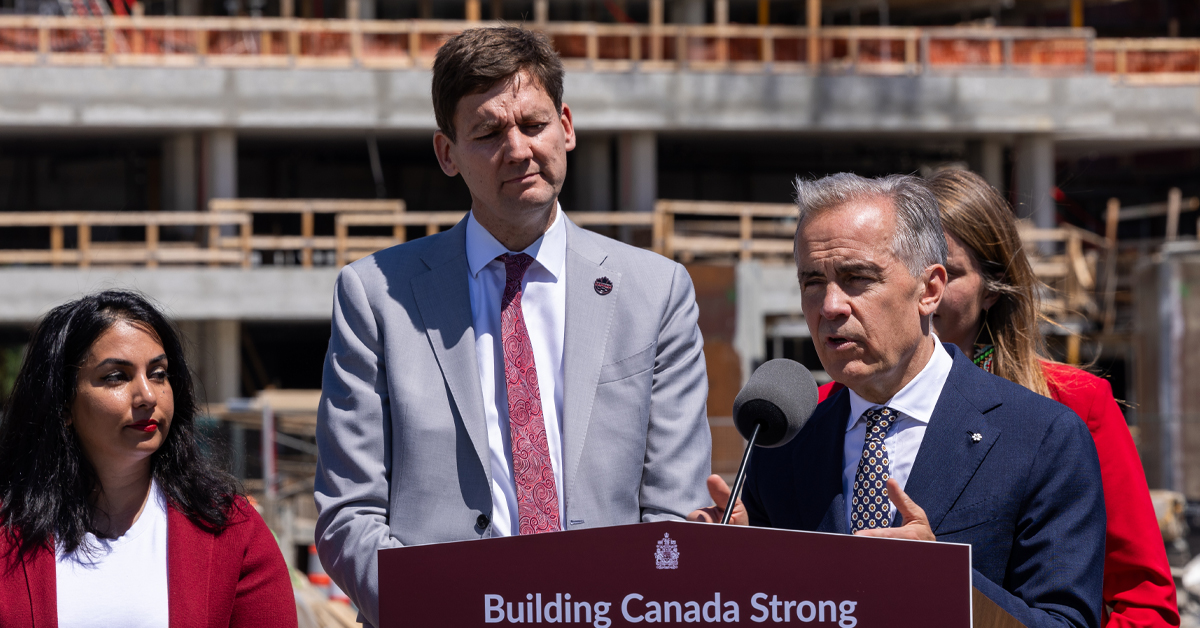
When the proposal was first announced on June 18, Carney pitched it as a plan to use public financing to acquire up to 2,200 unsold market condominiums in Metro Vancouver.
"Looking out at condos that have been built, that are unoccupied, that are going to sit there potentially for another couple of years; we are going to go and use the right financing mechanisms and convert those into affordable housing so people can move in and use those," said Carney.
David Eby and the NDP wants to use taxpayer dollars to buy up thousands of overpriced shoebox condos that British Columbians don’t want. This isn’t a housing plan, it’s a bailout that props up failure while ignoring the real solutions: cut red tape and build homes people can… pic.twitter.com/ps2WtBeWUg
— Kerry-Lynne Findlay (@KerryLynneFindl) June 25, 2026
Carney also acknowledged that developers are "stuck" and "don't want to sell at a loss," adding that further "models" would be released in the fall.
Critics say that's exactly what a housing correction is supposed to do. If developers are forced to lower prices to attract buyers, those lower prices can ripple through the market, putting pressure on comparable properties and gradually improving affordability.
The announcement was quickly criticized as a taxpayer-funded bailout for developers and investors holding unsold condo inventory, particularly after years of Vancouver being ranked among the world's least affordable housing markets, and just as the market had begun showing signs of cooling.
Conservative Leader Pierre Poilievre questioned why ordinary Canadians are left asking, "Where's your bailout?" while accusing Carney of having "a bailout for anyone who's part of the Liberal club of power brokers."
CONDO BAILOUT BACKLASH:
— Drea Humphrey (@DreaHumphrey) June 25, 2026
Premier David Eby just distanced himself from Mark Carney's plan to bail out developers by buying their overpriced, empty Vancouver condos.https://t.co/6BWILoPTDP pic.twitter.com/MUih0S8D4i
Now, however, both Carney and Eby appear to be reframing the proposal.
When pressed by reporters on Thursday, Eby suggested the original announcement got ahead of itself.
"The federal government was enthusiastic about us announcing this before all of the details were out, but in the absence of all the details, the plot has been lost a bit here," he said.
Eby also attempted to distance the proposal from the criticism that it would rescue developers.
"If you are a condo developer and took a bet on the high end of the market and you're facing a significant potential loss of profits, what we are proposing will not assist you."
Instead, Eby now says the province's intention is to seize an opportunity to "buy products below the cost of construction... and make them available through a rent-to-own program for British Columbians."
He also acknowledged, "the market will correct itself in Vancouver."
Carney likewise shifted his description of the proposal, suggesting it was "the province of British Columbia which initiated the idea," while now characterizing the plan as purchasing "distressed condos" at a discount and "setting up a rent-to-own structure for truly affordable housing."
CARNEY’s CONDO BAILOUT:
— Drea Humphrey (@DreaHumphrey) June 26, 2026
Carney claims the idea was initiated by B.C.
And all of a sudden it’s been a rent to own project. pic.twitter.com/QJy0E4UVr7
Those explanations differ noticeably from the initial announcement, which focused on using financing mechanisms to acquire unoccupied condos in Vancouver whose developers, by Carney's own admission, were "stuck" and "don't want to sell at a loss."
Whether the latest explanation represents a clarification or political backpedalling is something Canadians can decide for themselves. But if the public response is any indication, many aren't buying the new sales pitch and want the average Canadian to come first.
"If you're going to do something innovative, do something that actually helps everyday people in British Columbia get ahead," Hepner told Rebel News, suggesting governments should reduce red tape, lower development costs, or eliminate GST on home purchases instead of intervening in the condo market.
If you believe governments should help homebuyers instead of bailing out developers and investing in the luxury condo market, visit StopTheCondoBailout.com and sign the petition today.
NB-embed:stop_the_condo_bailout_petition
]]>And then in Toronto on Saturday, November 21, at Canada Christian College in Whitby.
Two cities. Two incredible days. And we want to see YOU there!
Now, if you've never been to one of our live events before, let us tell you what it's like. Because we genuinely believe there is nothing else like it in Canada.
We've been doing these gatherings for years. And every single time, without fail, the thing people tell us afterward — the thing they remember most — isn't any particular speech, as good as the speeches are. It's the feeling in the room. It's walking in and realizing you are surrounded by hundreds of Canadians who think the way you think, who care about the things you care about, who have been watching the same stories you've been watching and asking the same questions you've been asking. People who have felt, frankly, a little bit alone in their communities — and who suddenly realize they are not alone at all.
That is what Rebel News LIVE! is. It's a convention. It's a family reunion. It's a day where you get to be yourself, completely, without apology. And once you've experienced it, you keep coming back. Our attendees know what we mean.
Click here to get your tickets at RebelNewsLive.com before they sell out.
Now, who's going to be there this fall? Ezra Levant will be there. Sheila Gunn Reid will be there. Tamara Lich will be there. And the Rebel News team will be joining us.
Over the coming weeks, we'll be announcing some additional very special guest speakers — and trust us, you are going to want to hear who's coming. Stay tuned.
Here's what the day looks like. Doors open at eight in the morning with a light breakfast. Then a full slate of speeches and panel discussions — the kind of conversations you will never see on the CBC. A catered lunch. More speakers in the afternoon. And for VIP ticket-holders, an exclusive dinner with Ezra, Sheila, Tamara, and our guests at the end of the night.
And in between all of that — we've got a full merchandise store on-site. Rebel News toques, hoodies, mugs, books — and yes, we will sign them. We'll also have sponsor and exhibitor booths from some of the best freedom-oriented businesses and organizations in the country. People you want to know about, causes worth supporting, and groups doing the real work on the issues that matter. It's worth showing up early just to spend some time at those booths before the speeches begin.
It is the best gathering of freedom-minded Canadians anywhere in this country. We've been saying that for years, and we keep saying it because it keeps being true.
Now — we need to be straight with you about one thing.
These events sell out. Every single year, without exception. If you wait too long, you will not get in. We've seen it happen, and we don't want it to happen to you.
So here's what we need you to do right now: go to RebelNewsLive.com and get your tickets. See you there!
]]>The memo, dated June 19 and signed by Steven Lockyer, vice-president of Digital Health and chief information officer (interim), outlines a new youth awareness campaign for MyHealthNL, the province's online patient portal.
Under the policy, children under 12 can have their health records accessed by a parent or legal guardian through proxy access. However, for youth aged 12 to 15, parents or guardians can only access those records with the child's consent. At age 16, individuals gain full control over who can access their health information and may designate a trusted person to act as a proxy.
The policy has sparked concern among some parents and lawmakers, who argue that a 12-year-old is still a child and that parents retain legal and practical responsibility for their children's healthcare decisions.
The memo states that the changes are part of the province's broader OneSpotNL campaign, launched in April, which seeks to increase public awareness of MyHealthNL and its new features following the implementation of the province-wide electronic health information system and patient app.
NL Health Services says it will spend the summer promoting the changes through social media and partnerships with organizations across the province ahead of the school-year launch.
The policy does not specifically address what types of medical information may be withheld from parents if a child declines to grant consent for proxy access, a question that has become central to the growing debate over parental rights, youth privacy and informed consent in healthcare.
NB-embed:stop_classroom_grooming_donate
]]>Back in April, Pride organizers lobbied Ottawa for $9 million, claiming their organizations were a “proven economic driver.”
On Thursday’s Rebel Roundup livestream, Tamara Ugolini and Tamara Lich discussed this apparent contradiction.
“They called themselves this economic generator and that they drive all this prosperity during the Pride festivities. So then why can’t they pay for their own parade?” asked Ugolini. “They have a massive deficit every single year that’s only grown with sponsors pulling out recently… Does it perhaps have anything to do with how perverted the Pride parade has become in recent years?”
Ugolini shared her experience of spending her young adult years in some of Toronto’s most woke neighbourhoods and attending several Pride parades as a result.
“There was always a subsect of people who took things a little too far and were weird,” she said. “But it seems to be embraced and celebrated now rather than people going like, ‘Maybe that person shouldn’t be, like, fully nude in the street.’”
She noted that this is especially concerning given that Pride events are often marketed as family-friendly — something that does not mix with public indecency, which is supposed to be a crime.
“We really live in a time where the law enforcement is very selective about who they wish to pursue and who they don’t wish to pursue,” added Lich.
NB-embed:donate
]]>On last night's episode of The Ezra Levant Show, independent journalist Andy Ngo discussed his exclusive reporting on the sentencing of eight North Texas Antifa members to a combined 450 years in federal prison and what the case reveals about political violence and media double standards.
The sentencing comes after a federal jury in Texas convicted eight members of a North Texas Antifa cell on charges including rioting, using explosives, providing material support to terrorists, and attempted murder of a police officer.
This stemmed from a violent July 4, 2025, attack on the Prairieland ICE Detention Center near Dallas, where a police officer was shot and wounded.
Ngo described how the mainstream media has repeatedly refused to treat the Antifa militants as domestic terrorists.
"The whole facade that's been built up by Democrats and Liberals and leftists for a decade now, that Antifa doesn't exist, that they're peaceful protesters, or if they do exist it just means that it's anybody who's against fascism, all that is crumbling, which is why the media coverage, post the trial, post the sentencing, has been to gaslight and to lie about what happened," he said.
"They're calling the convicted terrorists peaceful protesters who are being sentenced to decades in prison because they were engaging in First Amendment protected activity," Ngo continued. "These are all lies. I've been reporting on the case from day one," he added.
With sentences ranging from 30 to 100 years, this case marks one of the strongest federal crackdowns yet on Antifa-linked violence in the United States.
]]>Guest this week: Jeff Evely (Canadian Armed Forces veteran)
Today, we're talking to Canadian Armed Forces veteran Jeff Evely about his recent legal victory after the Crown withdrew a ticket issued to him under Nova Scotia’s now-invalidated 2025 “woods ban.”
Plus, Prime Minister Mark Carney continues to face fierce backlash from Conservatives and the broader public after announcing a massive bailout for condo developers in B.C. using taxpayer funds.
And finally, parental rights in Newfoundland and Labrador have been thrust under the microscope after Premier Wakeham announced he will be reversing a policy that denied parents access to their children's medical records.
Join the Conversation
Hosts Tamara & Drea will read selected Rumble Rants and YouTube Super Chats on-air. Paid comments highlight your message and directly support our independent journalism.
To ask a question, all you need to do is send your question in as a "Rumble Rant" or "Super Chat" to highlight it in the chatbox.
"Rumble Rants" and "Super Chats" are sort of like donations, except with a comment! They're a great way to support Rebel News and participate in the show by sharing your thoughts, questions and opinions.
Get alerts for our next live news show
Don’t miss the next livestream on at 1 p.m. ET / 11 a.m. MT. Sign up below for instant reminders for all our daily news livestreams.
NB-embed:live_signup
Watch previous shows
]]>

Just ahead of Canada Day, the city of Salmon Arm has unveiled a new Veterans Commemorative Crosswalk, paying tribute to the Canadians who have bravely served our country.
Located at the intersection of Shuswap Street and Lakeshore Drive, directly beside Royal Canadian Legion Branch 62, the crosswalk features red maple leaves on a white background along with the words, "In honour of those who served and sacrificed."
https://x.com/DreaHumphrey/status/2069939657325129889
The project was first proposed by the local Legion earlier this year, with city council later supporting efforts to have it completed before Canada Day. City crews began preparing the site in the early morning hours before painting the crosswalk, completing most of the work within a few hours.
“This meaningful addition serves as a visible reminder of the sacrifices, service, and dedication of Canadian veterans, helping keep their legacy alive in our community every day” stated the city on a social media post.
The project’s completion during "Pride month" is also notable.
Over the past several years, rainbow Pride crosswalks have appeared in municipalities across Canada, often funded in whole or in part with taxpayer dollars.
]]>Happy PRIDE PROPAGANDA “season.”
— Drea Humphrey (@DreaHumphrey) June 1, 2025
“Hide yo kids, hide yo wife, because they indoctrinating everybody up here.” pic.twitter.com/xoobUlWR1T
Canada officially recognizes the LGBTQ movement through what it calls a 120-day "Pride Season," running from June through September, while veterans are commemorated through 11 nationally recognized observances throughout the year, most notably Remembrance Day on November 11.
Cost has also become part of that public debate.
Standard painted crosswalks typically cost only a few thousand dollars, while some decorative Pride crosswalks have cost taxpayers as much as $15,000. The funding for Salmon Arm's Veterans Crosswalk, however, was a joint venture.
In an email statement to Rebel News, Darin Gerow, the city’s program director, confirmed that the city used up to $5,000 of council initiatives whilst the local legion #62 contributed $4,500, bringing the joint project total funding to $9500. Gerow says that the “project an painting went much better than anticipated.”
NB-embed:donate
]]>
Ricardo Acuna of the Parkland Institute (a left-wing Albertan think tank) took to X to post a video explaining how support for independence is too low to merit holding a referendum on the issue. Most of his narrative was based on a single poll from early 2025, indicating 18% support for independence. He not only posits that a referendum shouldn’t be held but says the movement for independence itself isn’t legitimate. Ironic considering the historic labour movements his institute venerates began with seeds of public support much smaller than the independence movement in Alberta has.
The point of a referendum is to get a full and controlled measure of the voting citizens on an issue through a democratic vote. With a campaign on an issue followed by scrutinized voting and counting, a resolution can be reached on a contentious issue. Polls conducted by governments, media or advocacy groups tend to be slanted and only take small samples from the public. A referendum is the ultimate gauge of public opinion.
]]>
The bar to initiate a referendum in Alberta was set at 178,000 citizens signing a petition asking for one. On the question of unity, over 700,000 Albertans signed petitions asking for the question to be put to a referendum. This is far and beyond where the bar was set. It would be irresponsible and undemocratic for the government to refuse to allow the question to be put to citizens for resolution in a vote.
Whether current polling shows heavy support for one side or the other is irrelevant. Those support levels can and will swing as campaigns develop. That is the nature of participatory democracy. That, of course, is why the Parkland Institute doesn’t support holding a referendum. Left-leaning groups such as that are not known for their love of democracy or confidence in the citizens’ wisdom to make decisions for themselves.
Nobody can say with certainty how Albertans may vote on October 19th. But we can say with confidence that the unity issue merits putting the question to citizens in a referendum this fall.
NB-embed:independence_reports_donate
]]>
Fresh off the heels of his forgettable “Fight back now!’ campaign where unions planned to bring Alberta to a standstill on May 29, Gil McGowan of the Alberta Federation of Labour (AFL) is hoping to inspire members to lock arms with Indigenous protesters and block areas of critical infrastructure in the province.
In an outburst following Alberta’s scheduling of a non-binding referendum on unity for October 19th, Treaty 8 Grand Chief Trevor Mercredi threatened to organize Indigenous protesters to block critical infrastructure in the province. In his words, “That means everything. That means stopping industry. That means maybe going out on the highways. That maybe means doing what we need to do to be heard on this issue of separation."
Mercredi is under the misconception that his consent is required for Albertans to hold referenda, saying, “They will need the consent of the First Nations to move this forward, which is not happening."
]]>
The referenda to be held in Alberta on October 19th are completely legal and need no consent from Indigenous chiefs or labour representatives.
If McGowan manages to inspire some of his union members to join other activists in blocking highways, railways and pipelines, they will quickly encounter Alberta’s Critical Infrastructure Defence Act. They could be looking at the inside of jail cells.
The threat of mass civil disobedience from AFL members is slim all the same. With months of planning, McGowan’s day of action at the end of May was a total flop. If he can’t get union members out for a simple demonstration on a nice afternoon in May, it’s unlikely he will get them out onto railway tracks where they may be arrested.
Albertans have little to fear from the posturing of the AFL as the campaign unfolds for the fall referendum.
NB-embed:independence_reports_donate
]]>
A new report from the Fraser Institute is making waves because the numbers are eye-popping.
According to the study, Alberta's industrial carbon tax and carbon-capture requirements could increase production costs by:
- 25.6% for conventional oil
- 19.6% for oil sands projects
- 39.1% for natural gas
- 35.9% for electricity generation
Those figures aren't made up. They come directly from the Fraser Institute's report, Impact of Carbon Policies on Competitiveness in Oil, Natural Gas, and Electric Power.
]]>At the very moment Ottawa says it wants Canada to become an "energy superpower," Alberta producers are being asked to pay a carbon price that keeps rising and are now being told that a new West Coast pipeline should go hand-in-hand with a multibillion-dollar carbon-capture project.
Meanwhile, there is no equivalent federal carbon-pricing regime in the United States.
NB-embed:independence_reports_donate
]]>
The federal government is reportedly preparing to sign a major-projects agreement with British Columbia as early as next week. No extra conditions. No side deals. Just an agreement to move projects forward.
Alberta, however, appears to be getting a different deal.
According to reporting in The Globe and Mail, Ottawa wants Alberta to reach an agreement on the multibillion-dollar Pathways carbon-capture project at the same time it pitches a new West Coast oil pipeline.
That's an additional hurdle that B.C. doesn't appear to be facing.
]]>Alberta's energy sector has long argued that carbon taxes and emissions requirements already make Canadian producers less competitive than their American counterparts. A recent study from the Fraser Institute concluded that Canada's industrial carbon policies increase costs for the oil and gas sector and weaken its competitiveness against U.S. producers.
The issue isn't whether carbon capture is good or bad. It's why Alberta appears to be the only province being told it must solve another massive policy file before getting a nation-building project off the ground.
B.C. gets a major-projects agreement.
Alberta gets a major-projects agreement, plus homework.
For a province that has spent years complaining about different rules and different standards, this is exactly the kind of thing that fuels alienation.
NB-embed:independence_reports_donate
]]>Every Friday, a government-approved Islamic call to prayer is now being broadcast over downtown Regina. Some people have tried to dismiss concerns about this as nothing more than a complaint about noise.
They're wrong.
This isn't simply about noise pollution. It's about changing the character of our shared public spaces without public debate and placing an explicitly religious message at the centre of civic life.
A source tells Rebel News that this permit was approved by Regina police without ever being brought before Regina city council for public discussion.
That should concern every Canadian, regardless of their faith. This isn't like an innocuous church bell.
Church bells are tones. They function much like a clock tower, marking the passage of time or calling a congregation together without conveying a specific theological message to everyone within earshot.
The Adhan is something entirely different. It is a spoken religious proclamation: "Allah is the Greatest," "I bear witness that there is no god but Allah," "I bear witness that Muhammad is the Messenger of Allah."
This is not merely a sound in the background of city life. It is an explicit religious and ideological message being amplified over an entire downtown core.
For many Canadians, this raises a much larger question: should governments be facilitating the projection of a particular religion's message into our common civic spaces?
]]>No religion should expect the public square to conform to its practices, and no faith should enjoy special privileges that allow it to reshape our common spaces without public consent.
Many Canadians also see this as part of a broader trend of increasingly visible Islamic claims over public spaces, whether through amplified calls to prayer or organized prayers in streets and public squares rather than in houses of worship.
Hate fest back in Montreal, featuring Islamic street prayer
— Rebel News (@RebelNewsOnline) June 21, 2026
Activists from Montreal4Palestine returned to the city's streets following a short hiatus after a controversial May 24 rally drew backlash from even those who normally support the radical activist group.
After weeks of… pic.twitter.com/E6TUAsbML9
You may agree with those concerns, or you may not. But Canadians have every right to discuss them. At the same time, residents who object to this decision are now being met with police warnings about hate crimes and increased monitoring of online commentary.
The effect is chilling.
Many Canadians will reasonably wonder whether they can even voice their opposition without attracting police attention.
Let's be clear. Criticizing a government decision is not a hate crime. Questioning a permit is not a hate crime. Saying, "I don't want religious messages blasted over my downtown," is not a hate crime.
Free citizens have the right to object to decisions made in their name, using public authority, and affecting their communities. That's not hate. That's democracy.
If government agencies can authorize this in Regina without public consultation, they can do it anywhere. Today it's Regina. Tomorrow it could be your city.
That's why we're launching StopIslamicDomination.com. sign the petition and fund out independent journalism.
Because our shared civic spaces belong to everyone, and Canadians deserve a voice before they are fundamentally changed.
NB-embed:stop_islamic_domination_petition
]]>It was a long four days in court, often hard to sit through and difficult to listen to counsel for both governments defending mandates and deflecting blame for the policies implemented during the ‘pandemic’, with counsel for the Canadian government also stating that the pandemic was over and it was time to move on!
Like so many, however, Carrie and her family cannot simply move on. Their lives have been irreparably changed. The family were forced to sell their farm and have had to learn how to live with Carrie’s injuries and navigate family life in efforts to return to some semblance of normalcy.
]]>Of course, the government subsidized media were nowhere to be seen, despite headquarters for one of them located right across the street from the courthouse.
While this case is not overly dramatic or sensational, it is an important step for all Canadians who have suffered adverse events as a result of getting vaccinated.
NB-embed:no_more_shots_petition
]]>Pawer, fondateur du collectif Eros, affirme que son militantisme a commencé en 2024 après avoir « infiltré un club de drag queens » où, selon lui, des « drag queens lisaient des histoires à des enfants de 5 ans dans les écoles ».
« J’ai fait une caméra cachée », a-t-il expliqué. « Et à l’époque, ça avait fait un énorme buzz en France. »
Selon Pawer, cette controverse a aussi révélé une réalité politique que plusieurs refusent d’admettre : « Beaucoup de gens pensent que l’homosexualité, quand on est homosexuel, on est de gauche. Non, il y a aussi des homosexuels de droite. »
Cette expérience l’a mené à créer Eros, un collectif d’homosexuels opposés au militantisme LGBT de gauche.
« C’est là qu’Eros est né », a-t-il dit.
Aujourd’hui, Pawer affirme être visé par une enquête après avoir dénoncé un « pique-nique drag queen » qui aurait été promu auprès d’enfants dès l’âge de cinq ans.
Il soutient que les animateurs auraient utilisé un langage sexuel adulte et qu’il y avait « des stands avec des livres pornographiques », pendant que « des enfants couraient juste à côté ».
« Pour avoir dénoncé ça, je risque un an de prison et 45 000 € d’amende », a-t-il déclaré. « C’est extrêmement grave. »
Selon Pawer, la plainte aurait été déposée par le Planning familial de Nice ainsi qu’un groupe LGBT local pour « diffamation et injure publique ».
Mais il insiste : « Nous avons toutes les preuves. »
« Ce que je dénonce, c’est que le monde des enfants doit rester le monde des enfants », a affirmé Pawer. « Pourquoi les adultes viennent-ils dans le monde des enfants? »
Il affirme que la France est en train d’être engloutie par le « wokisme », ajoutant que « le gouvernement est complice » et « ferme les yeux ».
Pawer dit qu’il entend se battre dans ce dossier.
« Il est hors de question que je me taise », a-t-il déclaré. « Je me battrai jusqu’au bout. »
NB-embed:stop_classroom_grooming_donate
]]>Pawer, founder of the Eros collective, says his activism began in 2024 after he “infiltrated a drag queens club” where, according to him, “drag queens [were] reading stories to five-year-old children in schools.”
“I did a hidden camera,” he said. “And at the time it made a huge buzz in France.”
Pawer says the backlash also exposed a political reality many refuse to admit: “Many people think that homosexuality, when you are homosexual, you are on the left. No, there are also homosexuals on the right.”
That experience led him to create Eros, a collective of homosexuals opposed to left-wing LGBT activism. “That’s where Eros was born,” he said.
Now, Pawer says he has been placed under investigation after denouncing a “drag queen picnic” allegedly promoted for children as young as five. He claims hosts used adult sexual language and that “there were stands with pornographic books” while “children [were] running right next to it.”
“Because of denouncing that, I face one year in prison and a 45,000 € fine,” he said. “It is extremely serious.”
According to Pawer, the complaint was filed by the Family Planning organization of Nice and a local LGBT group for “defamation and public insult.”
But he insists: “We have all the evidence.”
“What I denounce is that the world of children must remain the world of children,” Pawer said. “Why do adults come into the children’s world?”
He says France is being swallowed by “wokism,” adding that “the government is complicit” and “turning a blind eye.”
Pawer says he will fight the case.
“It is out of the question that I be silenced,” he said. “I will fight until the end.”
NB-embed:stop_classroom_grooming_donate
]]>Sims slammed the move as another tax on food that will hit low-income families the hardest, noting canned vegetables are a pantry staple for many Canadians trying to stretch their budgets, especially as grocery prices continue to climb.
The tariff, announced June 19 and effective immediately, applies to imports from most countries but conveniently exempts the United States, Mexico, and several others.
"Canned tomatoes, a big chunk of them come from Italy, because those folks are really good at working with tomatoes," Sims explained.
"And what's super upsetting about this is that anyone whose ever pinched a penny knows that canned tomatoes are you're go-to staple in your pantry if you're trying to stretch your dollar, if you're making chili, you're making spaghetti sauce, food banks just really count on stuff like this," she continued.
"And [the government] is making it more expensive on purpose," Sims added.
The tariff was described by the federal government as a provisional safeguard measure that can last up to 200 days while the Canadian International Trade Tribunal completes its inquiry into surging imports. Imports of canned vegetables have risen sharply in recent years, with notable increases from countries like Thailand, Turkey, and Peru.
The government says the tariff is needed to protect Canadian processors facing “immediate challenges,” but critics point out it comes from the same Liberals who repeatedly promised to tackle the cost-of-living crisis.
NB-embed:donate
]]>Pollara, one of Canada's major polling companies, has released its fourth annual Trust in Media survey. The results show, for the fourth year in a row, Rebel News is getting stronger.
Ezra Levant walked through the numbers on Wednesday's episode of The Ezra Levant Show.
The number of Canadians who watch Rebel News daily has doubled in the past year, with 8% of Canadians now say they watch on most days, and another 14% watching occasionally — a combined reach of 22% of the country.
For comparison, the Globe and Mail, founded in 1844, backed by millions in government subsidies, and owned by Canada's wealthiest oligarch, sits at 11% daily readership.
"I think there's a real chance we'll catch up with them next year," Ezra said, "even though they've had a 171-year head start."
The numbers among Gen Z are even more striking. In the 18- to 34-year-old demographic, 14% say they watch Rebel News on most days. The Globe and Mail's daily readership in that same age group is also 14%.
]]>The trust numbers tell a similar story.
In 2023, Rebel News had a net trust score of minus 8 — meaning more Canadians distrusted it than trusted it. In 2026, that number is even. Among Canadians who actually watch Rebel News, the trust score has climbed from 57% to 72% over three years.
The Globe and Mail's trust score among its own readers is 74%. "We're almost in a tie with them," Ezra said.
Perhaps most surprisingly, Rebel News's net trust score among Liberal voters is minus 3. "Almost as many Liberals trust us as don't," Ezra said.
Throughout its 11-year history, Rebel News has never taken a cent in government funding. Instead, Ezra noted the company has spent hundreds of thousands of dollars fighting the government over issues like censorship and defending journalists who have been arrested while on assignment.
“Canadians notice,” Ezra said, “and they like it.”
NB-embed:donate
]]>Wilson condemned a recent poll commissioned by Calgary’s Chamber of Commerce that indicated almost half of Alberta’s businesses would consider leaving the province if citizens choose the second option on the unity-related referendum question this fall.
"What's important for all of us to keep in mind when we look at this propaganda coming out of some of the lefties at the Chamber of Commerce in Calgary, is that what their survey was measuring was fear, not opportunity," he said.
"And the reality is stark. The reality is that the farmland is not leaving. The oil and gas reserves are not leaving. The incredible industrial infrastructure processing, food processing, petrochemical, fertilizer plants, all of these things that generate our economic activity and create jobs are not leaving," Wilson continued.
"The youngest, most skilled work force in Canada is in Alberta and is growing, is not leaving. Investment is not leaving. Investment has been leaving. RBC's report from over a month ago found that over a trillion dollars in investment left Canada, primarily Alberta, because of the uncertainty created by Ottawa. Independence frees us from that uncertainty," he added.
As Albertans head to the polls on October 19, the key referendum question will ask voters to choose between remaining a province of Canada or directing the government to begin the constitutional process for a future binding separation referendum.
NB-embed:independence_reports_donate
]]>As part of Alberta's referendum campaign, we asked supporters what message they wanted us to put on our next lawn sign. The winner received nearly half the vote.
The winning slogan is: "Quebec Got to Vote, Why Can't We?"
And that's exactly how many Albertans feel.
We think Albertans should be allowed their say. Quebecers got to vote on their future — twice. Whether you support independence, oppose it, or are still making up your mind, the principle is the same: Albertans deserve the same democratic opportunity to have their voices heard.
This campaign is about giving Albertans a choice.
The people have spoken, and now we're printing the signs.
If you'd like one for your lawn, acreage, business, or fence line, visit Albertas-Choice.com to find pickup locations, pickup times, and everything you need to get involved.
Thank you to everyone who voted in our poll.
The people have spoken. Quebec got to vote. We think Albertans should get their say, too. Get your sign today at Albertas-Choice.com.
]]>Pollak noted the impact of the upcoming US midterm elections in November and the growing unease among the broader population over another expensive, drawn-out conflict in the Middle East.
"The primary issue facing the United States is the upcoming midterm elections. And Iran can impose incredible hardship on its own people because it's a dictatorship. This is long-term a disadvantage in a conflict because it means your society isn't adaptable, it can't grow economically as quickly," he said.
"But in the short term it's very useful because you can impose extreme hardships on your population to fight a war. The United States is a democracy. And again, while that has some of the long-term advantages of economic growth, and it allows an outlet for political dissent, even anti-war dissent, it's not really that helpful in the short term because there's a cantankerous minority that's opposed to going to war at all," Pollak continued.
"And Trump faces midterm elections in November where he could lose control of one or perhaps both houses of congress. They could both be controlled by Democrats, which would be a disaster for his leadership on foreign policy. It would also be a disaster for domestic policy, he'd have to spend a lot of his time answering congressional investigations and fighting off impeachments rather than pursuing America's foreign policy interests," he added.
The US and Iran recently completed the first round of high-level talks in Switzerland, mediated by Qatar and Pakistan. Mediators described the talks as “encouraging progress” and “constructive.”
The two sides continue to discuss Iran's nuclear program, sanctions relief, opening the Strait of Hormuz, and de-escalation in Lebanon.
]]>Today, we're looking at Pride Toronto announcing it is $700,000 short on funding ahead of this year's annual parade, with organizers warning that demonstrations could be scaled back further next year after similar funding struggles in 2025.
Plus, Prime Minister Mark Carney says claims he's keeping Canadians safe. Do you believe him?
And finally, Tamara Ugolini had a viral report this week detailing a creep in a public park who exposed himself to her and a Rebel videographer while the pair filmed a report in Cobourg, Ont., in an incident that is occurring far too often across Canada's public spaces.
Join the Conversation
Hosts Tamara & Tamara will read selected Rumble Rants and YouTube Super Chats on-air. Paid comments highlight your message and directly support our independent journalism.
To ask a question, all you need to do is send your question in as a "Rumble Rant" or "Super Chat" to highlight it in the chatbox.
"Rumble Rants" and "Super Chats" are sort of like donations, except with a comment! They're a great way to support Rebel News and participate in the show by sharing your thoughts, questions and opinions.
Get alerts for our next live news show
Don’t miss the next livestream on at 1 p.m. ET / 11 a.m. MT. Sign up below for instant reminders for all our daily news livestreams.
NB-embed:live_signup