Labor’s Digital Duty of Care bill would let eSafety run AI sock-puppet accounts to surveil and influence Australians
The Albanese government talks tough on artificial intelligence and hackers, yet its proposed Digital Duty of Care bill would let the eSafety commissioner run unlimited covert sock-puppet accounts and generate AI content that could be used to surveil and influence Australians behind a legal shield.

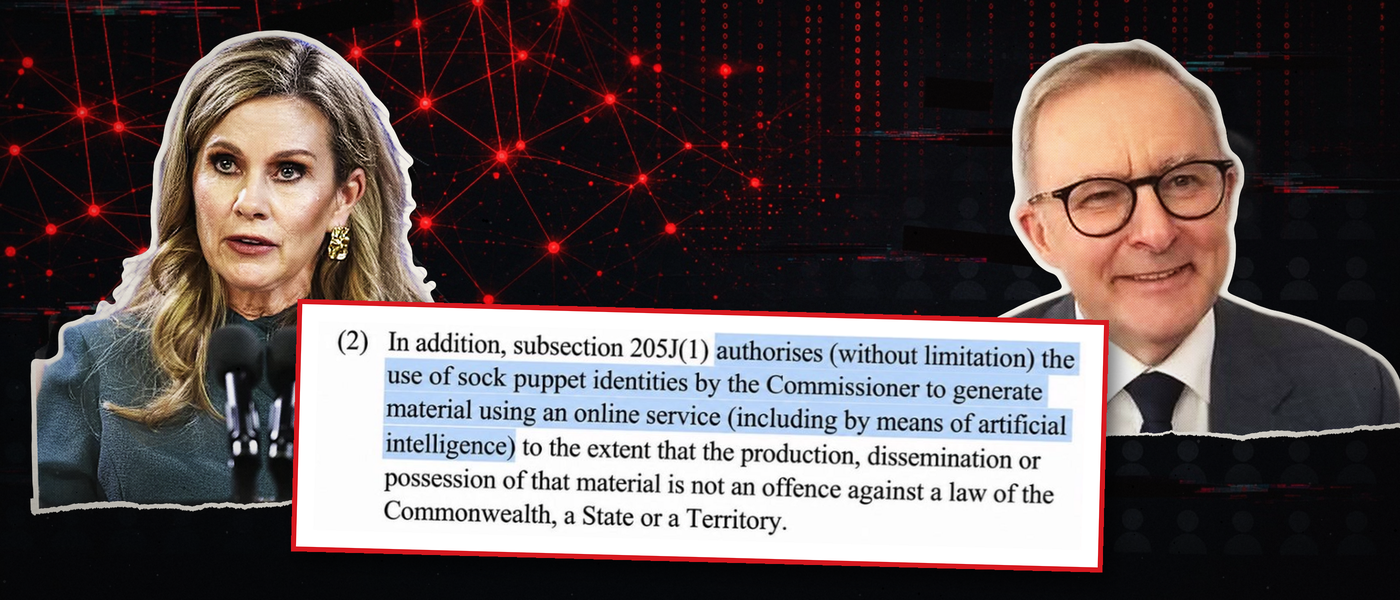
Anthony Albanese likes to talk about taming artificial intelligence in Australia's interests, yet his Government has drafted a law that would let the eSafety Commissioner hide behind fake identities, watch what Australians do online and produce material, AI included, with no one required to sign off.
The power sits in an exposure draft of Labor's Digital Duty of Care bill, dated 8 September. The draft calls these false personas "sock puppet identities", its own term, and s 205J(1) is blunt: "The Commissioner may assume a sock puppet identity for the purposes of performing the Commissioner's functions or exercising the Commissioner's powers under this Act."
Subsection 205K(2) "authorises (without limitation) the use of sock puppet identities by the Commissioner to generate material using an online service (including by means of artificial intelligence) to the extent that the production, dissemination or possession of that material is not an offence against a law of the Commonwealth, a State or a Territory." Contact with real users is allowed only so far as it keeps the account from being shut down.
The power applies "despite anything to the contrary" in any other federal, state or territory law and in any contract, while s 205L shields anyone acting "in good faith" from civil suits. The Commissioner needs no warrant, no case-by-case authority and no outside approval. University researchers need approval that eSafety can control, plus ethics clearance, to use the same identities, and get no AI power.
Federal police, the tax office and the intelligence agencies need no warrant for fake identities either, but under the Crimes Act 1914 each one requires a separate written authority from the agency head, who must be satisfied it is necessary and that the risk of abuse is minimal. Police authorities must be reviewed at least every 12 months, and law enforcement agencies report their use each year to the minister, who tables the report in Parliament. eSafety is not named in that scheme, and today's Online Safety Act has nothing like this. Enacted, the power would be lawful, but it would hand a civil regulator a covert toolkit without any of the checks placed on police.
Mike Nayna (@MikeNayna), who reviewed the bill alongside digital civil liberties group Liber-net, wrote on 23 September that the AI power "goes beyond passive monitoring & creates a capability that could, in principle, be repurposed for influence operations."
Australia’s proposed Digital Duty of Care Bill will dramatically expand eSafety’s investigative powers, including the authority to operate “sock puppet” accounts & collect sensitive information without consent. I went through the Bill with @liber_net. Here’s what we found. 🧵 pic.twitter.com/kl3DUoSqDY
— Michael Nayna (@MikeNayna) September 23, 2026
Liber-net, led by chief executive Andrew Lowenthal, went further in its 22 September submission. "The Bill gives eSafety government spy accounts," it says, warning the change "moves a civil online-safety regulator further into techniques normally associated with covert investigation." Its recommendation: "Delete the provisions authorising eSafety to operate false-identity accounts."
Michael Shellenberger called the plan “Creepy af” and warned of “AI bot networks” built to “secretly influence & manipulate online debates”. That goes beyond the text, which never mentions influence campaigns. The wording still leaves the scope broad enough to raise the questions Shellenberger is asking.
Many proponents of online civil liberties have slammed the draft bill. In contrast, the ABC’s national AI reporter Cameron Wilson has defended the government’s plan while dismissing concerns, writing online that “the legislation limits the sock puppet powers to ‘performing the Commissioner’s functions or exercising the Commissioner’s powers’ and may only ‘engage with users only to the extent necessary to prevent closure of the account’.”
The same draft bill would make the Commissioner an "enforcement body" under the Privacy Act 1988, a status whose enforcement related activities, in the privacy regulator's own guidelines, "can include lawful surveillance, intelligence gathering or monitoring activities where there may not be an existing investigation." Pair that with s 25C(2), which would let the Minister declare new categories of "serious harm" by legislative instrument, and the sock puppets become a ready tool to monitor and target Australians online and to gather material against political speech the Government of the day wants suppressed.
A regulator able to surveil Australians through false identities, armed with AI and civil immunity and with no one required to authorise, review or report on its use, is the unchecked power Australians are right to fear.
Consultation on the draft closed at midday on 22 September. The Government has promised to introduce the bill this year, but it still has no number or explanatory memorandum, and no minister has explained why the regulator needs sock puppets.
Rukshan Fernando
Rebel News Australia Content Manager and Commentator
Rukshan Fernando is an Australian political commentator, filmmaker, and journalist. He is known for his on-the-ground coverage and livestreams of protests and social issues, with a strong focus on stories often overlooked by the mainstream media. As a Content Manager and Reporter with Rebel News Australia, Rukshan works alongside Australia Bureau Chief Avi Yemini to bring the other side of the story from down under.
Featured Stories