
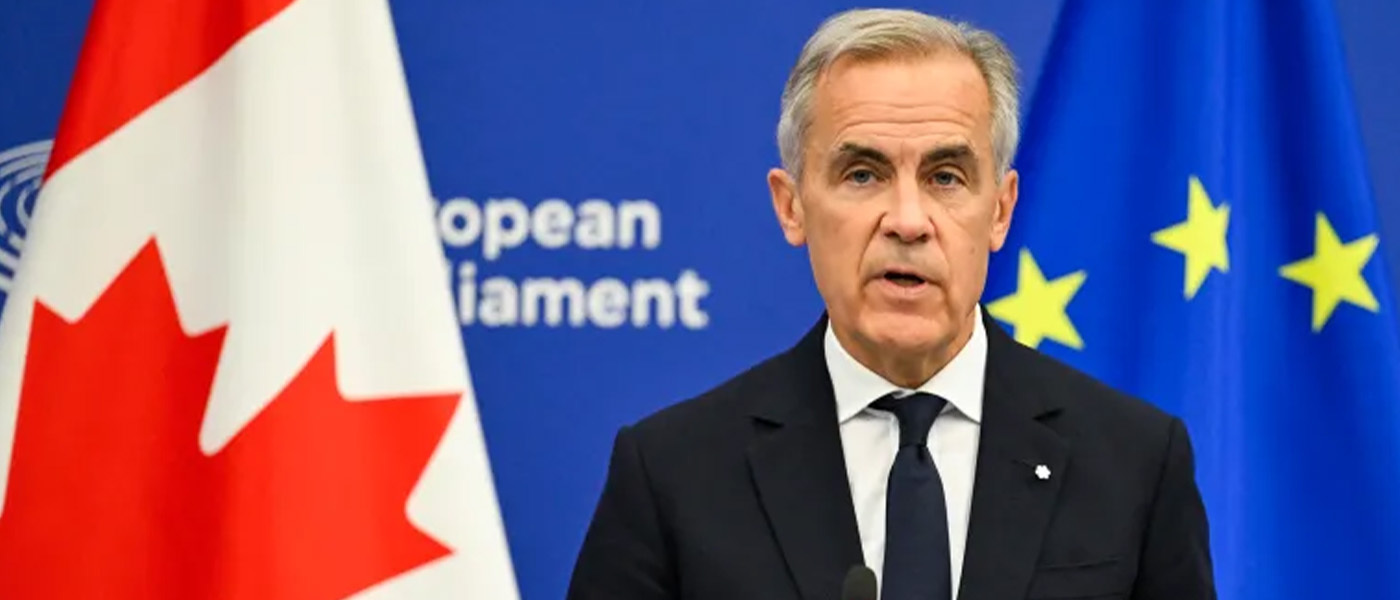
Carney applauded in Europe as Canadians await answers on EU associate membership
Mark Carney backs a proposed EU associate membership deal that could reshape Canada's trade, borders and sovereignty, despite Parliament being shut and Canadians learning about the plan through leaks and announcements overseas.


BECOME A MEMBER

Article by Rebel News staff.
Tonight on The Ezra Levant Show: Mark Carney receives a standing ovation in Strasbourg for a proposed European Union "associate membership" that Canadians first heard about through a Wall Street Journal leak, while Canada's Parliament has yet to hear a word about it on the record.
On Sunday, the Wall Street Journal, citing unnamed officials in Brussels and Ottawa, reported that Carney was exploring whether Canada could become an associate member of the EU. That same day, a second anonymous source told CTV that Canada was "not seeking EU membership in any capacity" and that the Journal had overstated the proposal.
The European Union’s top official said she would work to make Canada the bloc’s first associate member, a major shift indicative of the new ties traditional U.S. allies are forging with each other in the face of hostility from the Trump administration.
— The Wall Street Journal (@WSJ) September 16, 2026
🔗:… pic.twitter.com/dpvcnaalba
By Wednesday, European Commission President Ursula von der Leyen told the European Parliament that she wanted to open the door for Canada to become the European Union's first associate member, a category that does not currently exist in any EU treaty and would have to be created. On Thursday, Carney walked into the Strasbourg chamber, welcomed the ambition and received a standing ovation from hundreds of European lawmakers who cannot vote for him.
Canada's House of Commons has been dark since June 18 and returns Monday. Since the election, it has sat for 137 days, while Carney has appeared for 36 question periods. Global News counted 68 days abroad during his first year, twice Justin Trudeau's early pace. Carney will accept applause from a foreign parliament while the chamber accountable to Canadian voters remains closed.
The best place to get neutral news about Canada is through the foreign press.
— Ezra Levant 🍁🚛 (@ezralevant) September 18, 2026
99% of Canadian media take the massive subsidy from Mark Carney’s government — don’t expect them to bite the hand that feeds. https://t.co/04lHN401pH
What associate membership would actually mean remains undefined. A European analyst told NPR that the excitement centres on a status that does not yet exist. Canada's ambassador to the EU, Jonathan Wilkinson, said full membership would require Canada to surrender portions of its sovereignty, something Ottawa is not seeking.
The open questions concern borders, laws and money. Journal sources floated visa-free living and working in Europe, while Time described freedom of movement in both directions. The European passport pool represents roughly 450 million people, including millions who arrived over the past decade. A treaty guaranteeing reciprocal movement could expose Canada to European migration pressures without a clear cap or Canadian control over EU policy.
The Norway model would mean adopting EU rules without having a vote in writing them, potentially affecting sectors from farming and energy to online speech. Existing Horizon-style associate arrangements provide research access in exchange for fees, but without voting rights. The proposed relationship could amount to paying for access while Brussels retains decision-making authority.
Even European capitals are not aligned. Germany said the "associate member" label should be reconsidered, while French MEP Manon Aubry raised a "serious question of method" over the Commission making decisions on its own. NPR reported that some governments were furious they had not been consulted. Any major change would face the challenge of securing agreement among 27 member states.
The EU's existing trade relationship with Canada is hardly a model of efficiency. CETA, provisionally in force since September 2017, still lacks ratification in ten EU countries nearly nine years later. The French Senate rejected the agreement in 2024 amid agricultural concerns. Europe has not even completed the ratification process for its trade deal with Canada.
The alliance between Canada and Europe is not defined by what we oppose. It is about what we are for: freedom, solidarity, prosperity, sustainability. An alliance strong enough so that no one can dictate our choices.
— Mark Carney (@MarkJCarney) September 17, 2026
Europe and Canada are each strong. Europe and Canada are even… pic.twitter.com/RW85Z0EauJ
Carney's Strasbourg speech did not mention Donald Trump or the United States by name, but his jab about "better manners" and references to weaponized tariffs were understood in the room and in Washington as criticism of the Americans. Trump called the idea laughable and threatened serious tariffs or trade restrictions against Europe if he considered the move hostile.
Canada sold approximately $565 billion in goods to the United States last year. A December snapshot showed $44 billion in Canadian goods exports to the U.S., compared with $3.8 billion to the entire European Union. Ontario produces roughly 1.2 million vehicles annually, about one million of them for American buyers. CETA's automotive quota ceiling is 100,000 vehicles, and Unifor says even that quota has been underused.
Canada's defence industry also remains tied to Washington. Saab Gripen fighter jets require a General Electric engine licence from the United States, meaning that cancelling the F-35 purchase would not eliminate American leverage over Canadian military procurement.
If the objective is a durable trade settlement with the United States after tariffs on $27.6 billion of Canadian goods and ongoing annual USMCA reviews, then the Strasbourg performance raises questions about Ottawa's priorities. The government appears willing to cultivate European approval while tensions with Canada's largest trading partner remain unresolved.
The Prime Minister is out of touch and Canadians are out of money.
— Pierre Poilievre (@PierrePoilievre) September 17, 2026
He has his officials tell foreign newspapers he is secretly negotiating for Canada to become an associate member of the EU. Then he has his officials tell Canadian media it’s not happening. Then he tells… pic.twitter.com/RHM5ITIroJ
The broader political strategy echoes Carney's earlier "table or menu" speech at Davos, where he argued that Canada must have a seat at the table rather than be on the menu. It also resembles the China pivot, which Carney presented as a response to security concerns before travelling to Beijing and announcing a 49,000-vehicle electric vehicle quota. Neither initiative appeared in the election platform, debates or a throne speech. Both were leaked or announced abroad before Canadians had a clear parliamentary debate.
A Rebel News petition at NoToTheEU.com calls for any agreement that would place Canadians under European laws, courts, borders or financial obligations to require a recorded parliamentary vote, and preferably a national referendum.
GUEST: Ada Lluch (@AdaLluch), reporting from Ceuta, Spain, on illegal mass immigration and its impact on the West.

COMMENTS
-
Dave (David) Heinze commented 2026-09-19 01:38:48 -0400As is often, or usually the case, after watching the clips of Carney’s speech, I have to ask: What did he say? The man is all smoke & mirrors.
In “What Did He Say, Do or Really Mean?” I wrote “Then made a speech of no real substance and without
showing us what the deal really was.” https://davidheinze811596.substack.com/p/what-did-he-say-do-or-really-mean?r=j5uj3 -
 Bernhard Jatzeck commented 2026-09-19 00:49:08 -0400 FlagThings are about to get interesting. Earlier today, it was announced that the U. S. signed a deal with Denmark (an E. U. member) about providing security for Greenland. Carney might not like that.
 -
Bernhard Jatzeck commented 2026-09-18 20:51:22 -0400Bruce: that sounds like a good deal for Carney.
-
Bernhard Jatzeck commented 2026-09-18 20:50:46 -0400The EU adopted Beethoven’s musical arrangement of Friedrich Schiller’s “An die Freude”, as used in the final movement in the former’s Ninth Symphony, as its anthem.
Considering what a dictatorial body the EU’s become, Herr Beethoven might not be pleased. He might repeat what he did with his Third Symphony, the “Eroica”. He originally dedicated it to Napoleon Bonaparte, believing him to be a champion of freedom. But when he saw that the Little Corporal was becoming a tyrant, he crossed out that dedication and changed it to “To the memory of a great man”. -
Bruce Atchison commented 2026-09-18 20:48:18 -0400 FlagHow does Brookfield benefit from associate E.U. membership of Canada? And will we get Europe’s Jihadis?

