



Taxpayers foot $1.6 million bill for Alto's high-speed rail 'consultations'
Is the latest taxpayer-funded ad blitz really a ‘consultation’ or more of a stealth sell for the $90B bullet train?


Ottawa is spending big bucks to inadvertently sell Canadians on its ambitious and increasingly controversial $90-billion high-speed rail project through the Quebec City–Toronto corridor.
At a rural farm in Indian River earlier today, I asked Poilievre for his reaction to Bill C-15, which assists the Liberals in expropriating land for the $90 billion ALTO high-speed rail project
— Tamara Ugolini 🇨🇦 (@TamaraUgo) March 31, 2026
"Your private property is not safe under this Liberal government," he replied,… pic.twitter.com/9vxyQKlO1e
A new parliamentary response reveals that Crown corporation Alto poured over $1.59 million into advertising the consultation period between 2022 and April 15, 2026.
Every dollar spent was part of Alto’s broader public relations campaign to “inform the public about the consultation process in their region.”
“Almost immediately”
— Tamara Ugolini 🇨🇦 (@TamaraUgo) February 26, 2026
That’s how fast Transport Minister Steve McKinnon says private property could be seized after approval of the ALTO high-speed rail
Expropriation of pristine farmland and private hunting land, for a $90B megaproject that won’t be on time or on budget pic.twitter.com/mSWNVzr9nv
The Transportation Ministry breaks down the spending into two main categories: "Subscriber" campaigns running primarily from mid-October 2025 to March 2026, and a larger "Public consultations" push from mid-January to late April 2026.
$90 BILLION LAND GRAB! Locals in Madoc, Ont. are fighting to stop the ALTO high speed rail nightmare that will derail their communities in what will be one of the largest expropriation events in modern history pic.twitter.com/ZHBgnH3cYE
— Tamara Ugolini 🇨🇦 (@TamaraUgo) March 7, 2026
Despite the campaign labels, Transport Canada maintains that 100% of the spending was dedicated to raising awareness about the public consultations, not to promoting the rail project itself. The department was careful to point out this distinction, since promotional advertising would violate Canada’s official non-partisan advertising criteria.
This included more than $511,000 on the Subscriber campaigns in Quebec and Ontario, covering digital display ads, radio, local print media, search, and social media.
The other roughly $1.08 million was spent on public consultations, dominated by digital media, local print, out-of-home advertising, and radio across the corridor.
This comes as Alto faces mounting criticism from rural communities facing land expropriation, with farmers worried about prime agricultural land being carved up, and the official opposition questioning the project's timelines, costs, and ridership projections.
Open houses in places like Madoc and Peterborough drew heated opposition, with residents expressing fears of disrupted lives and environmental fallout for a train that won't run until the mid-2030s… at the earliest.
While locals organize petitions and highlight risks, the agency has been busy on the ad front and on executive compensation.
Other parliamentary responses note that nearly $3 million in bonuses was paid to staff for this project, before a single shovel touches ground.
This advertising push fits the typical top-down federal initiative pattern: advancing a Liberal mega-project despite grassroots resistance.
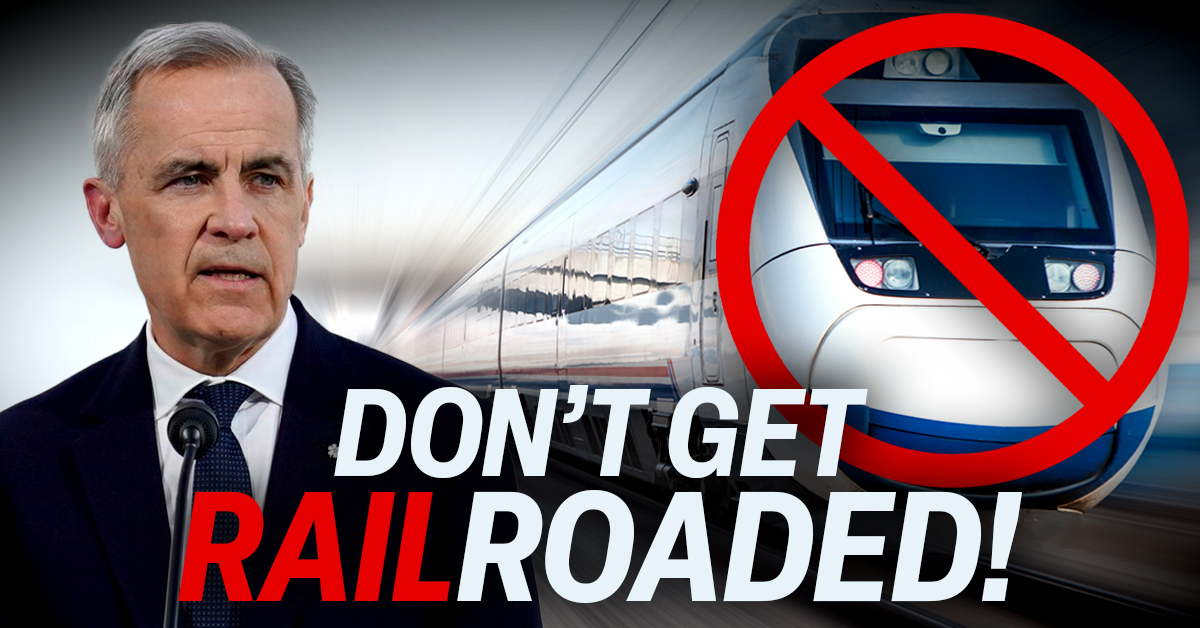
From the passing of Bill C-15 that expedites the expropriation process, to communities feeling "railroaded," the disconnect is clear.
Earlier this week, ALTO CEO lobbied the senate for “buy in” on a “regulatory framework” (hint: Bill C15) to expropriate properties in the path of their $90B mega project if “preferred voluntary agreements” are unsuccessful pic.twitter.com/3Tob5hITKX
— Tamara Ugolini 🇨🇦 (@TamaraUgo) February 28, 2026
Taxpayers are funding glossy campaigns to "consult" on a project many believe is already a done deal, while property rights and fiscal prudence take a back seat.
As rural Ontario and Quebec push back, questions remain: Is this genuine engagement, or expensive marketing for an imaginary bullet train?
Featured Stories


20:02


COMMENTS
-
 Bernhard Jatzeck commented 2026-06-09 00:08:36 -0400Bruce:
One of the selling points for this clunker is that it’ll make travel times along the route much shorter. If my travel experiences from several years ago are any indication, there’s little advantage.
During the time I worked on settling my father’s estate, I had to travel from Edmonton to NE B. C. I found that it took about the same amount of time to fly that route as it did to drive.
During the final year or so, I drove the truck I inherited. I could leave whenever I wanted to. I had lots of elbow room in an air-conditioned cab plus I could listen to classical music during the trip because the radio could receive SiriusXM. I could eat what I wanted when I wanted and I took a thermos or two of tea with me. On top of that, a tank of diesel fuel cost far less than airfare.
What’s not to like about that?
Unless Alto can provide distinct benefits over driving, it’ll never turn a profit. -
Bruce Atchison commented 2026-06-08 19:49:47 -0400This is a glory project we can’t afford. It’s time all citizens rise up against this pet project of the Liberals. It was never properly thought out. The Liberals just want a legacy they can point to and claim they’re building Canada strong.
-
Bernhard Jatzeck commented 2026-06-08 15:55:41 -0400Boondoggles like this are always funded on someone else’s nickel.
