Trump Administration warns Labor’s online “harm” powers risk censorship
Trump officials have warned Canberra that Labor’s digital duty-of-care bill could become a mechanism for viewpoint censorship. The submission objected to Anika Wells expanding the “serious harm” list by instrument, to one-size-fits-all product rules, and to any design that nudges US platforms to hide lawful speech behind a government “safety” test.
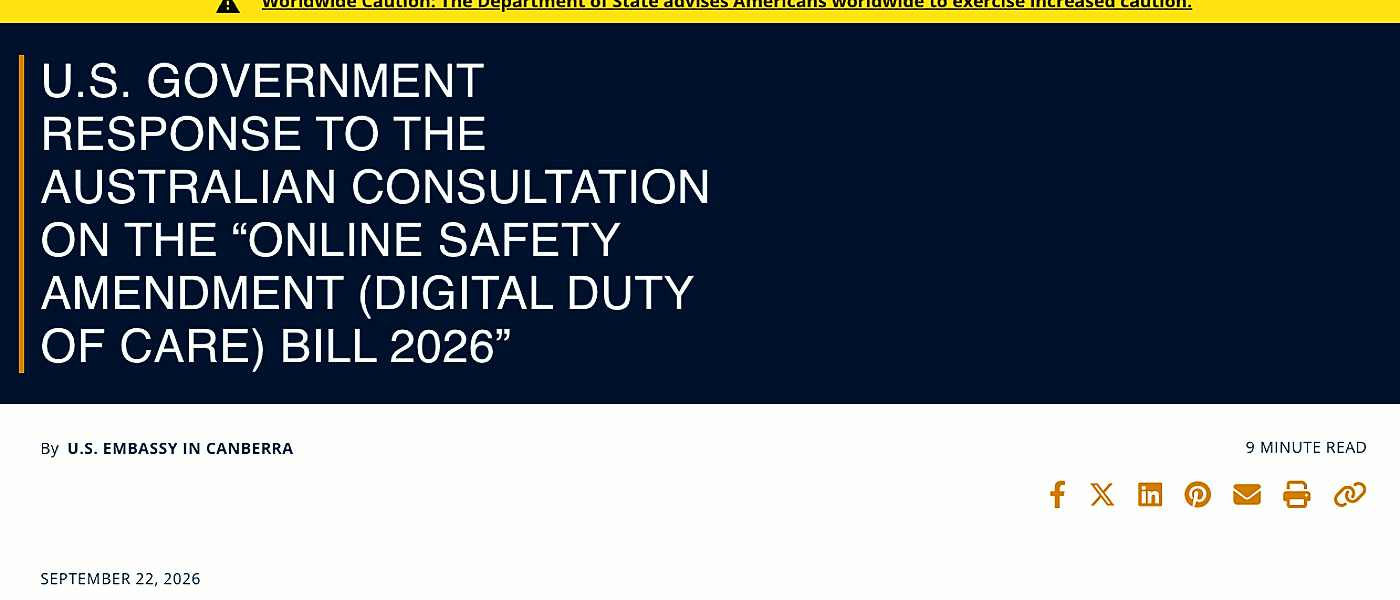
The Trump Administration has told Canberra that Labor’s Digital Duty of Care plan threatens free expression online. In a 22 September 2026 consultation response published by the US Embassy in Canberra, Washington put free speech and a free internet at the top of its list and raised “serious concerns” about government or ministerial designation of “foreseeable harm.”
The submission warned that platforms could be nudged to rewrite ranking systems so lawful but risky speech disappears rather than expose them to fines. Washington also objected to one-size-fits-all product rules, for example requiring chronological timelines or making recommendation engines opt-in only. “A framework that empowers governments to enforce vague definitions of ‘harm’ risks becoming a mechanism for viewpoint-based censorship,” it said. If algorithmic filtering of protected speech is compelled, “the U.S. government would likely consider such a measure as facilitating censorship.” It flagged extraterritorial pressure on US companies and users, and told Canberra to drop any requirement that platforms bury posts under fuzzy government “safety” tests.
Under Labor’s Online Safety Amendment (Digital Duty of Care) Bill 2026, Communications Minister Anika Wells could expand the “serious harm” list by disallowable instrument. Platforms that steer people into material caught by that list would face penalties reaching $109.2 million.
Wells insists this is safety-by-design, not speech control. “Just as we have basic safety standards for cars, toys or food, the duty of care applies basic standards for the online products we use every day,” she said when the exposure draft landed. She has also said the test for a new serious harm “would ultimately be, I guess, made by me on the expert technical advice of the eSafety Commissioner,” with the Senate able to disallow.
That ministerial call is the core of the domestic fight. Opposition Leader Angus Taylor has labelled the draft a “blank cheque for political censorship.” Shadow communications minister Sarah Henderson called it an “absolute threat to free speech,” arguing known harms should be “a matter for the parliament, not a matter for the minister.” Nationals leader Matt Canavan put it bluntly: “I’m deeply sceptical of giving any government the power to decide what you read on your phone.”
One Nation leader Pauline Hanson has drawn the same line. “Australia should be moving away from government censorship, not building the Orwellian machinery for it,” she posted as Labor prepared to unveil the package. One Nation is opposing the bill alongside the Coalition; Greens votes may still decide whether it clears the Senate.
Public unease lines up with that warning. News24/YouGov Pulse put almost half of Australians (48 per cent) off the idea of Wells defining harmful content. Split the rest: one in five (20 per cent) already call her power excessive; 28 per cent still want a statute but not in the minister’s hands. Concern is sharper among younger voters: 63 per cent of 18 to 24-year-olds flagged government power as a problem. Among 2025 One Nation voters, 42 per cent said the Communications Minister already holds too much power over what is harmful. Labor voters were the main bloc still backing a law “to make sure no harmful content” appears online.
Labor’s pitch remains child safety and user choice. The “My Feed, My Way” package would require platforms to offer adults a choice between an algorithmic feed and a following feed, and to shield under-18s from listed harms including eating-disorder promotion, pornography and crime glorification. Wells says she can “emphatically rule … out” using the scheme to police political misinformation, and that adult rules track existing illegality. Consultation closed at noon on 22 September.
Rukshan Fernando
Rebel News Australia Content Manager and Commentator
Rukshan Fernando is an Australian political commentator, filmmaker, and journalist. He is known for his on-the-ground coverage and livestreams of protests and social issues, with a strong focus on stories often overlooked by the mainstream media. As a Content Manager and Reporter with Rebel News Australia, Rukshan works alongside Australia Bureau Chief Avi Yemini to bring the other side of the story from down under.