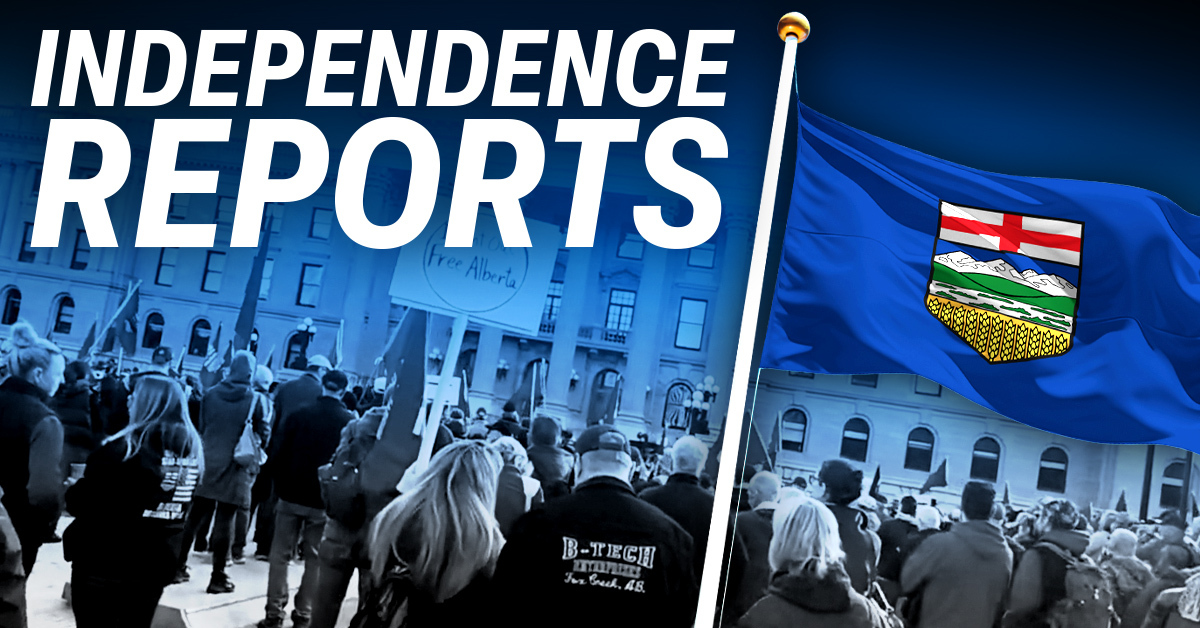

Alberta Fact Check: No, Carney. Alberta isn't Brexit, and Albertans aren't children
Carney's warning appears to rest on the idea that Albertans may not understand what they are voting for and need to be protected from themselves.


Prime Minister Mark Carney is warning Albertans against treating a vote on sovereignty as leverage, comparing it to Brexit and arguing that people can end up voting for something they do not fully understand.
It's a dramatic comparison. It is also a deeply flawed one.
PM Carney: "This is an observation from experience. In these separation issues it is often advanced that 'Vote for this and we will strengthen our hand in future negotiation.' That is a very dangerous bluff. I saw firsthand what happened in the UK, they're still trying to undo… pic.twitter.com/CU7fk5fcJO
— Scott Robertson (@sarobertson_) May 25, 2026
Brexit was a vote by the United Kingdom to leave a supranational political and economic union while remaining a sovereign country. The UK did not cease to exist. It did not need to establish a new constitution, determine citizenship rules, divide federal assets, negotiate internal borders, or redefine itself as a nation-state.
An Alberta sovereignty process would be something entirely different.
Alberta is a province within a federation governed by Canada's constitutional framework. Any move toward sovereignty would involve negotiations over federal assets and liabilities, constitutional issues, treaty considerations, trade arrangements and other legal questions. The Supreme Court's Quebec Secession Reference established that a clear expression of public will would create an obligation to negotiate, not an automatic exit.
So the comparison itself is weak. But the bigger issue may be the assumption hiding underneath it.
Carney's warning appears to rest on the idea that Albertans may not understand what they are voting for and need to be protected from themselves. That sort of paternalism is exactly what many Albertans say helped create western alienation in the first place.
The message sounds something like this: you can have a vote, but only if Ottawa likes the question, the motives and the outcome.
Albertans routinely make decisions involving businesses, mortgages, careers, investments and elections carrying enormous long-term consequences. Suggesting voters cannot understand constitutional questions is not really an argument against a referendum. It becomes an argument against democratic decision-making itself.
And then there is the Brexit record.
For years before the vote, critics warned of immediate economic catastrophe if Britain voted Leave. Predictions included severe recession, financial collapse, mass unemployment and prolonged economic chaos. Brexit certainly created disruption, years of political fighting and real economic costs.
The British Sandwich Association warned that if Brexit happened, there would be a UK sandwich crisis and you wouldn’t be able to get a good sandwich anymore. @JamesDelingpole, @CountDankulaTV or @PrisonPlanet, can you confirm? pic.twitter.com/1FA48EmfQO
— Ezra Levant 🍁🚛 (@ezralevant) February 1, 2020
But the full doomsday scenario never materialized.
The United Kingdom remains one of the world's largest economies and continues operating as a major financial centre while negotiating trade agreements around the world. The prediction was not merely that Brexit would be difficult. The prediction was that it would be apocalyptic.
It wasn't.
None of this means Alberta separation would be simple or consequence-free. It would be enormously complicated. But presenting worst-case scenarios as inevitable outcomes has a way of backfiring.
Quebec held sovereignty referendums in 1980 and 1995. Canada did not collapse. Democracy survived. Voters debated the issue, voted and moved on.
Ironically, the kind of top-down lecturing embedded in Carney's argument may do more to strengthen separatist sentiment than weaken it. Albertans have spent decades reacting badly to being told by Ottawa elites what they should think, what they should want and what is supposedly good for them.
That instinct to manage Alberta rather than persuade Alberta has historically done more to fuel alienation than stop it.
Sheila Gunn Reid
Chief Reporter
Sheila Gunn Reid is the Editor-in-Chief, Alberta Bureau Chief, member of the board of directors, and host of The Gunn Show at Rebel News. Sheila also serves as President of the Independent Press Gallery of Canada. A mother of three and longtime conservative activist, Sheila is the author of bestselling books, including her most recent release, Independence Blueprint: What Alberta Can Learn From Quebec.
https://mybook.to/sheilaFeatured Stories


14:26


COMMENTS
-
 Bernhard Jatzeck commented 2026-05-26 15:44:36 -0400Should we expect anything different from a prime minister who considers Albertans as serfs?