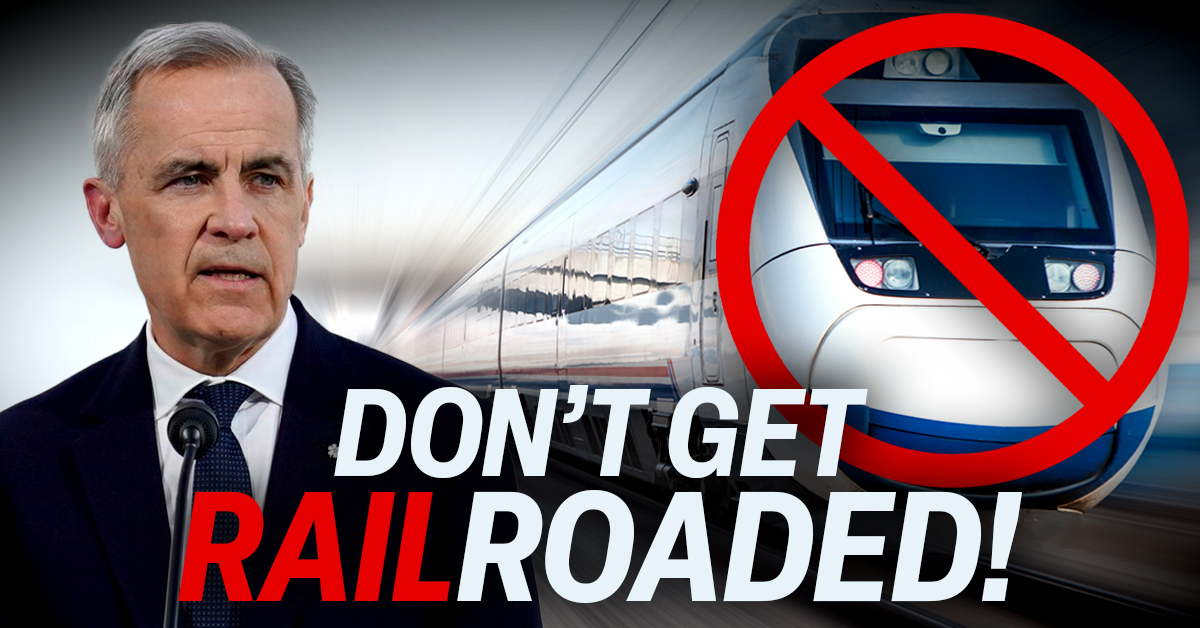

Liberals full steam ahead on $60–90 billion Alto rail boondoggle
Transport Minister Steven MacKinnon confirms the Toronto–Quebec City high-speed rail project is moving forward — as costs balloon before a single metre of track is laid, and a Parks Canada memo warns the route threatens the Rideau Canal World Heritage Site.

"We are moving forward with Alto." That was Transport Minister Steven McKinnon this week, doubling down on the Liberal government's proposed Toronto-to-Quebec City high-speed rail project.
Nothing says nation-building quite like a massive land grab carrying a $60 to $90 billion price tag before a single metre of track is laid or the route is even finalized. Meanwhile, the rest of the country drowns in housing shortages, healthcare wait times, and a cost-of-living crisis that forces families to choose between groceries and gas.
And if history — and every other megaproject on the planet — has taught us anything, that number is going to double, if not triple, while the timeline stretches into the next generation.
Meanwhile, taxpayers foot the bill and carry all of the risk, while Liberal-friendly firms like SNC-Lavalin, rebranded, collect the rewards.
Taxpayers are already on the hook for $1.6 million just for Alto's high-speed rail 'consultations.' That's before a single metre of track is laid, before any final route is even locked in, and while the project is supposed to still be in the let's-talk-about-it phase. One point six million dollars for meetings and PowerPoints. And somehow we're supposed to believe the final bill will stay in the $60 to $90 billion range?
And that's only a fraction of the $4 billion already committed to the project last fiscal year. So where is all of this money going? Well, at least $2.8 million in bonuses paid to top executives so far.
We need look no further than California's high-speed rail project to see that the proof of failure is right there in the spoiled pudding. It started at $33 billion and ballooned past $100 billion — now coined the "train to nowhere" to boot. European high-speed rail projects average nearly eighty percent overruns. Global rail megaprojects sit around forty-five percent overruns as a baseline.
So when Minister Steven MacKinnon stands there and says "we are moving forward with Alto," what he's really saying is: Canadians, brace yourselves. Your kids and grandkids will likely still be paying for this long after the ribbon-cutting photo ops are forgotten.
The economics? Weak. Ridership projections look like Mirabel Airport all over again — ambitious numbers, expensive infrastructure, and reality nowhere in sight. Alto is floating twenty-four million annual passengers by 2055, but independent analysis puts a far more realistic central case closer to nine to 10.5 million annually. The benefits are completely overstated: time savings, GDP bumps, emissions reductions — they all rely on those rosy numbers holding up.
Many argue that improving the existing Via Rail corridor — giving trains dedicated tracks where it matters, better scheduling, actual reliability — would deliver results faster and cheaper than this doomed-to-fail land grab.
Canadians have seen decades of failed high-frequency and high-speed proposals come and go. Billions studied, consultations held, and still we sit on delayed, overcrowded trains that share tracks with freight. Fix what we have first. But that doesn't produce the same shiny legacy project headlines, or the same contracts or pocket linings for the usual suspects.
And now, Alto has hit another problem: its proposed route poses a serious risk to historic sites and protected lands.
According to Blacklock's Reporter, a recent Parks Canada briefing memo says the proposed route could affect federally administered historic sites, national parks, historic canals — and even the Rideau Canal World Heritage Site. Parks Canada says it has already raised concerns with Transport Canada about the potential risks.
Yet despite billions of dollars shelled out, the government doesn't even know exactly where the train is going. The project is still in its early planning stages, with a broad 10-kilometre planning corridor under consideration — one that includes Rouge National Urban Park, the Lachine, Rideau and Trent-Severn canals, and national historic sites in Quebec. And that's only a fraction of the total route.
Talk about a train wreck.
Featured Stories

09:49

09:53

13:52

COMMENTS
-
 Peter Wrenshall commented 2026-08-19 10:07:58 -0400Of course Alto has to go ahead. There are many well-connected Liberal deep pockets that have to be lined.
 -
Bernhard Jatzeck commented 2026-08-18 20:05:10 -0400All we have to do is look at what happened in California and see how well that rail project turned out. Meanwhile, we know who’ll be crying all the way to the bank over that, don’t we?
-
Bruce Atchison commented 2026-08-18 19:41:47 -0400This reminds me about how communist governments rammed through disastrous policies and gas lit the population. Unless we can make a big enough ruckus to have this stopped, billions will be blown and grandchildren will be paying the price for today’s idiocy.