
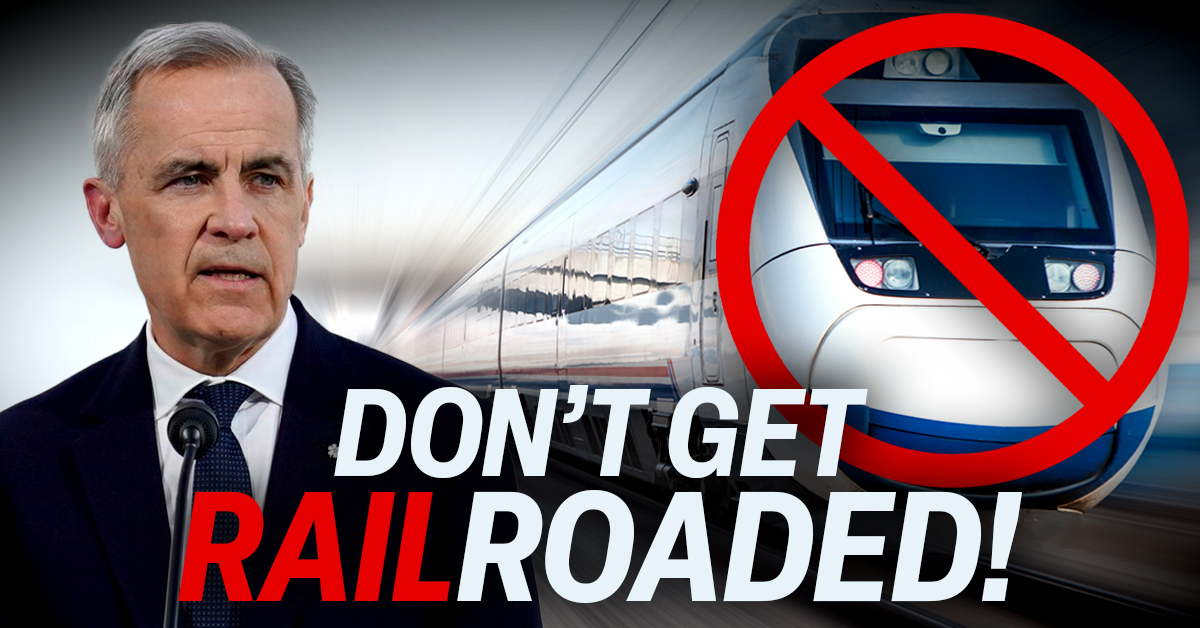

WARNING: Don't get railroaded by Carney's Quebec-Toronto train
The Liberals proposed plan for a high-speed rail connection linking Toronto to Quebec City is fraught with potentially disastrous financial, environmental and personal costs.

Ottawa has a costly plan for the country’s future: a 300-kilometre-per-hour bullet train linking Toronto to Quebec City in just two hours. Branded as ALTO, the high-speed rail line promises 18 million riders annually, thousands of jobs and a greener commute.
But the fine print tells a far different story, one that includes land expropriation, fractured farmland and a price tag that could soar tens of billions more than the $90 billion currently projected.
The Liberal government’s plan would carve out a new, dedicated corridor stretching roughly 1,000 kilometres through some of Ontario and Quebec’s most productive agricultural regions. The corridor is set to span up to 60 metres in width, fenced off and cutting through private property, including land that has been in families for generations.
For many rural residents, the concern isn’t faster travel between major cities; it’s losing their livelihoods with little to no benefit in return. There are currently no rural stations planned along significant stretches of the route despite the massive implications for those regions.
One only has to look to cautionary tales both abroad and at home to see the disaster this project could wind up being.
In 2008, California approved a high-speed rail project with an estimated $33 billion price tag and a targeted completion date of 2020. Today, the cost of the California High-Speed Rail has ballooned to more than $135 billion, with portions still under construction, and full operation still years away.
Closer to home, Toronto’s Eglinton Crosstown LRT was initially budgeted at $4.6 billion, with a 2020 launch date. Costs have since climbed past $13 billion, and the project was plagued by delays and legal disputes. Most devastatingly, local businesses along the route have closed following years of construction disruption.
It finally began operating earlier this month on Feb. 6.
Meanwhile, Canada’s existing passenger rail provider, VIA Rail, struggles with service reliability. In early 2025, on-time performance dropped significantly amid disputes and speed restrictions imposed by freight rail operator CN.
Despite those challenges, Ottawa is full steam ahead.
MP Michael Barrett @MikeBarrettON speaks to media on some of the problems with the Alto High Speed Train Project.https://t.co/BEBwTtWMSe pic.twitter.com/bXe89pHkvk
— Lynne Brooks 🇨🇦 (@LynneBr37562004) February 25, 2026
Estimates for ALTO hover around $90 billion, though full costing will likely soar past that.
The project is being advanced by a consortium that includes AtkinsRéalis, formerly known as SNC-Lavalin, a firm best known to Canadians for scandal and corruption before rebranding.
That alone raises concerns about oversight and accountability.
Mirabel: Manifestation contre le projet de TGV entre Québec et Toronto.
— Guillaume Roy (@guillaum3roy) February 25, 2026
24 février 2026
-----------------
Mirabel, Qc: Protest against the high-speed rail project between Quebec City and Toronto.
February 24, 2026 pic.twitter.com/RDgLwzYk0n
ALTO is also unfolding against the backdrop of Bill C-15, federal legislation aimed at accelerating major infrastructure projects. There’s mounting concern that this added measure only serves to streamline approvals and expropriation processes, effectively limiting avenues for public opposition.
Public consultations on the rail proposal have been underway, but the timeline is tight, concluding by the end of March, with some landowners claiming that they were unaware of any of this.
The government is framing ALTO as nation-building infrastructure — a long-term investment in economic growth and emissions reduction. Others see the risk of another megaproject mired in cost overruns, delays and unintended consequences.
As consultations continue, does the promise of speed and modernization outweigh the potential cost — financial, environmental and personal — for those along the proposed route?
Featured Stories


14:26


COMMENTS
-
Susan Ashbrook commented 2026-02-27 02:23:33 -0500If government promotes it, you just know it’s not gonna work out well.
-
Bruce Atchison commented 2026-02-26 23:10:17 -0500As usual, governments mess up things up big time! A business would evaluate the cost and benefits and decide if the project has merit. Governments are so terrible that they can’t even make profit selling marijuana.
-
 Bernhard Jatzeck commented 2026-02-26 20:49:51 -0500There’s not a lot of money to be made in passenger train service any more. This project is designed to keep Via Rail afloat, a business that’s like the CBC and Canada Post, constantly dribbling away its cash.
Compare that with Canadian Pacific. Roughly 30 years ago, it dumped everything that had nothing to do with trains. Gone were its airline (which went by names such as Canadian Pacific Airlines, CP Air, and, finally Canadian), its chain of hotels, and its marine shipping line. The result was that the CEO concentrated on the company hauling freight by rail.
Soon after that, its share price rose dramatically and a lot of people made money from that. In recent years, CP bought Kansas City Southern Railway and the new company, Canadian Pacific Kansas City, is one of the most profitable rail lines in North America. That acquisition allows goods to be seamlessly shipped from Canada to the southern U. S.
So, what’s the reason behind “Van Horne” Carney’s bullet train and who’s going to make money from it? Will it ever be built? Just ask the people of California who’ve had a similar project inflicted upon them. -
Bernhard Jatzeck commented 2026-02-26 20:34:59 -0500Carney, you ain’t no William Cornelius Van Horne.