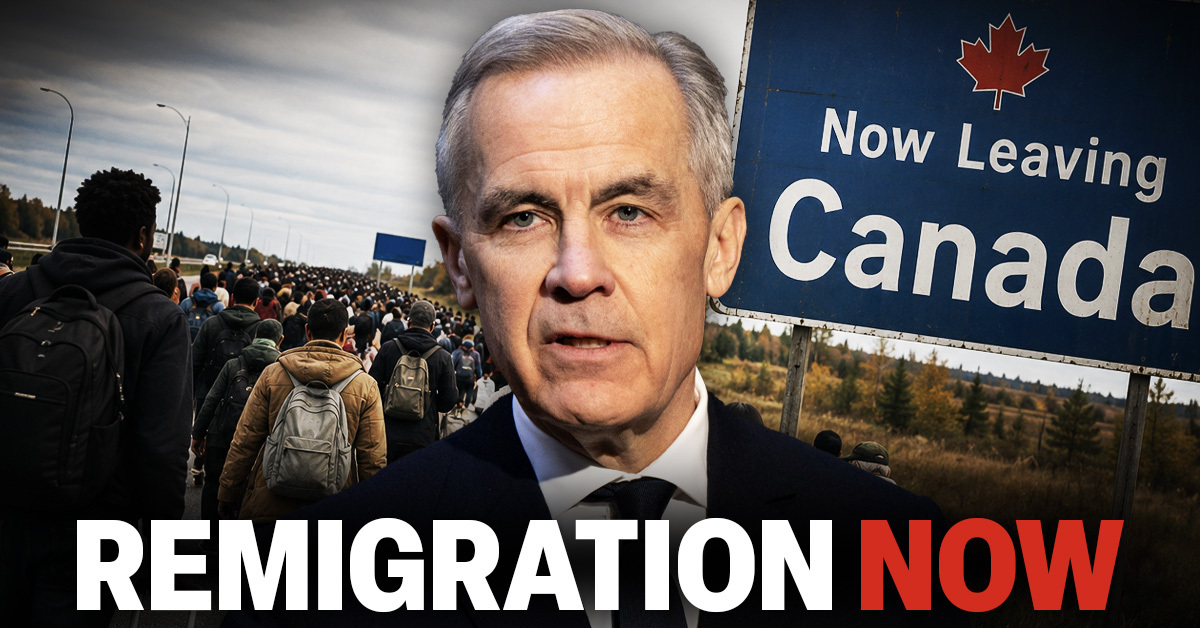

Canada’s mass exodus sees 120,000 working-age people flee the country
Housing has doubled, wages lag, and healthcare waits soar as educated Canadians are voting with their feet while Ottawa celebrates “nation building” policies.

Canada just hit a record no one is celebrating. While Liberal politicians boast about growth and “nation building” progress, a record 120,640 Canadians formally left the country last year. The staggering numbers reflect primarily educated, working-age adults in their 20s, 30s and early 40s.
That surpasses the previous high of roughly 118,000 emigrants in 2024 and dwarfs the elevated but still lower outflows of 70,000–95,000 seen from 2020 to 2024.
Statistics Canada’s hard data, drawn from tax filings and administrative records, shows the quarterly breakdown: 29,800 in Q1, 24,700 in Q2, 41,200 in Q3 and 24,900 in Q4.
For a nation of about 41 million, the loss equals roughly 0.3% of the population. This might seem miniscule, but these are not random departures. In fact, they are the exact demographic every country fights to keep.
The top destination for Canadian emigrants is the United States, followed by the United Kingdom, Australia and New Zealand.
Retirees and remote workers are also heading to lower-cost options such as Mexico, Portugal and Costa Rica as they seek a higher quality of life.
Talk to those who have left or are planning to, and the reasons are consistent; housing and rents in major cities and smaller towns alike, stagnating wages and the soaring cost of living with a massive taxation drain and dwindling public safety are top of mind.
In Canada in 2026, a family earning $100,000 — which was once considered a solid upper-middle-class income — can barely make ends meet. Home ownership has become a fantasy in the biggest job markets.
A software engineer in Vancouver averages about $130,000 CAD, but that same role in Seattle pays roughly $180,000 USD — and that’s before Canada’s higher tax burden and soaring living costs. Across tech, engineering and finance, skilled workers can often earn 20–40% more south of the border. Plus, they get to keep more of it, all while facing lower housing costs just hours away.
This shows that Canada’s mass exodus isn’t just about the paycheck, but poor service delivery on the part of an increasingly bloated bureaucracy – at all levels of government.
Months-long waits for specialists, grocery prices climbing faster than incomes, and the sense that hard work no longer guarantees a better life are clearly wearing people down.
Immigration Minister Lena Diab points to recent immigration changes as though it’s enough.
Temporary worker and student arrivals down 73% from 2024, asylum claims reduced 63%, and a permanent resident population declining for 18 straight months.
Yet she fails to reconcile that it was the same Liberal government, in power for more than a decade, that ramped up targets and flooded the country with temporary residents while housing starts and infrastructure never kept pace.
The “leaky bucket” is real. The Institute for Canadian Citizenship’s 2025 report found highly skilled immigrants are among the most likely to leave within five years, driven by the same housing, healthcare and underemployment pressures.
Population estimates for late 2025 showed the first sustained quarterly declines in a long time, largely from these tighter immigration rules.
That doesn’t account for the damage already done to retention, especially when a country loses experienced Canadian workers to newcomers with questionable credentials. Importing replacements who face the same affordability wall, and hoping they stay longer, seems a lot like trying to nail Jell-O to a tree.
The result isn’t ‘nation-building,’ it’s just a revolving door.
If 25- to 45-year-olds keep leaving at this pace, the tax base shrinks, skills shortages deepen, and pressure on those who remain intensifies. Retention becomes increasingly difficult when the daily math of housing, wages and opportunity no longer adds up.
Without fixing the cost-of-living crisis, Ottawa is simply accelerating the cycle and replacing the people who leave while calling it ‘progress.’
Featured Stories



15:14

COMMENTS
-
 ron hauck commented 2026-08-08 14:00:43 -0400Got to do something with the corporatism that seems to work with and have a lot of control of the government. The fascism part that seems to work along side of the socialism.
 -
Bruce Atchison commented 2026-08-07 19:36:44 -0400This is why socialism ruins countries. Liberals figure the country runs from the top down. So individual incentives are retarded to the point that nobody wants to build anything. The country comes progressively poorer and unsafe. Capitalism and conservatism have the opposite effect.
-
Bernhard Jatzeck commented 2026-08-07 19:36:04 -0400Think of how much money the federal government will make from this by charging them all an exit tax. Yes, there is such a thing. Gad Saad, who recently moved to the U. S., commented on that a short while ago.