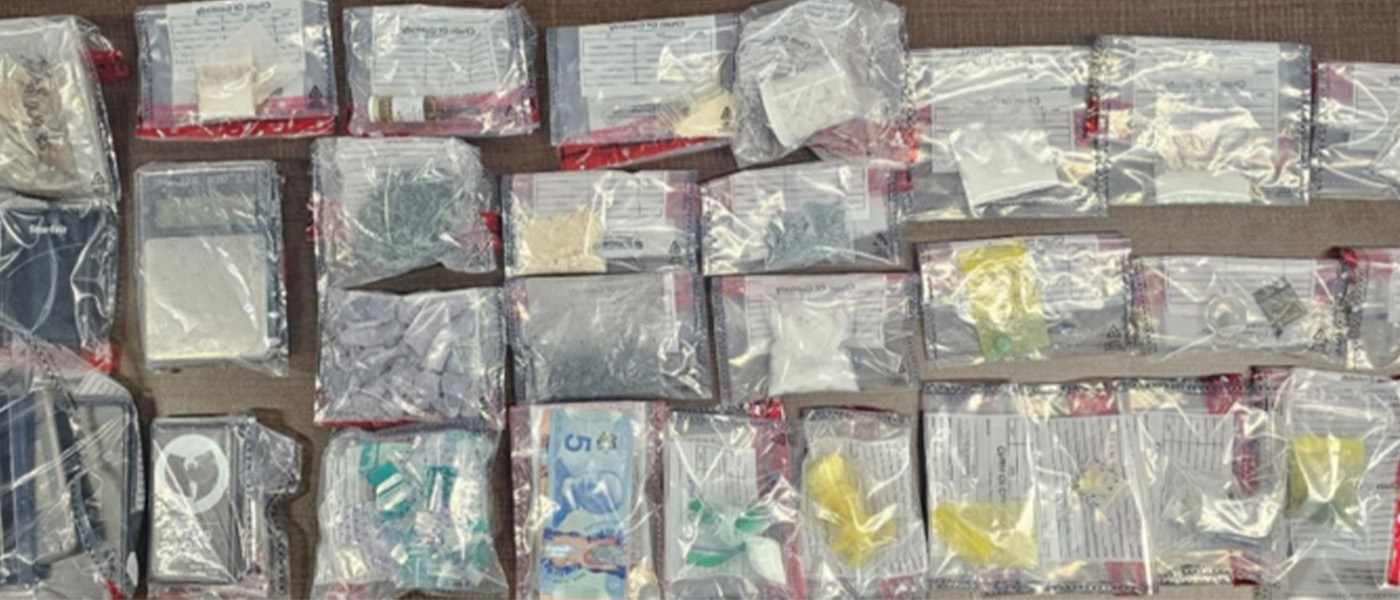


Drug bust at controversial Cobourg shelter validates long-standing community concerns
The recent bust exposes how criminality, street-level disorder, and unchecked drug activity have become intertwined under the noses of the shelter and Northumberland County.

A joint police operation between the Cobourg Police Service and Port Hope Police has reignited and validated community concern surrounding the shelter and transitional housing units at 310 Division Street, long criticized for escalating crime, open drug use, and community disorder.
Late Thursday night and into Friday morning, officers executed search warrants at the Division Street address and a second residence on Margaret Street. Police seized 472 grams of fentanyl, 30 grams of cocaine, 46 grams of crystal meth, as well as morphine, oxycodone, psilocybin, cash, cellphones, packaging, and drug-production materials. The haul carries an estimated street value of $320,000.
For many residents, the bust confirms what they’ve been warning about for years.
“Small towns like this don’t normally have this kind of thing,” one resident said, who moved from Toronto seeking a safer community. “Hopefully we can clean this up and get moving forward because enough’s enough—it’s too close to children.”
“It was a matter of time. Fentanyl is killing people. I lost about 10 friends in the last year,” said another.
The shelter at the centre of the controversy, operated by Transition House but owned by Northumberland County, was re-designated as low-barrier in 2018—coinciding with the rise in disorder that residents and nearby businesses say has overwhelmed the neighbourhood in the years since. Despite these concerns, Transition House received additional funding and a larger facility last year.
Locals and those using the facility say little has improved. One bluntly assessed the county’s efforts as “poorly run,” accusing the county of “misappropriating a lot of funds.” Another added that the closest detox beds are in Kingston or Toronto, and that he often works alone overnight to keep people safe. “Harm reduction,” they call it.
Another nearby resident said the expanding issues have left those in the community fearful. “Even myself,” he says, “I’m reluctant to go out at night because it's getting into a potential incident—just unprovoked, because the people are whacked out on whatever they're on there… It's sad, really sad.”
Cobourg Councillor Adam Bureau, Chair of Cobourg Police Services Board, highlighted the systemic failure faced by Cobourg and other communities across the country. “Shelters and warming rooms are a Band-Aid solution. Until governments get serious about mandatory rehab and treatment, this will keep happening,” he said.
Though he praised police efforts—“They took a ton of illegal drugs off the street last night, and I couldn’t be more proud”—others questioned the revolving-door justice system that sees repeat offenders quickly released.
One local summarized the broader sentiment: “Until they clean it up from the ground up, nothing’s going to change. Something has to be done soon.”
As the community waits for further updates, one resident summarized the prevailing mood: “People avoid the area; people with children don’t want to come to the area here. It’s a known issue, but nobody wants to do anything. The mayor wants to act on it, but the county says otherwise.”
Cobourg Mayor Lucas Cleveland declined to comment, citing the ongoing investigation.
Despite multiple requests, including in-person and emailed, the Cobourg Police Service provided no additional comment beyond the initial media release. Officers on scene refused to clarify what quantity of drugs originated specifically from 310 Division Street.
After further inquiry, Northumberland Warden Brian Ostrander emphasized that the incident did not occur within the shelter-operated portion of the building. He clarified that the fourth-floor transitional housing units are entirely separate from shelter services and subject to strict rules.
“Transitional housing units in this facility are separate from homeless shelter services, with units governed by an occupancy agreement. Every occupant signs a ‘Crime-Free Addendum’ as part of this agreement,” Ostrander said, adding that the county “awaits further information as this matter moves through the justice system” and “will continue to cooperate fully with police.”
Transition House’s interim executive director, Christian Harvey, echoed this clarification.
“The County of Northumberland owns 310 Division Street and licenses the 1st, 2nd, and 3rd floors to Transition House to operate the shelter,” Harvey explained. “The search warrant… was in a unit on the 4th floor, which are private residences not operated, staffed, or supervised by Transition House. As a result, we have no ability to comment on what happened, as we are not involved in what happens on the 4th floor.”



COMMENTS
-
 Marilyn Hagerman commented 2025-11-19 15:44:16 -0500With regard to the Cobourg, Ontario podcast…. 310 Division Street is in deep with corruption paybacks – you name it! Try this note below. If the cap fits, wear it!!
The U.S. government has unsealed fresh criminal charges and sweeping financial sanctions against former Canadian Olympic snowboarder Ryan James Wedding, alleging that he orchestrated the importation of up to 60 metric tonnes of cocaine a year into the United States and Canada, relied on a Toronto lawyer who, according to the U.S. Treasury, “has also helped Wedding with bribery and murder,” and, while under the protection of a former Mexican law-enforcement officer with ties to senior Mexican police officials, ordered dozens of sophisticated assassinations across Canada, Latin America and the United States — including the execution of a federal witness in Colombia, according to U.S. government filings.
According to Attorney General Pam Bondi, “Wedding controls one of the most prolific and violent drug trafficking organizations in this world,” working “closely with the Sinaloa Cartel, a foreign terrorist organization, to flood not only American but also Canadian communities with cocaine.” Bondi said Wedding’s organization is responsible for moving multi-ton quantities of cocaine each year through Mexico into Los Angeles, before the drugs are shipped onward to Canadian and U.S. cities in long-haul semi-trucks.
https://open.substack.com/pub/thebureau/p/modern-day-escobar-us-says-former?r=15itu6&utm_medium=ios
Sent from my iPhone -
Bruce Atchison commented 2025-11-17 19:07:55 -0500We have a crisis of irresponsibility here in Canada. It’s always “somebody else’s fault.” Our leaders must be replaced with responsible people.
-
Ruth Bard commented 2025-11-17 17:57:45 -0500Always somebody else’s problem. Where does the buck stop?