
"Making a Killing": A Documentary Challenging the Kamloops Residential School Narrative
The documentary asserts that discovery of unmarked graves at the Kamloops school is a "false accusation" and "conspiracy theory" without scientific evidence.

BECOME A MEMBER

Tonight on The Ezra Levant Show, a new documentary titled "Making a Killing" is set to challenge the prevailing narrative surrounding the Kamloops Indian Residential School and the broader "reconciliation industry" in Canada.
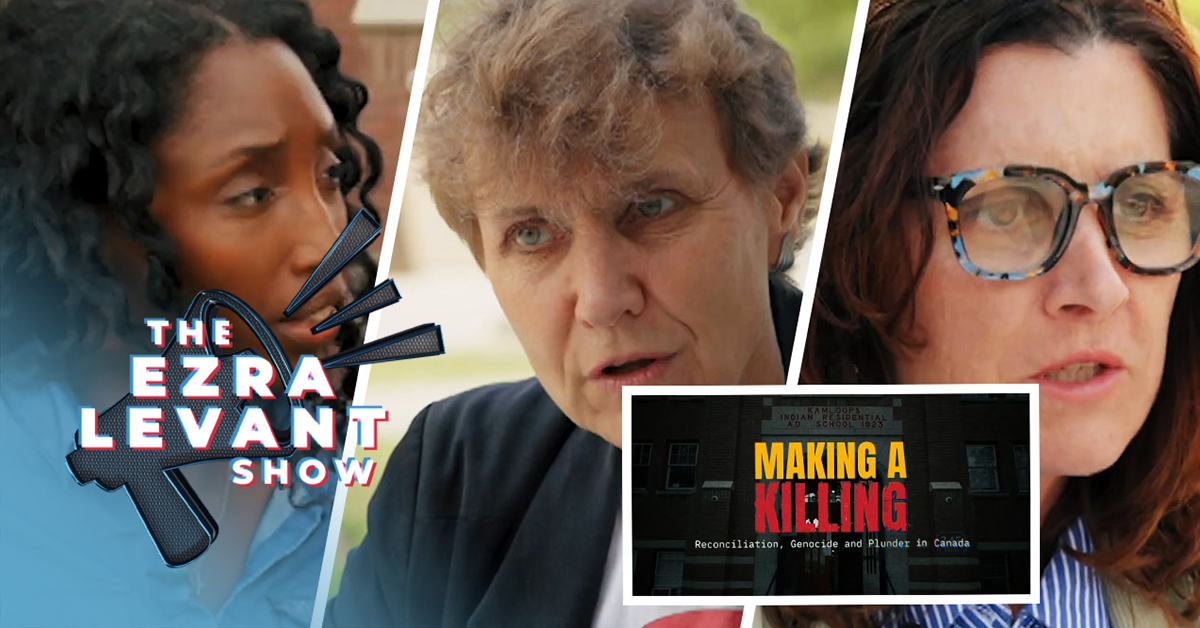
Produced by One BC, a new political party in British Columbia, the film features a panel of outspoken critics including MLA Dallas Brody, Professor Frances Widdowson, and Rebel News's Drea Humphrey.
The documentary and its creators argue that the claim of 215 children found in unmarked graves at the Kamloops school is a "false accusation" and a "conspiracy theory" that lacks scientific evidence.
They contend that this narrative has been exploited for political and financial gain, leading to billions of dollars in "voluntary cash payments" to Aboriginal groups and the potential surrender of land under the United Nations Declaration on the Rights of Indigenous Peoples (UNDRIP).
Key Arguments and Controversies:
- Challenging the "Mass Grave" Narrative: The film questions the accuracy of reports regarding 215 children's remains at Kamloops, highlighting that ground-penetrating radar identified "anomalies" and "probable graves" rather than confirmed bodies. The panelists emphasize that, to date, no bodies have been exhumed at Kamloops or other residential school sites where similar claims have been made.
- The "Reconciliation Industry": Critics featured in the documentary argue that the focus on these claims diverts attention and resources from the real social problems faced by marginalized Indigenous populations. They suggest that a "neo-tribal elite" and a "reconciliation industry" are benefiting from these narratives, which they describe as a "surrender of the province."
- Suppression of Dissent: The panelists recount instances of censorship, deplatforming, and even violence against those who question the official narrative. Professor Widdowson describes being mobbed and assaulted at the University of Winnipeg for discussing the Kamloops claims, while Dallas Brody was expelled from the Conservative Party of British Columbia for her views. Drea Humphrey also details encountering hostility and being labeled a "residential school denier" and "white supremacist" for her investigative journalism.
- Media and Political Influence: The documentary criticizes mainstream media, particularly the CBC, for what it describes as "mass jury tampering" – promoting the narrative without critical examination of the facts and actively discouraging skepticism. The film also points to political figures like Jagmeet Singh using terms like "mass grave" and legislative efforts (e.g., Bill C-15 aligning Canadian law with UNDRIP) as contributing to the "surrender of Canada."
- Financial and Land Implications of UNDRIP: The film delves into the financial and territorial implications of UNDRIP, specifically Articles 19, 26, and 32, which they interpret as requiring the return of all land to Aboriginal groups, granting veto power to Indigenous governments over decisions, and mandating indefinite funding from non-Indigenous governments.
The documentary and its proponents contend that examining the evidence and fostering open discussion are crucial for moving forward and addressing the actual needs of both Indigenous and non-Indigenous people in Canada.

COMMENTS
-
 John Landry commented 2025-10-14 07:20:06 -0400The people making money from this are picking the bones of the dead. This is a desecration of my ancestors who have walked this land for thousands of years. Native people have suffered of the flesh and now their resting souls are being made corrupt. This will have no positive effect for the living or the dead.
 -
 Susan Hamann commented 2025-10-14 05:02:20 -0400Canada has fallen! This is beyond unbelievable! Is there hope for Canada? I’m praying that God would reveal Himself to the nation of Canada once again….
 -
Paul Scofield commented 2025-10-13 20:52:32 -0400The more I hear from Prof. Widdowson, the more impressed I become. I assume that there exists in Confederation the use of Habeas Corpus — especially applicable in the original “show me the body” Latin sense in the Kamloops Indian Residential School case. I suspect that they do not exist. Dallas Brodie nails it on Kamloops being the card holding up the whole edifice and enabling what several have labelled “the truth and reconciliation industry.” Watch out friends. The dishonest Canadian left is going to try moving heaven and earth to make Kamloops Canada’s original (slavery-equivalent) sin.
-
Bruce Atchison commented 2025-10-13 20:46:45 -0400The grievance mongers really are making a killing and on our dime too. Like any other group, they don’t care about truth when they can benefit from a lie. And all this pandering just stokes the racial divide. That’s what socialists like the Liberals like.

