
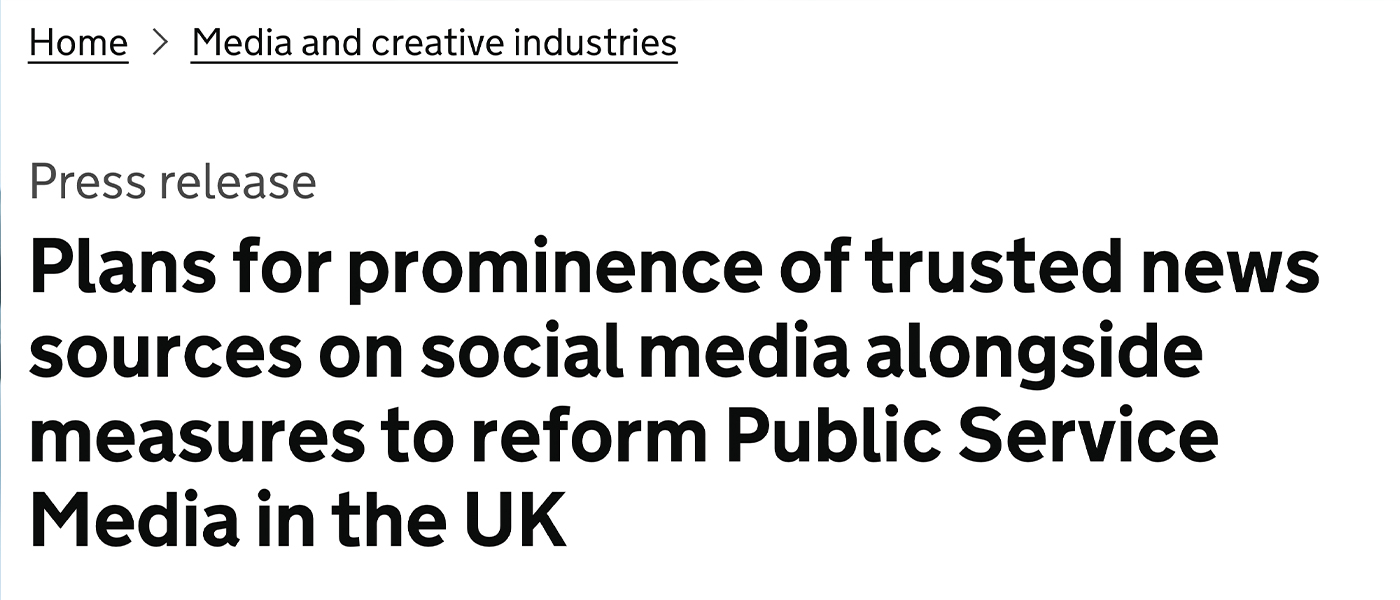

The U.S. warned Britain not to create a 'trusted news' system — Canada already has one
What Britain is only contemplating, Canada has already been doing to Rebel News and to every genuinely independent outlet in the country — exactly what the U.S. just told Britain not to start.

BECOME A MEMBER

Article by Rebel News staff
Tonight, on The Ezra Levant Show, the U.S. government formally tells Britain that ranking "trusted news" to the top of your feed is censorship — but Canada's been doing it for years.
A letter was published this week by the United States Embassy in London, addressed to the British government, all about what you are doing right now: watching news the government didn't pick for you.
Here's the background. On June 23, Britain's culture secretary, Lisa Nandy, put out a green paper — a discussion document, a trial balloon, cheekily titled “Watch this Space.” Her idea was that Britain's public service broadcasters — the BBC, ITV, Channel 4, Channel 5 — should be made “prominent and easy to find” on platforms like YouTube. Prominent means, in the government's own words, more likely to sit at the top of a person's social media feed. The BBC goes to the top, and then, in the government's phrasing, “other trustworthy providers.”
Who qualifies as trustworthy? The paper doesn't say. Who decides? It doesn't say that either.
Ezra's guess is that "trustworthy providers" means reporters that politicians trust — not reporters the people trust. There's a difference.
The government cites an Ofcom figure to justify the plan: 75 percent of young people aged 16 to 24 get their news from social media, not from the BBC. To a government that owns a broadcaster, that Ofcom number is a threat. But the fix on offer isn't a better BBC; it's an algorithm rigged so the BBC shows up whether viewers want it or not.
YouTube saw it immediately. In July, the platform warned British creators the rules could force it to “put some channels above others,” and urged them to write to the consultation. Ezra isn't in the habit of defending YouTube — it has demonetized Rebel News, throttled it, and pulled its videos. But even YouTube can see that ordering it to put the BBC on top means somebody else goes to the bottom. By YouTube's own accounting, British creators are worth more than £2 billion a year to the UK economy and 45,000 jobs. Those are the people who'd be pushed down the list.
The consultation closed August 31. That's where it gets interesting.
On July 14, Jim Jordan, chairman of the U.S. House Judiciary Committee, wrote directly to Lisa Nandy. His letter described the plan as creating “a tiered information system in which media outlets that are supported and legitimized by the British government are at the top,” a form of gatekeeping, he wrote, that stifles independent and smaller outlets. He demanded a briefing.
That was a congressman speaking. Then came the executive branch.
On September 2, the U.S. Embassy in London filed the formal position of the American government in the British consultation. It states plainly that Washington has “serious concerns” about the plan, and that a government picking which outlets get preferential visibility “risks becoming a mechanism for viewpoint-based censorship.”
Then comes the line Ezra wants read twice: “the effect on a government-disfavored speaker or media source's reach is not meaningfully different than outright removal.” Not meaningfully different than outright removal. In other words: bury someone in the algorithm, and you've censored them, full stop. No need to delete the channel, just make sure nobody sees it.
The U.S. government says it would “likely consider such a measure as facilitating censorship,” and warns it “could establish a template that authoritarian regimes could invoke to justify more control over online content.” Washington's ask is not to amend the plan. It's to withdraw it entirely.
Then come the questions — and Ezra has been asking versions of every one of them in Canada for four years. What criteria decide whether an outlet is “sufficiently trustworthy”? Who makes that call? Will the criteria be public? Is there an appeal for outlets left off the list? And what role do third-party “media literacy” groups — the fact-checkers — play in deciding who gets ranked?
Good questions, every one. Canada already answered them, years ago, and the answer was always the same: the government decides, and if an outlet doesn't like it, see it in court.
Canada doesn't call it a trust list. It's called a Qualified Canadian Journalism Organization (QCJO), and it functions as a journalism licence. Hold one, and a newsroom's payroll is subsidized, and its subscribers get a tax credit. Don't hold one, and it's shut out. The committee that decides is appointed — by the government, not by the public. When Rebel News, one of the largest independent news organizations in the country, applied, Trudeau's committee ruled that less than two per cent of what we do qualifies as “original news,” and labelled us “activists.”
Ezra has made this point before and makes it again: it is anathema to a free press for a government committee to determine who is or isn't a journalist.
Real democracies don't issue journalism licences. Russia does. Iran does. China does.
Rebel News sued. In September 2024, the Federal Court sided with the CRA — a result Ezra found frankly shocking. Rebel News appealed. Last September, in the Federal Court of Appeal in Toronto, a lawyer for Mark Carney's government told three judges the whole point of the system is to make sure Canadians get journalism that is “informed and reliable.” A ruling is still pending, and Ezra isn't optimistic — this is Canada in 2026, after all.
So the government decides who is informed, reliable, trustworthy and, ultimately, who is approved.
Set the two side by side. Britain proposes a list of government-approved news, and the Americans file a formal objection calling it censorship. Canada built a list of government-approved news, enforced it through the tax code, fought a newsroom in court for four years to keep it, then layered on a second mechanism at the CRTC — and the American response has so far focused on unfair trade practices. Fair concern. But what about the freedom part?
What Britain is only contemplating, Canada has already been doing to Rebel News, and to every genuinely independent outlet in the country — exactly what the U.S. just told Britain not to start.
At least Britain's government had the decency to run a public consultation, and got told off by its closest ally for the trouble. Canada never asked anybody. A government committee simply decided Rebel News isn't journalism, and left us to spend more than $177,000 fighting that decision in court.
Ask who makes the “trusted” list in Canada. The outlets on the payroll: the CBC, with its billion dollars a year; the newspapers cashing subsidy cheques. Ask who's left off it: the outlets that won't take the government's money.
Trustworthy, it turns out, means paid for.

COMMENTS
-
 Bernhard Jatzeck commented 2026-09-05 17:22:38 -0400Canada….. East North Korea.
 -
Bruce Atchison commented 2026-09-04 20:47:35 -0400Talk about censorious thugs; that’s what the UK and Canadian governments are. Alberta really must leave confederation.
