
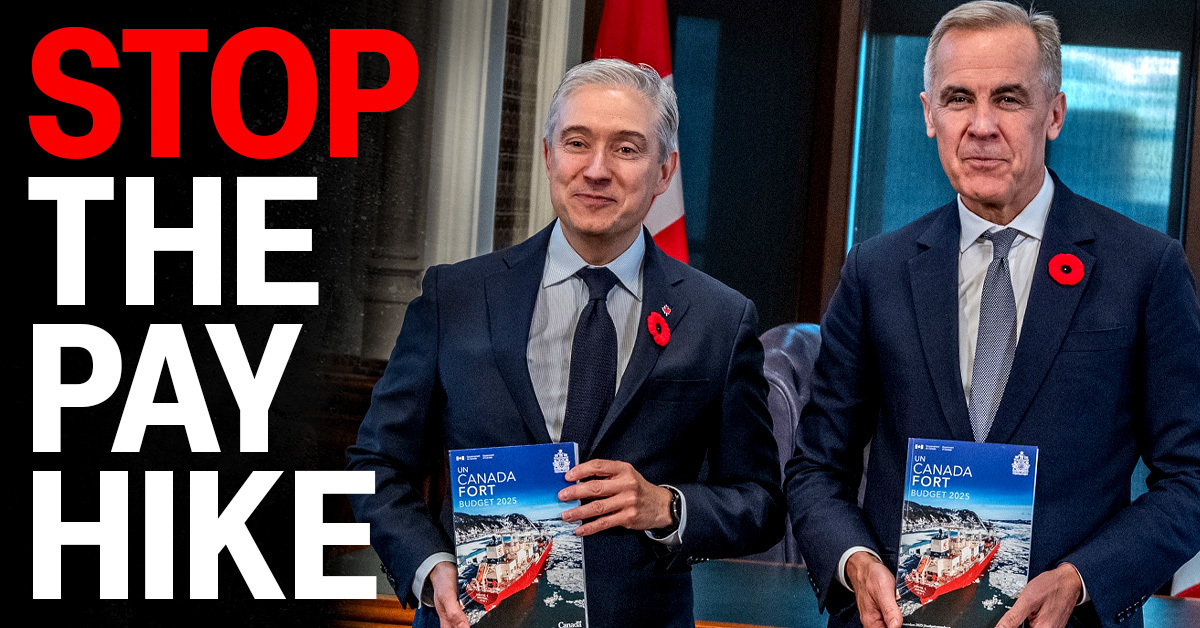

While Canadians are told to tighten their belts, Ottawa’s payroll grows
New Parliamentary Budget Officer figures show Ottawa’s spending climbing faster than population growth while Canadians are expected to absorb a ballooning deficit amid a cost-of-living crisis.

The newly released Parliamentary Budget Officer’s Personnel Expenditure Analysis shows that federal personnel spending hit $76.3 billion in 2024–25, up from $71.9 billion the year before. That’s a 6% spike in just 12 months, for a bureaucracy expanding at a pace that exceeds population growth.
Now, the government will probably try to bury this by clinging to the fact that growth has slowed compared to the double-digit jump the year prior, but they won’t emphasize that even after stripping out so-called “one-time payments,” departmental personnel spending still climbed to $64.2 billion — marking a 6.7% increase.
That’s more than double the pre-pandemic average growth rate of just over 3%.
Keep in mind, this is five years after the height of the COVID pandemic.
While personnel spending includes salaries, pensions, overtime, and bonuses, there’s a category that deserves far more scrutiny called ‘other’ and ‘one-time payments.’
The trend line from 2006 onward shows gradual spending increases, until 2020 and 2021 when these ‘one-time payments’ shoot upward. Never let a good crisis go to waste, so they say.
With emergency measures in place, these unprecedented times obviously required extraordinary decisions… and spending. The issue is that those spending levels didn’t snap back. Instead, they became the new baseline.
All of this, while the federal public service has grown to 448,000 full-time employees — an increase of 7,000 in just one year. It’s the largest federal workforce in modern history.
In 2024, it was noted that in nearly 15 years, Canada’s population grew by 21.1%, while the number of federal public servants rose by 30%, meaning that the bureaucracy has expanded significantly faster than the population it serves.
Even more telling, though, is that compensation per employee jumped 5.1% this year alone — to over $143,000 per full-time employee. That’s the second consecutive year of historically high per-employee growth.
Salaries rose nearly 5%, but ‘other payments’ per employee surged 16%.
The official excuse is that this was part of an accounting shift involving the RCMP — costs that were previously categorized as transfer payments are now listed as personnel expenses. Even considering that technical change, those ‘other payments’ still tripled.
Under that catch-all are things like employer contributions to health plans, disability insurance, employment insurance, and a collection of miscellaneous expenditures that rarely receive public debate.
The ‘one-time payments’ are tied to pension plan adjustments, retroactive collective agreement payouts, severance packages, etc.
Meanwhile, Ottawa insists growth is slowing, and Prime Minister Mark Carney said he’d cut the public service
🇨🇦I’m going to post this everytime Mark Carney lies about reducing Public Service.
— THE OFFICIAL RECORD (@SatireSquadHQ) December 6, 2025
More CRA workers being hired.
CRA is the most inefficient area of Federal Government and now needs even more people?🤷🏻♂️
Or they planning more taxes? pic.twitter.com/oAkPaSVe6I
Slowing growth on top of a dramatically expanded base still equals bigger government. So while the number of federal employees per 100,000 Canadians dipped slightly this year — that’s largely due to record population growth, not workforce restraint.
Let’s keep in mind that Canadians fund all of this.
While households are tightening budgets, facing higher interest rates, higher taxes, and higher grocery bills, the federal payroll continues to climb well above historical norms, outpacing population growth itself.
This isn’t about whether public servants deserve fair compensation; it’s whether this bloated bureaucracy is sustainable. When pandemic-era spending spikes become permanent structural increases, taxpayers deserve transparency and accountability.
What becomes abundantly clear is that once government spending ratchets upward, it rarely comes back down.
This time isn’t any different.
Featured Stories

08:00


COMMENTS
-
Melvyn Schobel commented 2026-02-20 06:43:45 -0500The Liberals have dug a hole so deep that they have no choice but to stay on their current path. More spending, more immigration to secure votes to remain in power, to be the front runner in climate change and to make Canada look good when we produce less than 1% of carbon emissions. Carney is a joke not to be taken seriously. Some day, when the Conservatives wake up with a strong leader at its helm, will Canada be great again.
-
Bruce Atchison commented 2026-02-19 19:21:46 -0500Of course those bureaucrats figure they’re worth what we pay them. But they aren’t and we voters must fire Carney. And how I wish there would be severe consequences for those rogue Liberal leaders for what they’ve done. It’ll take generations to fix the damage and we taxpayers are the ones stuck with the bill.