


Woke ideology is corrupting crime data
A Quebec child sex-crime case has exposed a startling reality about how Canadian authorities record the gender of accused criminals — and it raises serious questions about whether Canadians are getting an accurate picture of who is actually committing certain crimes.

Stop blindly trusting Statistics Canada.
That may sound extreme, but what is happening inside Canada's institutions should concern anyone who believes crime statistics are supposed to reflect objective reality rather than political ideology.
And one recent case in Quebec shows exactly why.
On July 2, the Granby Police Service issued an appeal for potential victims of Emma Grégoire, who faces multiple charges related to alleged sexual offences involving two children, aged four and six, as well as possession and production of child sexual abuse and exploitation material.
Throughout the entire police release, the accused was referred to using female pronouns and feminine terminology. Yet buried in the release was another detail: Emma Grégoire had also used the name Cédric or Cédrick.


Police never clearly stated that the accused is transgender or biologically male. Interestingly, the police service also disabled comments on this particular social media post. Legacy media outlets then largely repeated the police version of events, presenting the accused as a woman while mentioning only that Grégoire had previously been known as Cédric and that police had not specified how the accused identified in 2022 and 2023.
But five minutes of basic online research led to what appears to be the accused's Facebook profile, showing a person who previously presented as male and has publicly identified as a woman since 2020.
For the average reader who sees only a headline and opening paragraph, the impression is simple: a woman named Emma is accused of committing sexual crimes against children.
But does that tell the public the whole story? And what happens when the same approach is used to compile Canada's official crime statistics?
According to Statistics Canada data cited in this report, women represented only about four per cent of people accused of sexual crimes involving children in 2024.
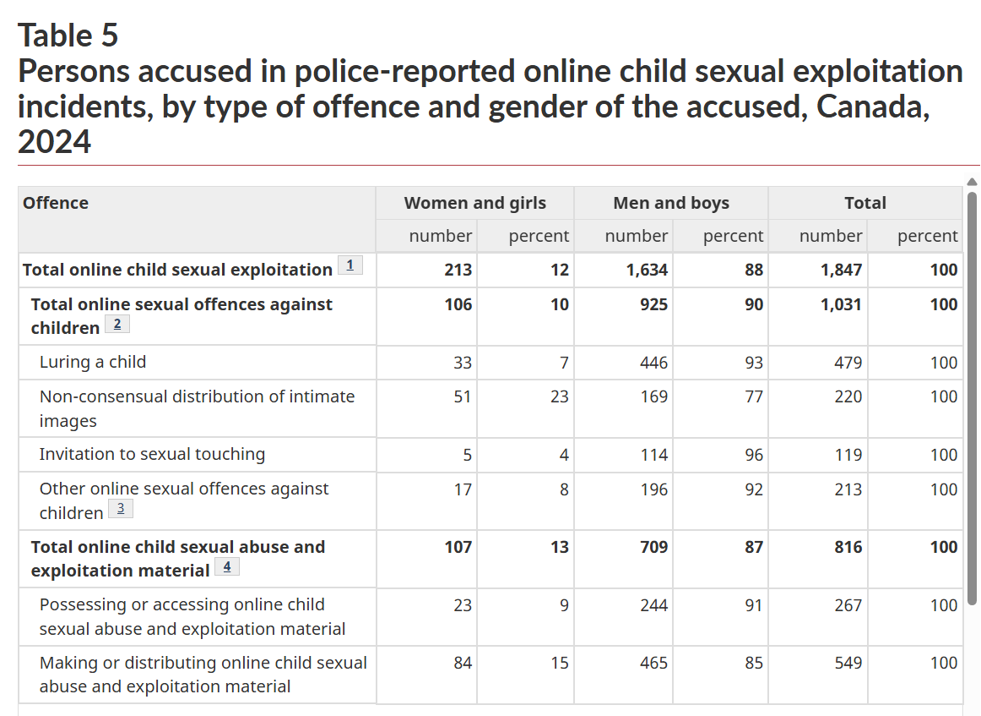
But those numbers deserve closer scrutiny. I contacted the Granby Police Service to determine where the accused is currently being detained.
A men's institution or a women's institution? Police refused to disclose that information. The question matters because Canada's correctional policies allow certain inmates to be housed according to gender identity rather than biological sex.
According to the Correctional Service of Canada's own policies, gender-diverse offenders may request placement in an institution aligned with their gender identity or expression, regardless of anatomy or the sex marker appearing on official documents. That means a biologically male inmate could potentially be housed in a women's institution.
In cases involving sexual offences, this raises obvious and serious questions about the safety of vulnerable female inmates and their children.
But the questions do not stop there.
I also asked the police why their public communications exclusively used female terminology without clearly informing the public that the accused was biologically male or transgender.
Then I contacted Statistics Canada with an even more important question:
If this accused is eventually found guilty, will the crime be recorded statistically under men or women? The answer is stunning.
Police services record a person's gender as it is “lived and expressed,” rather than automatically recording sex at birth. Statistics Canada says this approach better reflects Canada's population and that the statistical impact should be minimal because transgender people represent a very small proportion of the population.
But is the impact really minimal? A Government of Canada study found that, among gender-diverse federal offenders with a history of sexual offences, 82 percent were transgender women.
That raises an obvious question: in crime categories where female offending is already statistically rare, could even a relatively small number of biologically male offenders being categorized as women significantly affect the data?
There is another striking exception.
According to Statistics Canada, crimes are generally categorized according to recorded gender — except homicide data, where sex at birth may also be taken into consideration.
So why the exception? Why does biological sex suddenly matter when recording homicide, but apparently not in the same way for other serious crimes?
Canadians depend on official statistics to understand who commits crimes, who is victimized and where public-safety risks exist.
But statistics are only useful when people clearly understand what is actually being measured. If a biologically male accused can be counted as a female offender solely because that person identifies as a woman, the public deserves to know that when interpreting the data.
This is bigger than one criminal case. It is about whether ideology has begun influencing institutions that Canadians depend on to objectively measure reality.
Because when definitions change, statistics change. And when statistics stop meaning what ordinary people think they mean, Canadians have every reason to start asking questions. When we lose sight of reality, we risk losing our ability to understand society itself.
Alexandra Lavoie
Quebec based Journalist
Alexa graduated with a degree in biology from Laval University. Throughout her many travels, she has seen political instability as well as corruption. While she witnessed social disorder on a daily basis, she has always been a defender of society’s most vulnerable. She’s been around the world several times, and now joins Rebel News to shed light on today’s biggest stories.
Featured Stories

16:47

06:41


COMMENTS
-
 Fran g commented 2026-07-16 17:53:43 -0400LIbs woke shit encompasses so many issues that it is bound to turn and bite them right in their asses.
 -
Marilyn Hagerman commented 2026-07-16 11:54:59 -0400Carney’s Marxist government is trying hard to include mentally ill as an acceptable reason for MAID. It’s an acknowledged medical fact that transgenderism is a mental illness. Two and two equal four???Multi-crazed woke ideologies gone, male sexual predators dressed up as females….to name just a few….all gone, all eliminated by Carney’s infamous MAID!!!