

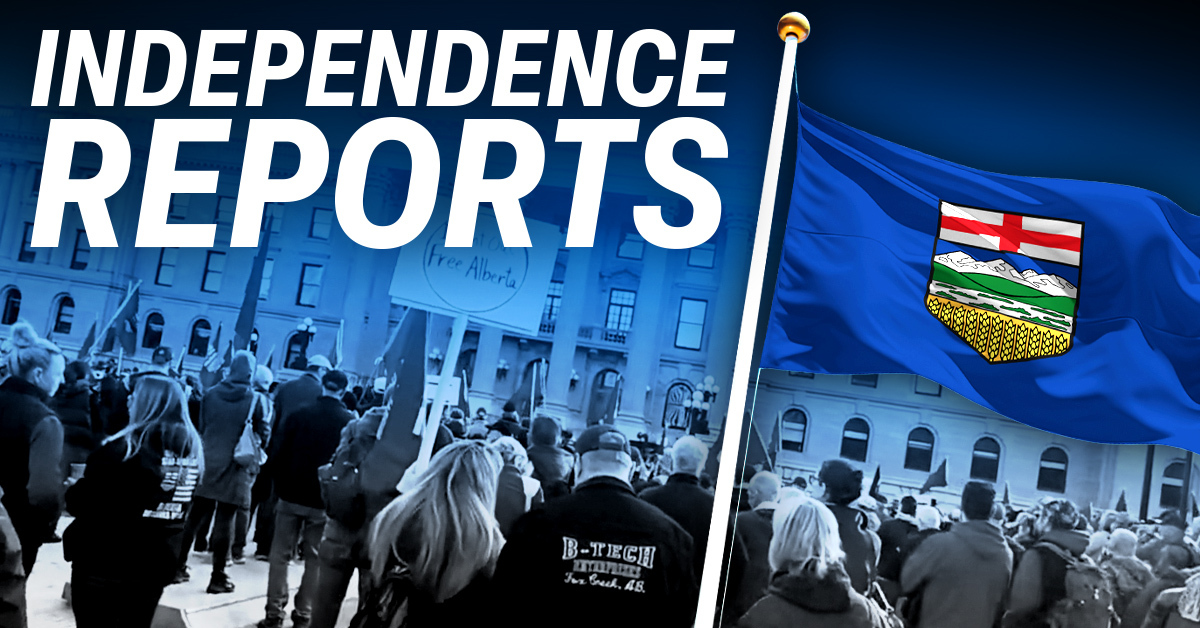

Alberta Fact Check: Since when do abusers fight for their victims to have a choice?
In an article for The Line, Lead Not Leave organizers Jared Wesley, Peggy Garritty and Jim Dinning compare Alberta separatists to abusive spouses, despite the movement's central demand being a referendum that lets Albertans decide their own future.


Three prominent opponents of Alberta independence have published an article comparing Alberta separatists to abusive spouses, gaslighters and emotional manipulators.
Writing in The Line, University of Alberta political scientist Jared Wesley, former Calgary Chamber of Commerce CEO Peggy Garritty, and former Alberta treasurer Jim Dinning argue that separatists are not victims of a toxic relationship with Canada but are themselves behaving like abusers.
The article, titled Abuse? Really?, accuses separatists of "poisoning the partnership" between Alberta and Canada, engaging in "gaslighting," using "a classic tactic in emotional manipulation," and employing "emotional blackmail."
The authors write that Alberta separatists exhibit "some of the most obvious traits of toxic relationships" and suggest the movement is attempting to isolate Albertans from the rest of the country.
It's a striking accusation, especially coming from three prominent figures associated with Lead Not Leave, the organized campaign established to oppose Alberta independence and persuade Albertans to remain in Confederation.
But the article's central analogy falls apart almost immediately. The entire Alberta independence movement is organized around a single democratic demand: a referendum.
Separatists are not asking Albertans to obey them. They are asking Albertans to vote.
Abusers do not campaign to give people more choices.
Abusers do not collect hundreds of thousands of signatures so citizens can decide their own future.
Abusers do not spend years arguing that the final decision should belong to voters.
Yet that is exactly what Alberta's independence movement has done.
More than 700,000 Albertans signed one of two competing petitions on Alberta's future. One petition sought a referendum on independence. The other sought a vote to remain in Canada.
Whatever side of the debate one supports, those signatures demonstrate that Albertans want a say in the future of their province.
The authors argue that separatists are forcing Albertans to choose "between province or country." But no one is forcing Albertans to choose Alberta.
Separatists are asking Albertans whether they want to choose Alberta.
There is a fundamental difference between imposing a choice and offering one.
The article repeatedly frames separatists as attempting to take agency away from Albertans. Yet the mechanism they are advocating is a democratic vote in which Albertans themselves make the decision.
If Albertans vote to stay in Canada, Alberta stays.
If Albertans vote to leave, negotiations begin.
Either way, the outcome is determined by voters.
Perhaps the most revealing passage comes near the end of the article, when Wesley, Garritty and Dinning insist Alberta already possesses "agency, wealth, constitutional protections, influence, and opportunity."
If Alberta has agency, then surely Albertans have the agency to reconsider Confederation.
Surely they have the agency to debate independence.
Surely they have the agency to sign petitions.
And surely they have the agency to vote.
The authors accuse separatists of denying Albertans agency while criticizing the very mechanism that would allow Albertans to exercise it.
Reasonable people can oppose Alberta independence. There are legitimate debates to be had about trade, pensions, debt, citizenship, borders, treaties and the economic consequences of separation. Those are serious questions deserving serious answers.
But comparing hundreds of thousands of Albertans who support a referendum to abusive spouses is not a serious argument against independence.
It's an attempt to delegitimize the people asking the question.
The strongest argument against Alberta independence is that it would be difficult, risky and uncertain.
Instead of making that case, the authors chose to compare their political opponents to abusers, manipulators and gaslighters. In doing so, they revealed the weakness of their own analogy.
Since when do abusers spend years fighting for their supposed victims to have more choices?
Since when do abusers collect signatures so people can decide for themselves?
A movement built around a referendum may be right or wrong.
But a movement whose central demand is "let the people vote" is a strange candidate for the role of abuser.
Sheila Gunn Reid
Chief Reporter
Sheila Gunn Reid is the Editor-in-Chief, Alberta Bureau Chief, member of the board of directors, and host of The Gunn Show at Rebel News. Sheila also serves as President of the Independent Press Gallery of Canada. A mother of three and longtime conservative activist, Sheila is the author of bestselling books, including her most recent release, Independence Blueprint: What Alberta Can Learn From Quebec.
https://mybook.to/sheilaFeatured Stories


17:31

COMMENTS
-
 Allan Young commented 2026-06-16 14:19:47 -0400Perfect point !
When do abusers fight for your rights, NEVER ! -
Bernhard Jatzeck commented 2026-06-16 14:19:37 -0400Where have those people been for the last 40 or 50 years? They talk as if PET’s NEP never happened.
-
Beatty Matthew commented 2026-06-16 12:13:06 -0400If Alberta was to separate or threaten to separate, imagine what could be achieved.
This referendum question is only a question on could we separate , should we consider to separate.
That’s all, by answering “YES”, leaves us options, for the future , which is a really good position to be dealing with Ottawa.
I don’t care what political affiliation you are, liberal, NDP, or conservative, the option to choose should remain open for further discussions and negotiations.
This November referendum question, is only stating, “let’s leave us options”, and see where it goes from there.
Yes, I am a patriotic, sometimes though you must make a stand, for the benefit of the whole country.
This is why, leaving us an option, will have huge benefits to all of Canada.
So, let’s give this some thought, shall we.
