


EXCLUSIVE: Cobourg mayor addresses community division, social challenges
Lucas Cleveland discusses past shelter policy errors, his support for addiction treatment, and his public safety vision.

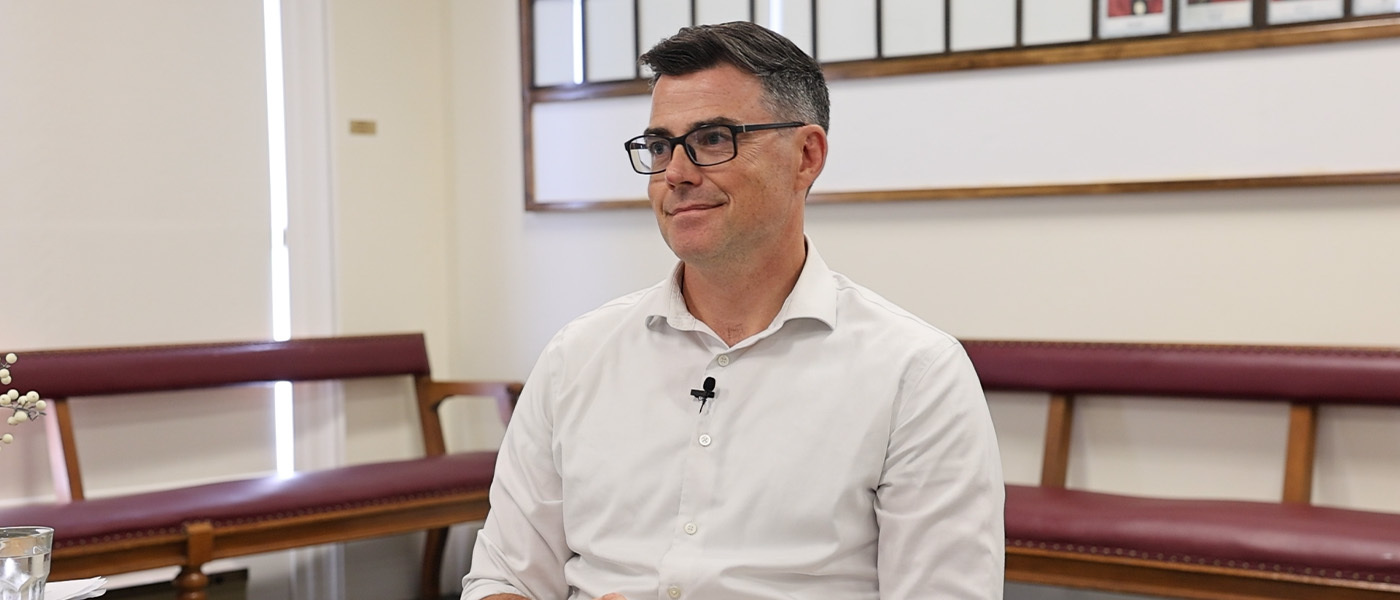
In an unscripted sit-down at Cobourg Town Hall, I had the privilege of speaking with Mayor Lucas Cleveland about the pressing issues facing this vibrant community of 22,000.
With division palpable across the town and council chambers, Cleveland offered candid insights into his leadership approach, the controversial expansion of shelter services, and his vision for Cobourg's future.
Cleveland began by addressing the polarized reactions to his decision to engage with Rebel News, emphasizing his commitment to transparency. “I don’t agree with everything Rebel News says, but I heard you ask tough, important questions at our town hall,” he said. “I support that, and I want a frank discussion.”
This openness, we both noted, stirred debate on social media, reflecting the deep divisions within the Cobourg community.
When pressed on his role in unifying a fragmented community, Mayor Cleveland said, “I move forward the same way I always have—waking up with a positive attitude, tackling problems head-on,” drawing on his experience managing multi-million-dollar projects in the oil and gas industry in Alberta and building a zero-waste grocery market in downtown Cobourg called The Market & Smør.
The Mayor says that his campaign promises, still publicly available online, underscore his dedication to transparency and progress, even amid controversy. “Change is always difficult,” he acknowledged, citing historical social movements as evidence that progress often comes with resistance.
A focal point of our discussion was the expansion of shelter services at 310 Division Street, a decision Cleveland initially supported but now regrets. “I saw a problem—a three-bedroom house serving as the epicentre of social services for 2,000 square kilometres—and thought a larger shelter was the solution,” he admitted.
Despite the 2018 shift to a low-barrier shelter at Transition House worsening issues for the surrounding community, Cleveland now supports a higher-barrier model to better serve vulnerable residents. “It’s okay to make mistakes,” he said. “You learn by taking chances and making decisions.”
Cleveland also addressed the broader social challenges, including drug addiction and homelessness. He emphasized Cobourg’s generosity while condemning “drug advocates” who, he believes, normalize harmful behaviours. He highlighted his collaboration with Port Hope Mayor Olena Hankivsky to secure funding for a rehab bed at the Canadian Centre for Addictions' Cobourg location, a step toward addressing addiction that promotes recovery instead of enablement.
“No one is saying we shouldn’t help those struggling,” he said, stressing the need for provincial and federal support to tackle these complex issues.
On policing, Cleveland praised Cobourg Police Chief Paul Vandegraaf as “honorable and diligent,” dismissing notions of division between them. “We don’t always agree, but we work professionally in our lanes,” he said, noting recent arrests as evidence of effective police work. Addressing rumours of a proposed police budget cut, he clarified that no reduction was proposed, but rather a capped 4% increase.
"I’m done placating pushers of death who continue to normalize drug use in our community. No one is shaming an individual for having an addiction and no one is shaming an individual for having mental health crisis. But criminality and criminals need to be dealt with as such. And I look forward to the next year and a half advocating on the one side to make sure there are better treatments for our most vulnerable and on the other hand, making sure those who break the law are held to account."
Looking ahead to the 2026 election, Cleveland confirmed his intent to run for a second term, driven by what he sees as a critical choice between “order and law” and “criminality and chaos.”
His primary objective is to position Cobourg as a community marked by what he calls inevitable growth, while still protecting farmland, but ensuring robust infrastructure.
Featured Stories

03:31

10:27


COMMENTS
-
 c williams followed this page 2025-08-03 16:51:41 -0400
 -
 Daniel Rankin followed this page 2025-07-31 17:31:59 -0400
 -
Robert Pariseau commented 2025-07-31 16:55:34 -0400Try that with a big-city mayor.
-
Bruce Atchison commented 2025-07-29 19:22:46 -0400This chaos is brought to you by leftists, makers of destruction.
