



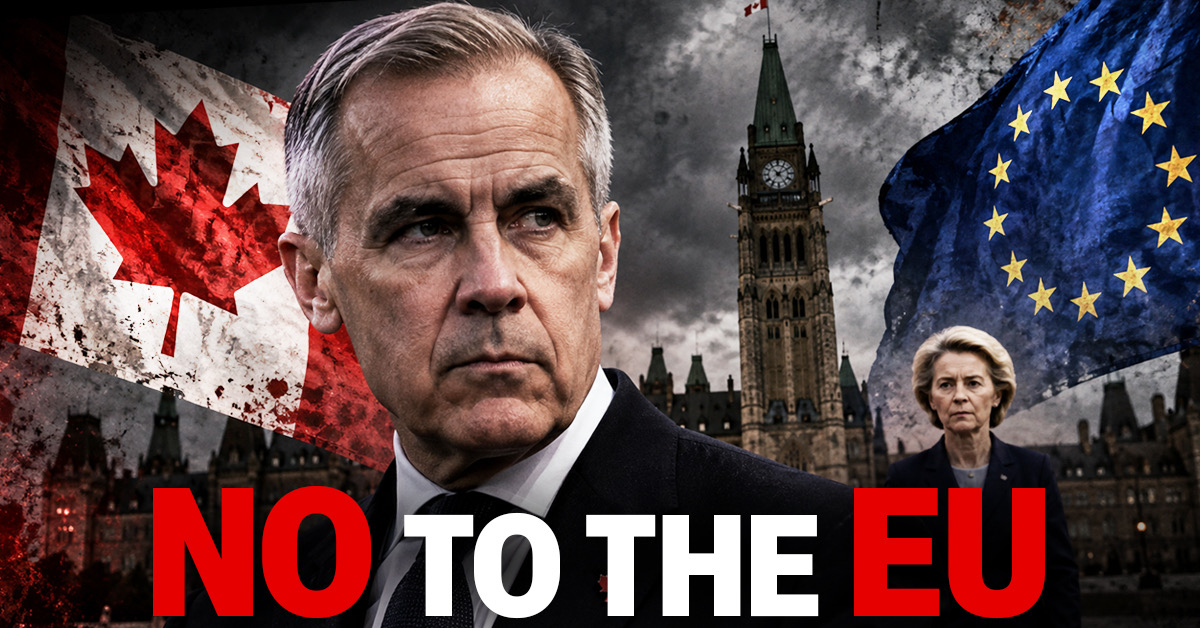

Who asked Canadians? Carney moves Canada closer to Brussels at Montreal EU summit
Rebel News was outside the Canada-EU summit, where no one could say what associate membership would cost or what Canada would give up.

Article by Rebel News staff
Rebel News reporter Alexa Lavoie was at the Old Port of Montreal as Prime Minister Mark Carney welcomed European leaders for the Canada-European Union summit, a two-day meeting that could bring Canada closer to Brussels than ever before.
Delegates met behind closed doors. No media were allowed inside. Alexa watched a long line of cars arrive at the venue and noted they were gas cars, not electric ones.
Carney said the partnership means "affordability, more competition, more choice," along with opportunity for young people, researchers and companies. "And it means, at its base, sovereignty," he said.
"We are working towards the deepest possible partnership short of accession," he said.
But who asked Canadians if they wanted this?
European Commission President Ursula von der Leyen, who is not directly elected by European voters, has proposed making Canada the EU's first associate member. That wording was pulled from the draft joint declaration, but she used it again as soon as she landed in Montreal.
Von der Leyen also spoke about closer alignment between Canadian and European policies, governments, parliaments and even courts. That is no longer a trade deal. It is a new relationship between the institutions that govern both sides of the Atlantic.
Carney said Canadians shouldn't get hung up on the label. "The name doesn't matter," he said. "What matters is that the complementarities of our two jurisdictions strengthen our sovereignty."
But when it comes to sovereignty, the label matters far less than what a country agrees to give up.
Immigration is one example. Brussels is rolling out its new Pact on Migration and Asylum and is already pulling non-member countries like Norway and Switzerland into parts of that system. In an interview with the New York Times, Carney said Ottawa has been talking with the provinces about when to "resume some controlled increase in the population."
Online speech is another. In December 2025, the European Commission fined Elon Musk's platform X 120 million euros over alleged transparency failures. Critics called it censorship by bureaucrats. Canada and the EU are now discussing closer co-operation on artificial intelligence, digital regulation and cybersecurity.
Not everyone in the host province welcomed the summit. Quebec Premier Paul St-Pierre Plamondon was denied speaking time. He called it "vassalization" and refused to attend.
The United States is still Canada's largest trading partner by far. Asked what associate membership would cost, Carney said, "We don't view this as paying for something. We view this as coming together."
Alexa was in Paris earlier this month, where she saw boarded-up businesses and riot police facing projectiles and water cannons in the streets. She said it is what happens when a government loses control of its radicals and stops enforcing its own laws.
"As Canadians, we have the right to know what they are discussing about our future," Alexa said outside the venue. "A country can lose part of its sovereignty without ever losing its flag."
Sign the petition at NoToTheEu.com and tell Mark Carney that Canada's future belongs to Canadians.
Alexandra Lavoie
Quebec based Journalist
Alexa graduated with a degree in biology from Laval University. Throughout her many travels, she has seen political instability as well as corruption. While she witnessed social disorder on a daily basis, she has always been a defender of society’s most vulnerable. She’s been around the world several times, and now joins Rebel News to shed light on today’s biggest stories.
Featured Stories

10:11

6:08

