

WATCH: Outrage machine attacks Rinehart and Hanson but here’s what they’re not telling you
Gina Rinehart's vision for northern Australia sparked outrage from the usual suspects, hoping you would never know what she really said.

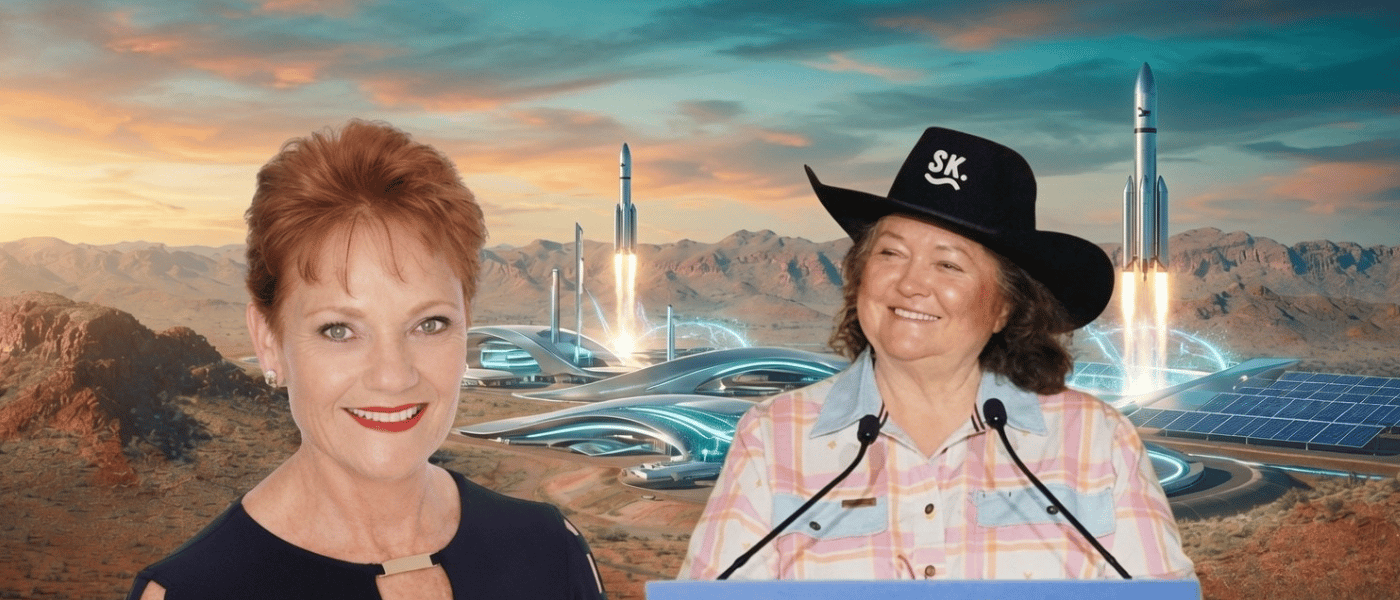
It's open season on mining magnate Gina Rinehart and One Nation Leader Pauline Hanson. The outrage machine, the left, the woke right and every political opportunist in between have gone berserk over comments Rinehart made in Townsville where the duo appeared together at the National Bush Summit.
Much of the reaction has been oddly selective, seemingly driven by the brief mention of Israel and Rinehart’s proposal to incentivise investment by exploring ideas such as “free land” in the region.
Watching the woke right and woke left unite in outrage over Gina Rinehart and Pauline Hanson is genuinely funny.
— Avi Yemini (@OzraeliAvi) June 20, 2026
At least the woke left are consistent.
The woke right will be back kissing Pauline’s ring after the next poll when they learn just how irrelevant they really are.
Rinehart spoke about attracting world-leading expertise and investment to northern Australia, citing Taiwan’s semiconductor industry, SpaceX’s satellite technology, and Israel’s defence innovation as examples of the kinds of success Australia should seek to emulate.
If she had only mentioned Taiwan and SpaceX, it is doubtful anyone would have noticed. Instead, a single reference to Israeli expertise became the focus of the story, overshadowing a much broader discussion about industry, technology, and economic development.
Pauline and Gina want to give Israel free land in Queensland to make an Israel 2 - she actually said this, this is not a joke... pic.twitter.com/CtEhYhKEJT
— friendlyjordies (@friendlyjordies) June 20, 2026
It is clear that Israel-related outrage bait has seeped into parts of Australia’s political discourse across the spectrum, although it is especially growing in prominence among some on the right, who are now using it to shift support away from One Nation, a party that Gina Rinehart has publicly backed.
“Australians Are Done With Governments That Push Foreigners”.
— 2 Worlds Collide Podcast (@2worldsPodcast) June 20, 2026
Want to support me? Links in bio to my Patreon program and merch. pic.twitter.com/44gkeFFoO1
Rinehart's proposal was straightforward. She argued that northern Australia, particularly around Townsville, has enormous untapped potential. With vast amounts of land, a strategic location, a deep-water port and existing infrastructure, the region could become a major hub for advanced manufacturing, technology and defence industries.
Rather than accepting Australia's decline as little more than a supplier of raw materials, she called for policies that would encourage investment, reduce bureaucratic obstacles and attract world-class companies capable of creating jobs and transferring valuable skills and technology to Australia from countries like Israel and Taiwan.
The so-called “free land” proposal was just one part of a broader plan to use Australia’s national resources to make the country more competitive and attractive to investment.
Anyone with a serious understanding of the issue knows these are concessions, not a surrender of sovereignty or land ownership. They are contractual arrangements designed to deliver real opportunities for Australians.
They do not cede sovereignty to any foreign entity, nor do they allow companies to dictate Australia’s foreign policy.
Whether you agree with every aspect of that vision is beside the point. Serious people can disagree about tax incentives, foreign investment settings or the best way to develop northern Australia. Those are legitimate policy debates.
Right-wing activists screeching "Gina and One Nation want to give Away Australian land to Israel reeeeeeee" should be muted. It is a flat out lie. A complete straw man and a totally dishonest misrepresentation of what Gina Rinehart actually said.
— Daniel (@VoteLewko) June 24, 2026
Special economic zones for…
What is harder to understand is why so many critics appear uninterested in discussing the proposal itself.
For decades, governments of both major parties have spoken about innovation, advanced manufacturing and economic resilience. Yet Australia continues to lose industrial capacity while becoming increasingly dependent on imports for everything from technology to critical supply chains.
Rinehart's argument is that Australia should be learning from global leaders and attracting expertise that can help rebuild domestic capability.
Of course, Australians should always be cautious about protecting national sovereignty and strategic interests. Any proposal involving major investment deserves scrutiny. But there is a significant difference between partnering with successful industries and surrendering control of national assets.
Australia has always had major foreign multinational corporations and brands as part of its landscape. The car manufacturing industry is a clear example. Once heavy regulation, high costs, union demands and a small domestic market made it uncompetitive, companies like Toyota,…
— Rukshan Fernando (@therealrukshan) June 21, 2026
That distinction has been lost amid the outrage.
The same critics who accuse Hanson and Rinehart of undermining Australia rarely acknowledge their long-standing focus on national self-reliance, stronger borders and policies aimed at putting Australian interests first. One Nation's entire political brand has been built around sovereignty and resistance to globalist decision-making.
Yet somehow, the narrative being pushed is that discussing international expertise is equivalent to selling out the country.
Australians deserve a more serious conversation than that.
Rinehart's speech was ultimately about ambition. It was about using Australia's advantages to attract investment, develop industries and create opportunities for future generations. Those ideas may succeed or fail on their merits, but they deserve to be debated honestly.
The most revealing aspect of the controversy is how little attention has been paid to the rest of what she said. Critics are free to reject her vision, but the fact that one reference eclipsed an entire discussion about industry and development suggests the outrage was never really about economic policy in the first place.
Before joining the pile-on, Australians should ask themselves whether they're hearing the full story or simply the version that generates the most outrage. Because if the debate is reduced to slogans and selective reporting, the country risks missing a much bigger conversation about its future.
Avi Yemini
Chief Australian Correspondent
Avi Yemini is the Australia Bureau Chief for Rebel News. He's a former Israeli Defence Force marksman turned citizen journalist. Avi's most known for getting amongst the action and asking the tough questions in a way that brings a smile to your face.
https://followavi.com/Featured Stories

33:28

14:35


COMMENTS
-
Bruce Atchison commented 2026-06-24 20:12:36 -0400Leftists are all emotion and no logic. They never listen to the whole argument. Israel and Musk trigger them and they go off on a tare.