



Alberta Fact Check: Danielle Smith's $400 billion independence price tag doesn't add up
It is true that some capital expenditures would be required if Alberta were to become independent, but operational costs would come from what the province no longer would be transferring outward in federal taxes, however.

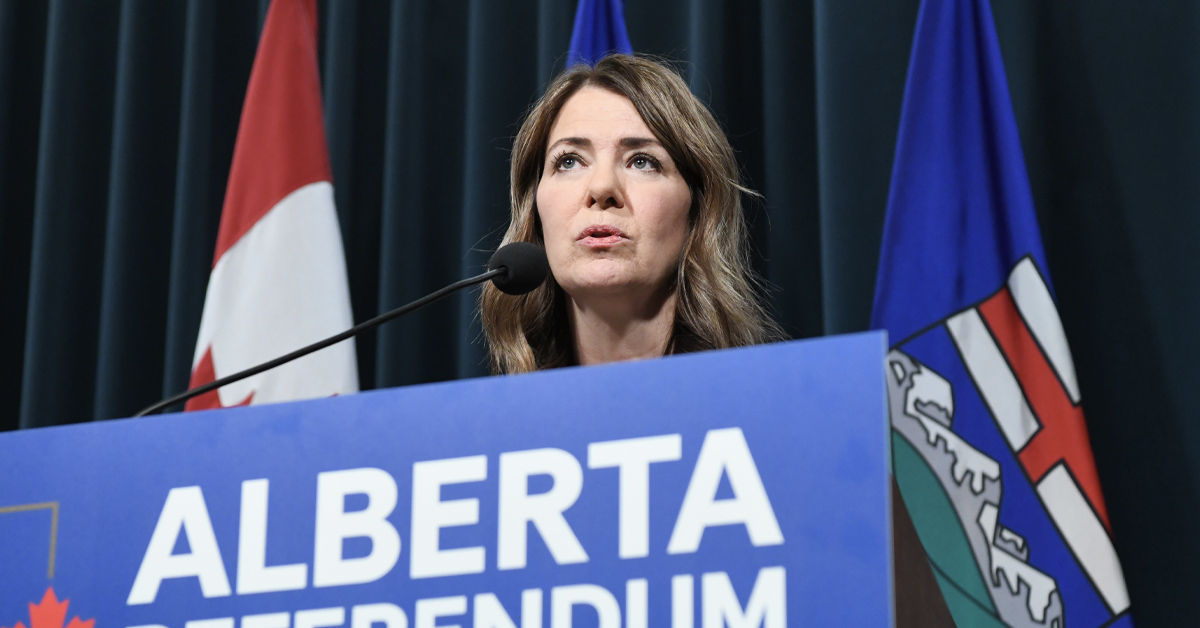
At a Calgary press conference about improving surgical access, Premier Danielle Smith fielded a question about the costs of provincial independence with some figures that could be considered misleading or exaggerated.
Much of the $400 billion in costs the premier referenced would not be new expenditures. They would be assumptions of obligations the province already has.
For example, Smith began by stating an independent Alberta would likely be saddled with $170 billion of the national debt along with the interest payments to service it.
This may be true, but the statement neglects to point out Alberta is on the hook for that debt already in being part of the federation. It wouldn’t be a new liability. It would just be broken away from the larger, national one.
The premier mentioned Alberta having to spend $25 billion per year to meet NATO obligations. That is making the assumption that an independent Alberta would be a NATO member and would commit to the 5% of GDP in military spending.
Canada itself has made grand commitments to military spending but has only just barely reached 2% of GDP in military expenditures. As with the federal debt, Alberta is already spending funds on the Canadian military. Canada does not cover the bill on Alberta’s behalf.
If an independent Alberta were to match current military spending, it would be less than half of what the premier claimed.
Alberta is expected to have sent nearly $70 billion dollars to Ottawa in federal taxes and fees in 2025. That money pays for OAS, Child Tax Benefit and every other federal service and transfer that comes back to Albertan citizens.
On average, Alberta sends out over $20 billion more per year than it gets back from Ottawa. Premier Smith has noted that many times in the past. In March she said the net-loss for Alberta was $26 billion.
Premier Smith mentioned how Alberta would have to assume responsibility for CPP and EI. With both of those programs, Alberta contributes more in than it draws in benefits.
Smith has often mentioned the overcontribution to the Canadian Pension Plan. Alberta would save money by exiting those plans and forming its own version of them.
The premier also said Alberta would have to form its own post office. While that would have a cost, it’s a poor example of a service from Ottawa that Alberta may risk losing.
The Canadian postal service is losing billions of dollars and refuses to cut its size and costs significantly. A scaled down modern service created in Alberta could provide what little is required of a national postal service in today’s world.
Premier Smith rattled off banks and foreign offices as things that Alberta would have to create but neglected to mention the province already has both of those things. Admittedly, the reach of foreign affairs would have to be expanded with some expense to Albertans.
It is true, some capital expenditures would be required if Alberta were to become independent. Border control facilities, local defence infrastructure and offices for newly assumed provincial services would be among them. The operational costs would come from what the province no longer would be transferring outward in federal taxes, however.
Likewise, the regulation of things such as telecom services, railways and financial services can all be done provincially. It would increase the local bureaucratic load, but it’s not as if the province isn’t already covering it.
Just last May, Premier Smith mentioned how half a trillion in investment had been driven out of Alberta due to federal policies. If an independent Alberta were to shed the policies hindering investment, there would be an increase in investment into the province. There would doubtless be a short-term chill during the transition period though.
Albertan independence wouldn’t lead to the creation of an immediate economic paradise. There would be some capital flight, some instability, and some startup costs for replicating federal services. To imply that Alberta would be assuming over $400 billion in new expenses to become independent is inaccurate and hyperbolic.
Cory Morgan
Cory Morgan is an Alberta-based columnist, political commentator, and longtime advocate for Western Canadian independence. He is the author of the recently updated book The Sovereigntist’s Handbook, a grassroots guide for independence supporters and political activists.
http://sovereigntistshandbook.com/

COMMENTS
-
Bruce Atchison commented 2026-06-03 20:56:43 -0400Smith is wrong. And she’s besotted with Mark Carney. Must we have another Jim Prentice moment?
-
 Matthew Beatty commented 2026-06-03 09:22:20 -0400We got this, pay the 400 billion and we will make them pay us back.
You renovate for two reasons, for profit, or enjoyment, we will have both.
There’s a lot of options, still available. -
Bernhard Jatzeck commented 2026-06-02 15:59:51 -0400One way of becoming profitable is to stop needless expenditures. Ending the “equalization” payments will definitely help Alberta.

