Harper criticizes Trump, urges Carney gov’t to seek trade outside U.S.
A year ago, Harper would have advised strengthening economic and security ties with the U.S., he claimed. However, when recently asked, his advice was the opposite.

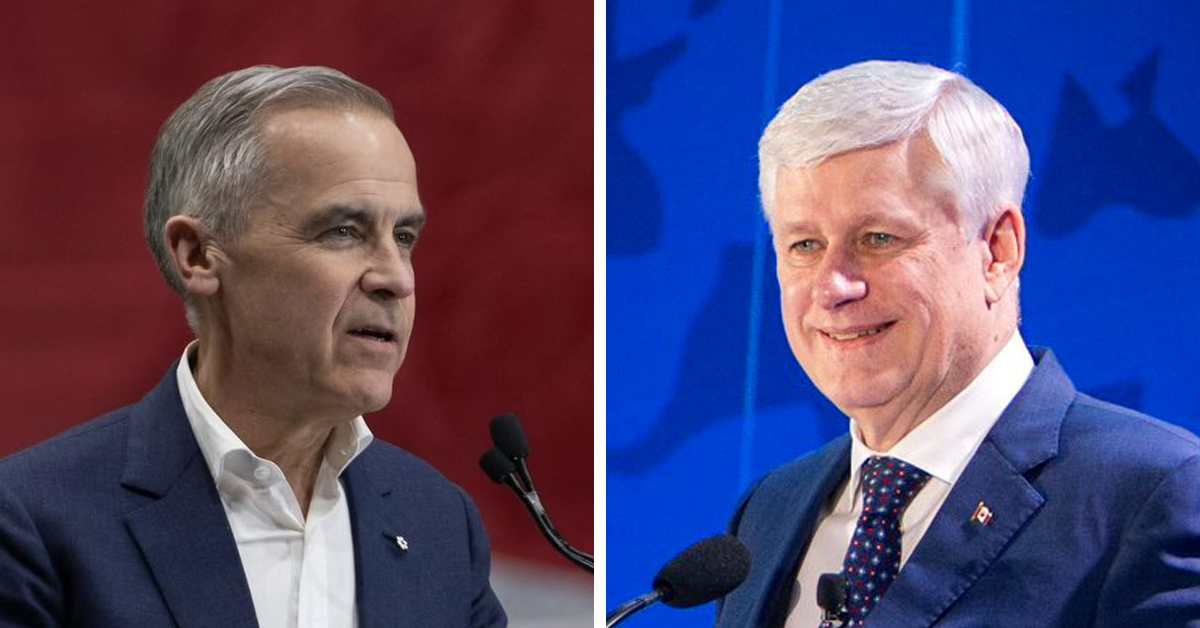
Former prime minister Stephen Harper advised Ottawa to seek new trading partners beyond the U.S., citing over-reliance on a single market despite geographic closeness. He reportedly advised the government on U.S. trade policy two weeks ago, a claim unverified by the PMO.
“I think it’s fair to say I’m probably the most pro-American prime minister in Canadian history,” Harper began in a recent speech to Canadian and American lawmakers in Saskatoon.
“We’ve got to get something short-term worked out with the Trump administration. But this really is a wake-up call for this country to truly diversify its trade export markets,” he added.
"It's just the way it is": President Trump says there's nothing Prime Minister Mark Carney can say in today's meeting that will allow for tariffs to be lifted on Canada. pic.twitter.com/bWiUjisnrl
— Rebel News (@RebelNewsOnline) May 6, 2025
A year ago, Harper would have advised strengthening economic and security ties with the U.S., he claimed. However, when recently asked, his advice was the opposite.
“Canadians are a combination of just angry and bewildered by what is happening here,” Harper said. “I really do hope that a realization seeps into the United States.”
However, U.S. President Donald Trump has continued doubts on free trade with Canada, claiming Prime Minister Mark Carney has yet to table a compelling enough argument as to why Canada should be tariffed less.
"I think Canada could be one where there's just a tariff, not really a negotiation," Trump reiterated last Friday.
Harper criticized the president’s tariff-based economic growth as “failed policy,” hoping Americans recognize the importance of international allies and trading partners.
“We just cannot be in a position in the future where we can be threatened in this way and not have that leverage,” he said.
PM Carney says his government will "get the best deal for Canadians" in trade negotiations with the US after backing down on imposing a Digital Services Tax on American firms.
— Rebel News (@RebelNewsOnline) July 2, 2025
"We are making progress," he claims. pic.twitter.com/F0lw2MkXFw
During Carney's snap election, Canada quietly backpedalled on retaliatory tariffs, and the Digital Services Tax was repealed to appease Trump. Currently, Canadian exports face a 25% tariff under Trump's emergency powers, who cites fentanyl trafficking as a national security threat.
Despite meetings, including at the G7, and Canada’s attempts to address U.S. concerns on border security through Bill C-2 (which ultimately failed), negotiations have stalled.
The U.S. now imposes tariffs on Canadian steel, aluminum (now 50%), and automobiles. Energy and potash also face a 10% tariff, and a tariff on copper will be effective on August 1, 2025.
Carney, as recently as Monday, held onto hope that a deal could be struck to deescalate trade tensions. "The negotiations are at an intense phase, it's a complex negotiation."
This follows the president's earlier threat this month to impose a 35% tariff on goods not complying with CUSMA, effective August 1.
Trump offered Canada tariff exemptions if manufacturers moved to the U.S., but Carney insisted on a deal beneficial to Canada and certainty for Canadians.
"The rules-based global order is under threat," declares PM Carney.
— Rebel News (@RebelNewsOnline) June 23, 2025
"We can nostalgically look back and long for the old order to somehow return, or we can build a new one with purpose and partnership." pic.twitter.com/phoj1jNCxl
Meanwhile, a trade framework agreement was reached between the U.S. and the EU, on Sunday, establishing a 15% tariff on most goods, according to the Associated Press.
Trump stated the EU agreed to purchase $750 billion in U.S. energy, invest an additional $600 billion in America, and make a significant military equipment acquisition. It remains before EU lawmakers for their approval.
Britain's "ill-timed" May invitation for Trump led to a limited bilateral trade agreement with London on the promise of increased defence spending.
Carney later suggested that Canada is in a strong position due to U.S. reliance on Canadian energy exports, but stood firm against continued reliance on U.S. defence procurement.
Carney claims NATO's boost in defence spending includes money for "things we're already doing.
— Rebel News (@RebelNewsOnline) June 26, 2025
"The PM says exporting critical minerals counts towards the new 5% GDP commitment, and "benefits the Canadian economy but is also part of our new NATO responsibility." pic.twitter.com/c9D04L0wiN
Harper, who also advocates for Canadian self-reliance in security, called for increased defence spending to independently protect Canada's land, seas, and skies, rather than depending on the United States.
“While the border is a shared responsibility, let’s make sure we spend a lot more on defence so that we can be independently responsible for our own land, seas and skies.”
On June 9, Prime Minister Carney announced a massive defence budget investment to push Canada above NATO’s 2% of GDP target, a promise unfulfilled for over a decade.
Two weeks later, he signed a $1.25-trillion strategic defence and security partnership, ReArm Europe, to reduce its reliance on the U.S. for defence procurement and strengthen ties with the European Commission.
Carney, a self-proclaimed crisis manager, earlier called Canada “the most European of non-European countries.”
Alex Dhaliwal
Journalist and Writer
Alex Dhaliwal is a Political Science graduate from the University of Calgary. He has actively written on relevant Canadian issues with several prominent interviews under his belt.


COMMENTS
-
 Bernhard Jatzeck commented 2025-07-30 20:42:22 -0400I was never impressed by Harper and this proves my point.
 -
Bruce Atchison commented 2025-07-30 18:31:22 -0400I blame Marx Carnage for these Trump tariffs. If he would negotiate like a negotiator, not like a rubber stamp, we’d have low or no tariffs costing Canada’s poor money. Remember that we don’t grow oranges and bananas up here. Our fresh vegetable season is so short too.