
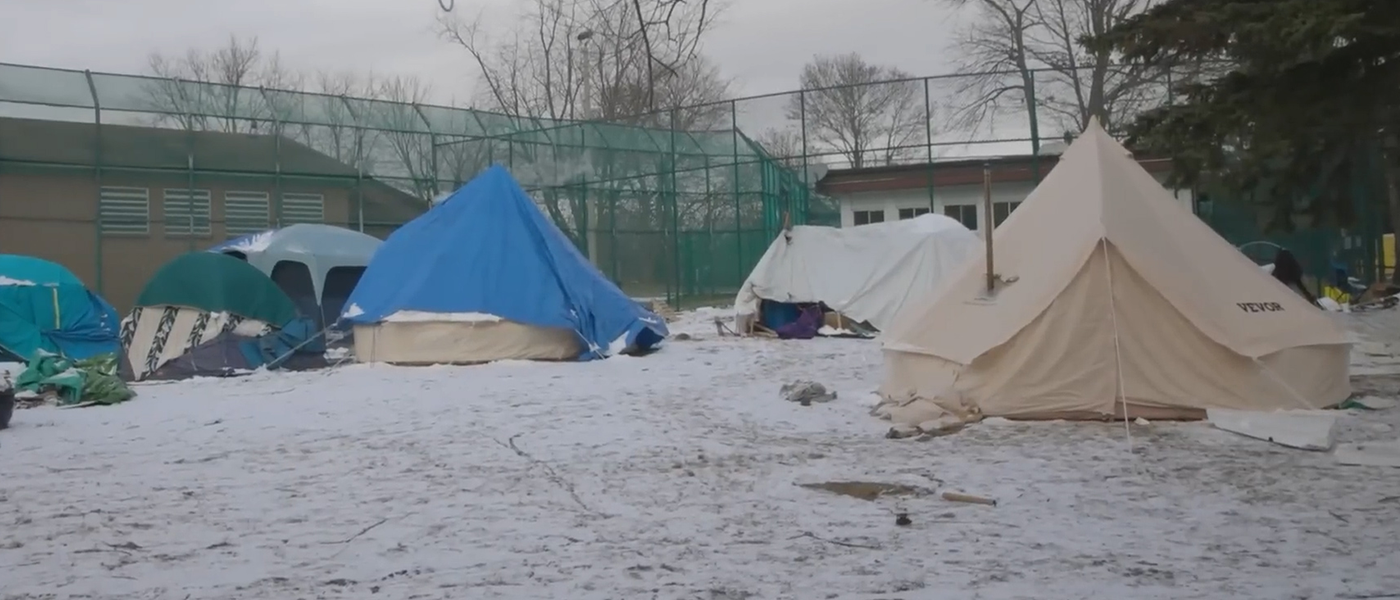


Proposed military-grade modular tents aim to break chronic homelessness, addiction cycles in Cobourg
Jordan Stevenson, founder of the Integrated Homelessness Addiction Response Centre, warns that taxpayers will bear the financial burden of the opioid crisis, with or without a winter warming hub.

Following the July closure of Northumberland County's 24/7 emergency hub at 310 Division Street, county staff presented a report last week proposing four potential sites—two in Cobourg and two in rural areas—for a new winter warming center for the 2025–2026 season. The estimated costs of $215,000 to $400,000 align with the county's budget, addressing increasing demand for emergency shelter and limited regional capacity.
Jordan Stevenson of IHARC proposed "Rally Point," a $280,000 plan for 30 chronically homeless, substance-addicted individuals in downtown Cobourg. It offers hot meals, modular tents, and high-tech data collection, with scalable operations.
“First of all, we’re learning from the mistakes of past implementations,” said Stevenson, who claims his proposal avoids past implementation errors, which led to chaos and crime in the surrounding area.
https://rebelne.ws/3O4wHLL
Stevenson's focus remains on helping individuals transition from homelessness and addiction by connecting them with treatment options and providing support for a successful exit from their current circumstances.
The proposed site at the paramedic station could integrate with emergency services. Stevenson stressed proactive community engagement to avoid past issues like crime.
The Rally Point adopts a "hospital first" strategy, directing individuals experiencing withdrawal or overdose to medical care, away from street exposure. Stevenson stated, “If we can divert them to emergency care first, and then into medication-based treatment like Suboxone or Methadone, we reduce harm and increase the chance of long-term recovery. Otherwise, they’ll seek out illicit substances regardless.”
IHARC has been tracking street-level data both formally and informally for the past two years. Stevenson reported that on any given night, 38 individuals sleep outdoors in the county, while shelter capacity remains full.
The majority are actively addicted or struggling with severe mental illness, and there aren’t many options on where to go.
“The healthcare costs alone are just staggering,” Stevenson shares. “For 38 people living outside, we’re going to flood the system regardless, and it will be exponentially more expensive than if we can handle this in a controlled manner,” he said, noting one emergency healthcare visit costs roughly $1,600 from start to finish.
Stevenson also admits that there needs to be a shift in measuring success.
“I think we need to look at how we are facilitating exits from the overall system,” he said, acknowledging that this has to take place “in conjunction with a number of professionals.”
Regardless, both action and inaction mean taxpayers bear the cost.
County Council will decide whether to open a warming hub this winter at a special meeting on Tuesday, October 28, 2025. They will consider the need for shelter and solutions like IHARC’s Rally Point.
Featured Stories


COMMENTS
-
Klazina VanBergeyk commented 2025-10-28 14:18:34 -0400Thanks, this sounds like a much wiser plan, than all of the ‘safe supply’ centers to just keep addicts enslaved.
-
 Marilyn Hagerman commented 2025-10-28 13:13:21 -0400Law enforcement in Cobourg needs to clamp down on drug supply!! The entire mentality to sweep these addicted “out of sight, out of mind” is beyond deplorable! Ontario premier Ford can adopt the same plan at Alberta’s Premier Smith….long term support and long term after care – mandatory treatment and constructing such facilities province wide. It is a successful humanistic solution! Ford instead sucks up to Marxist Carney by putting together a “little boy get you plan” against President Trump for a taxpayer cost of $75 million!!!! Something is desperately wrong in this once great country of Canada!! Caring about others is “out of fashion” in Carney’s Liberal Marxist world! Communistic behaviours and ideologies has become the norm!!!!
 -
Don Hrehirchek commented 2025-10-28 12:23:32 -0400This is an ideal . Yes costs may come down . In My opinion proof will be in the pudding. People have to want to change . It is human nature to want to take advantage of others. That is one bad side of human nature. As I say proof will be in the pudding . Say 2-3 years from now .

