




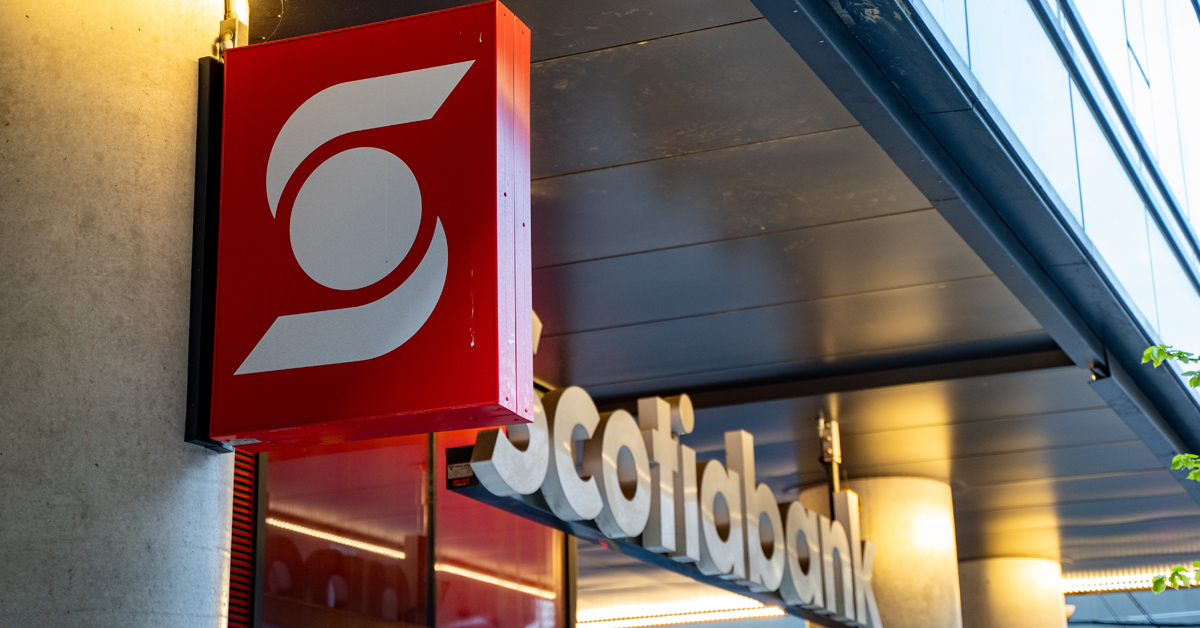
Scotiabank branch won't accept cash from non-clients, Blacklock’s says
A Calgary branch announced a new, first-of-its-kind policy that they will only accept cash transactions from their own clients.

After federal cabinet introduced Bill C-2 on June 3, Scotiabank enacted a policy banning cash payments, donations, or deposits of $10,000 or more, in single or related transactions from non-clients. This applies to banks, credit unions, charities, and other federally registered businesses.
Scotiabank spokesperson Daniela De Silva declined to comment on whether the policy complies with the Bank Act, according to Blacklock’s.
A Calgary branch announced the policy change effective July 14, 2025: “... we will only accept cash transactions from Scotiabank clients,” it said, without explanation.
The Bank’s new policy is the first restriction of its kind.
.@ScotiaBank announces it won't make change for walk-in customers without an account.
— Blacklock's Reporter (@mindingottawa) August 7, 2025
Follows Bill #C2 that abolishes $10K cash transactions regardless of the source or circumstance. https://t.co/MFkNfnHTrP @FinanceCanada @CdnBankers @OSFICanada pic.twitter.com/WjOKgFT9De
Opposition MPs escalated protests against the proposed ban in late June. “I am hearing from my constituents that they are concerned,” Conservative MP James Bezan told the Commons.
“Cash is still legal tender,” he said, noting, “There are ways we can enforce money laundering and terrorist financing rules … without going after people legitimately collecting cash.”
Plus, the Proceeds of Crime and Terrorist Financing Act already requires reporting of deposits exceeding $10,000 to prevent money laundering
If passed, Part 16 of Bill C-2 would allow federal agencies to seize funds and share personal financial data based on mere suspicion of money laundering, terrorist financing, or sanctions evasion, without conviction or proof. This grants permanent power to financially penalize dissenters without emergency orders.
Liberal border bill threatens to usher in a cashless economy, digital ID
— Rebel News (@RebelNewsOnline) June 5, 2025
Liberal border security Bill C-2 threatens to outlaw cash payments of $10,000 or more, which freedom advocates warn serves as a precursor for digital currencies.https://t.co/gXf6AC3dyb
Conservative MP Michael Ma emphasized the impracticality of forcing all transactions through electronic means, stating that cash is vital for small businesses to avoid high credit card fees.
While the Bank Act (Section 627.04) forbids banks from coercing customers to buy products in exchange for other services, it doesn't mandate cash acceptance (Section 627.05).
Freedom advocates warn that C-2 could serve as a precursor for digital ID and central bank currencies (CBDCs) that enforce ideological aims.
Criminalizing large cash transactions, even if rare, risks a slippery slope, according to the Justice Centre for Constitutional Freedoms, where the government could drastically reduce the legal limit and eliminate cash.
Stop C-2: Mark Carney’s new bill lets police open your mail without a warrant — and worse!
— Rebel News (@RebelNewsOnline) June 6, 2025
I’ve read Mark Carney’s new bill, C-2. It claims to be Canada’s response to Donald Trump’s demand for border security. And there’s a little bit of that in the bill. But the rest of the… pic.twitter.com/HL7Wxl8VKZ
When earlier questioned about the potential for abuses of civil liberties, Public Safety Minister Gary Anandasangaree asserted his lifelong commitment to protecting human rights, claiming that he believes the bill has "fundamentally struck the balance."
The Justice Centre's March report, Central Bank Digital Currency, warns that a cashless economy, enabled by a CBDC under Prime Minister Mark Carney, would allow for total financial surveillance and government interference, exemplified by the traceable transactions of the 2022 Freedom Convoy.
Carney backed the Trudeau government's freezing of bank accounts in response to the convoy and has shown prior interest in central bank digital currencies as a member of the WEF Board of Trustees.
Alex Dhaliwal
Journalist and Writer
Alex Dhaliwal is a Political Science graduate from the University of Calgary. He has actively written on relevant Canadian issues with several prominent interviews under his belt.
Featured Stories


14:09


