Alberta Conservatives to debate viability of separation at upcoming annual meeting
There are reportedly three policy proposals on the table to address Alberta's growing separatist sentiment.

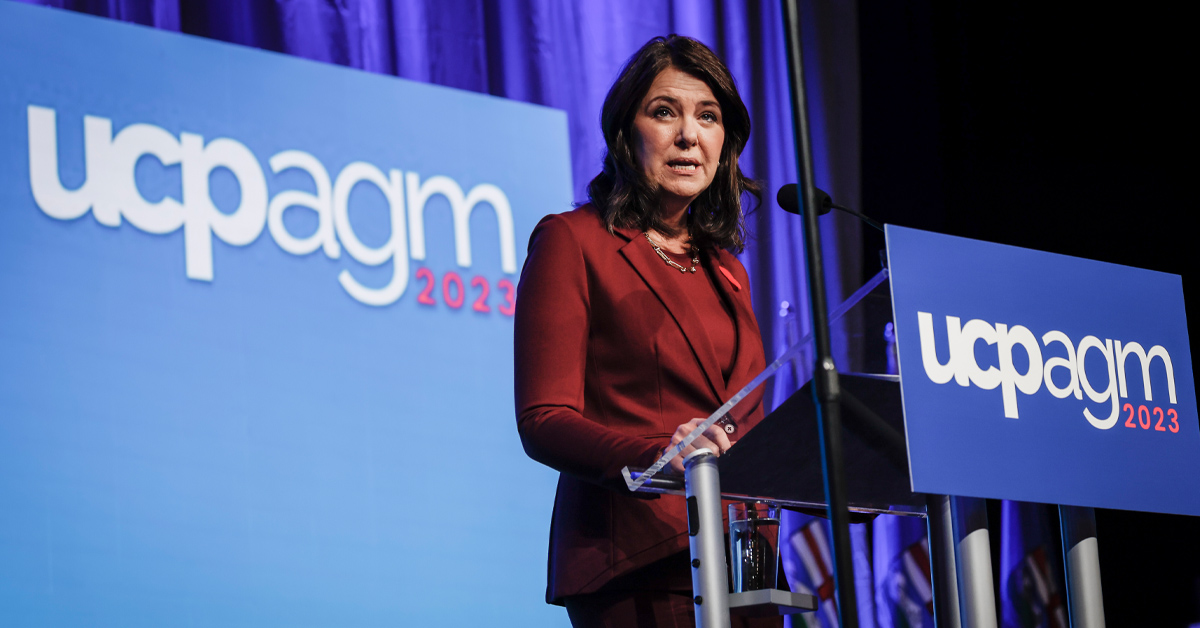
United Conservative Party members seek a detailed plan on the pros and cons of Alberta's independence, a draft proposal for their 2025 AGM reveals.
Draft resolutions, obtained by National Post, reveal broader policy proposals and the priorities of many UCP members. They will vote on non-binding policy resolutions for debate at their November 28 convention.
“We do know that [Danielle] Smith is very closely attuned to the concerns of the party base, and that’s where this is,” said Duane Bratt, a University of Calgary political scientist.
Three proposals reportedly address Alberta's growing separatist sentiment. “We are a raucous family that has a lot of robust discussions,” Smith said last November.
Amidst recent rallies and calls for a secession referendum, one proposal seeks a standalone referendum on leaving Canada. Another pushes for "Canada 2.0," with an Alberta Constitution and negotiations for a new federation. The third explains the pros and cons of secession.
The resolution's rationale clarifies that while many already back independence, a significant number do not.
Angus Reid found 65% of UCP voters favour Alberta leaving Canada, while a Janet Brown poll showed 54% would back independence in a vote.
"The only members of Danielle Smith’s base that don't support independence are the ones that have had their faces in the trough for decades, and who are served very well by the status quo," said Jeff Rath, a lawyer with the Alberta Prosperity Project.
Following a June 23 byelection, Smith addressed concerns about a vote split with the Republican Party of Alberta (RPA), stating the need to both advocate for a strong Alberta within Canada and address the causes of separatist sentiment.
RPA leader Cam Davies aimed for 20% of the vote, believing the byelection mainstreamed separation. Independence-minded candidates secured 18%, tripling their 2023 share.
The Premier attributes Alberta's separatist sentiments to federal policies harming the province, citing the oil tanker ban on B.C.'s north coast, the Impact Assessment Act, and the oil and gas production cap.
Rath dismissed vote split concerns, stating the independence movement finds comfort with the UCP and doesn't need another political vehicle. He claims Smith will back independence once it’s to her benefit.
Smith, despite not supporting Alberta separation, has stated she would allow a referendum on it in 2026.
Effective July 4, Alberta's lowered referendum bar intensified separatist and pro-Canada movements. The Alberta Prosperity Project (APP) filed its separation petition the same day, with 120 days to gather 177,000 signatures.
Thomas Lukaszuk's petition to keep Alberta in Canada, approved June 30, has garnered 456,000 signatures, exceeding the required 294,000. It was filed before the amended rules took effect.
Support for Alberta's separation from Canada has varied. A May 2025 Angus Reid poll showed 36% support for separation, with half favouring a referendum. However, a more recent survey found separatist sentiment cooled to 26% support, with 65% opposed and 9% undecided.
Alex Dhaliwal
Journalist and Writer
Alex Dhaliwal is a Political Science graduate from the University of Calgary. He has actively written on relevant Canadian issues with several prominent interviews under his belt.
Featured Stories


04:05

13:06

COMMENTS
-
 Bernhard Jatzeck commented 2025-10-29 20:41:27 -0400It’s about time! I’ve been wondering whether the UCP would ever get around to this. However, I fear that any effort towards actual separation will be scuttled by Edmonton and Calgary.
 -
Bruce Atchison commented 2025-10-29 19:33:03 -0400Don’t believe the fearmongering of Thomas Lukis-thug and his group. Alberta would have so much money from not paying for the wealth transfer to have-not provinces that we could fund our own pension plan and police. We also could block the Trans Canada Highway until Ottawa caved to our demands.