




Trump threatens 35% tariffs on Canada while Carney vacations
Carney has been unable to reach a successful trade deal with the U.S. president despite a journalist recently labelling him as the 'Trump whisperer'.

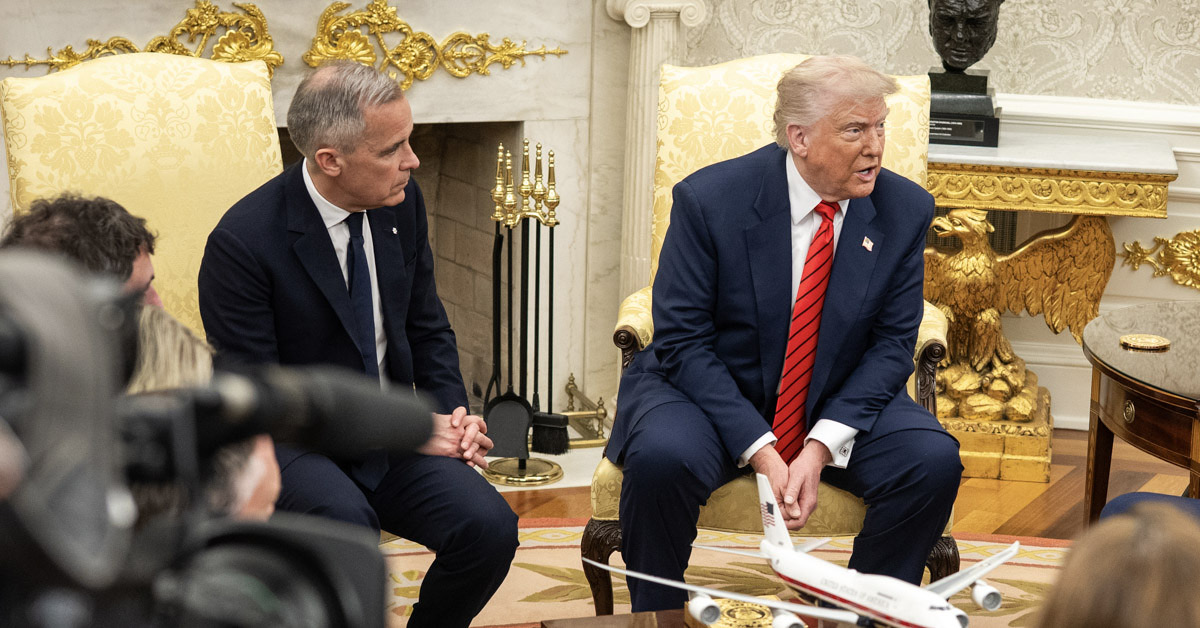
On Thursday, U.S. President Donald Trump announced his administration will be imposing a 35% tariff on Canadian imports, effective August 1. This follows Canada's attempts to address U.S. concerns about fentanyl crossing the border.
Trump, in an open letter to Prime Minister Mark Carney on Truth Social, stated that any tariff increase by Canada would be added to the existing 35% U.S. charge.
He then promised no tariffs if Canada built or manufactured products in the U.S., ensuring quick approval within weeks.
“Canada has made vital progress to stop the scourge of fentanyl in North America,” Carney wrote yesterday on X. “We are committed to continuing to work with the United States to save lives and protect communities in both our countries.”
“We are building Canada strong,” he continued, vowing to unify the economy for major national projects and strengthen global trade.
President Trump has often criticized Canada's trade practices in his second term, amid efforts to reshape global trade.
His administration earlier imposed three sets of tariffs affecting Canada: universal levies on steel and aluminum (recently doubled to 50%), tariffs on automobiles and car parts, and Canada-Mexico-specific tariffs related to border security and drug trafficking, some with USMCA carve-outs.
Canada retaliated; however, Carney eventually quietly backpedaled most measures.
"The stakes have never been higher for our economy": Mark Carney reacts to President Trump leaving tariffs on Canada after he paused tariffs on dozens of other countries. pic.twitter.com/UuubxMHblu
— Rebel News (@RebelNewsOnline) April 10, 2025
On March 12, Canada imposed a 25% levy on $30 billion in U.S. goods, expanding counter-tariffs to an additional $125 billion the next month.
A mid-election notice on April 16 revealed the Liberal cabinet delayed collecting tariffs on most goods until October, effective May 7.
Carney, seeking to mend relations, called Trump a "transformational president" and anticipated cooperation on fentanyl and trade.
He met Trump May 6 at the White House, making no progress, though he temporarily ended most tariffs the next day. Trump, citing "America First," maintained tariffs on Canadian free trade.
At the G7 Summit, the PMO clarified that a new deal would be signed within 30 days. Trump claimed a deal was "achievable" within days, only to walk back those remarks days later.
From 'elbows up' to starstruck: Carney gushes over Trump at G7
— Rebel News (@RebelNewsOnline) June 17, 2025
This flip-flop isn't just embarrassing—it's revealing. Carney didn't change his mind on Trump. He changed audiences.
Liberal leader Mark Carney has humiliated himself—and every progressive who voted for him—by… pic.twitter.com/7rJQECiZiT
Due to Canada’s perceived failure to stop illicit fentanyl, the U.S. imposed tariffs, with the president attributing some of the 80,000 annual American fentanyl deaths to Canada.
In response to concerns from the White House, Ottawa announced a $1.3 billion investment in border security and appointed a fentanyl czar to no avail.
The Manhattan Institute reported in July that Canada is a rare source of fentanyl seizures, accounting for only 1% of pills, capsules, or tablets seized, despite Trump's claims.
At the G7, Prime Minister Carney and President Trump discussed illegal drugs and border security. Carney stressed the need for U.S. leadership; Trump called their relationship "very good."
President Trump is asked why the US and Canada haven't reached a trade deal, telling reporters he and PM Carney are "going to see if we can get to the bottom of it today."
— Rebel News (@RebelNewsOnline) June 16, 2025
Trump reiterates he's "a tariff person," adding Carney has proposed a "very good" but "more complex" idea. pic.twitter.com/mKqITzWxDX
After Kananaskis, Canadian officials were optimistic about a swift trade deal, and U.S. Trade Representative Jamieson Greer agreed to continue discussions, with both countries aiming to accelerate a new deal.
Bill C-2, introduced by the Liberal government, sought to increase border security through enhanced agency powers and stricter immigration rules to appease Trump, but failed.
Trump halted talks June 27 over Canada's Digital Services Tax; Canada scrapped it June 29.
Trump’s press secretary applauded the concession on large multinationals, which Trump called an anti-American trade barrier.
“We’re making progress towards a final deal,” Carney said June 30, adding, “There’s more to be done.” The prime minister then admitted to media he gained nothing by repealing his $3.7 billion internet tax, according to Blacklock’s.
Carney also delayed counter-tariffs on steel and aluminum to July 21, aligning with negotiation progress. Alas, the Carney-Trump trade deal was doomed.
The National Post reports Carney is staying in the National Capital Region, possibly at Harrington Lake, or his cottage in Val des Monts, Québec.
— Rebel News (@RebelNewsOnline) July 8, 2025
READ MORE: https://t.co/s5zUVsCc4J pic.twitter.com/FekovxaEZw
On July 4, American ambassador to Canada Pete Hoekstra declined to commit to a new Canada-U.S. trade deal by July 21, though he called an eventual deal “good” for both nations.
On Thursday, former Canadian ambassador to the U.S. David MacNaughton told CTV News the July 21 deadline was “not realistic.”
Tariffs remain an ongoing threat to Canada’s prosperity, given Trump’s latest threat and 50% tariffs on Canadian copper, effective August 1.
PMO spokesperson Audrey Champoux said an official response would be forthcoming once more details emerge. Carney is reportedly on vacation in the National Capital Region for an undisclosed number of days.
Alex Dhaliwal
Journalist and Writer
Alex Dhaliwal is a Political Science graduate from the University of Calgary. He has actively written on relevant Canadian issues with several prominent interviews under his belt.
Featured Stories
05:37


COMMENTS
-
Bruce Atchison commented 2025-07-11 20:45:59 -0400Marx Carnage more like. He’s imitating Trudeau with his vacationing while Canada is in deep trouble.What Donald Trump ought to do is block all Liberal members and government bureaucrats from coming into America. As long as the elitists can cross the border easily, they have zero interest in us citizens.

